Inflation, Disinflation, Deflation, and Reinflation – The Price-Level CycleSL
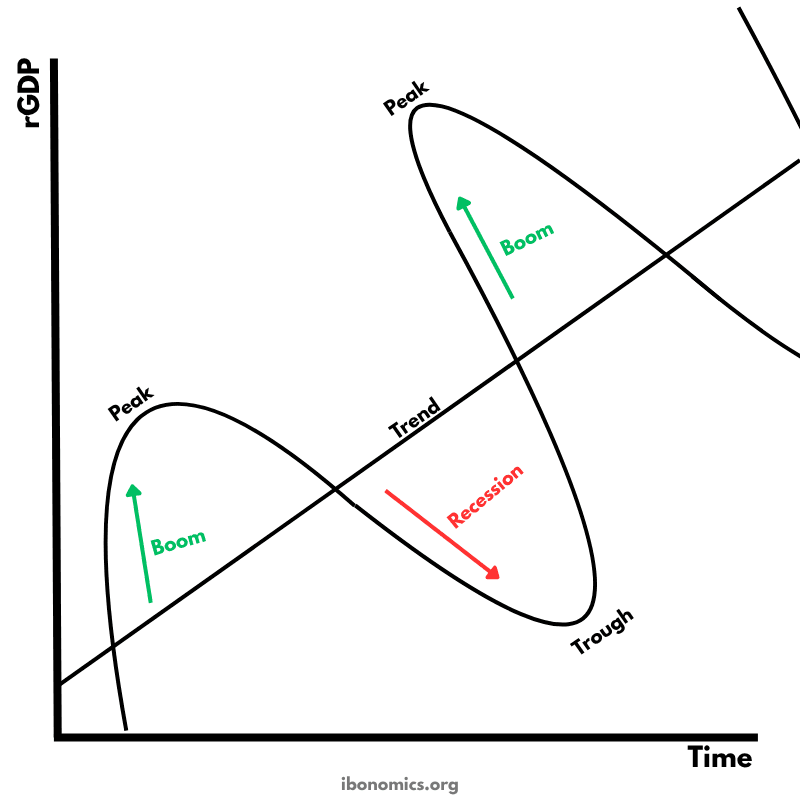
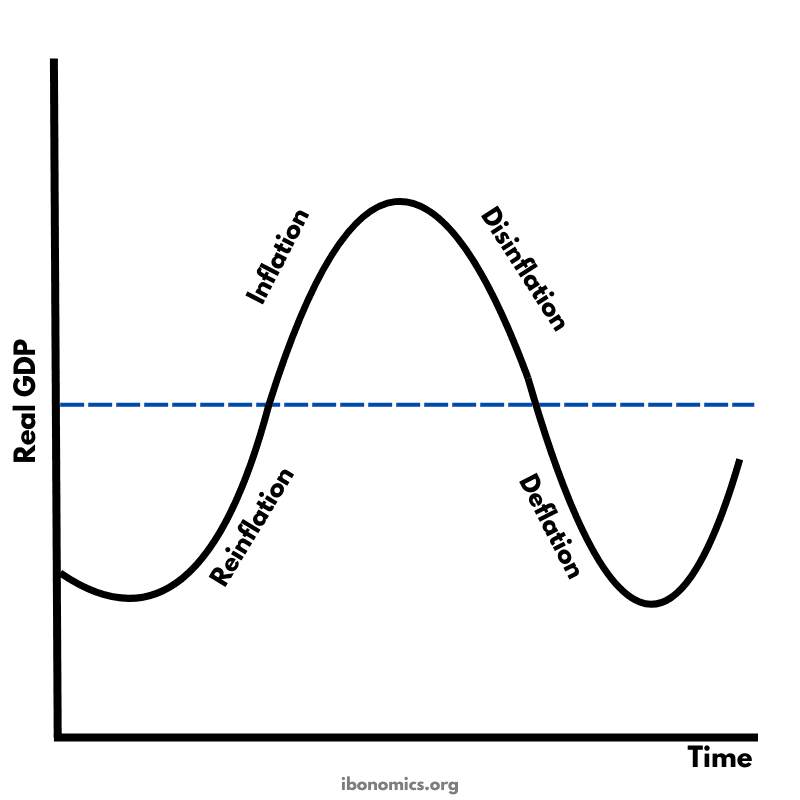
MacroeconomicsThis diagram illustrates the movement of the price level over time, showing how an economy can shift between inflation, disinflation, deflation, and reinflation. Each phase represents a different rate of change in the general price level. The diagram helps students visualise how price pressures rise and fall throughout the business cycle.
Curves and elements
- inflation
- Inflation: The rising section of the curve where price levels increase at a faster rate.
- disinflation
- Disinflation: The slowing of inflation shown by the flattening of the curve after the peak.
- deflation
- Deflation: The downward section where prices fall below the long-run trend line.
- reinflation
- Reinflation: The recovery from deflation when prices start rising again.
Key explanations
- 1
Inflation occurs when the general price level is rising at a sustained rate. In the diagram, this is the upward section where prices increase more quickly over time.
- 2
Disinflation is a fall in the rate of inflation. Prices are still rising, but at a slower pace. This appears on the diagram as the curve flattening after the peak.
- 3
Deflation is a decrease in the general price level. Prices are falling, shown by the downward section of the curve below the trend line.
- 4
Reinflation occurs when the economy recovers from deflation and the price level begins increasing again. This is shown when the curve turns upward after reaching its lowest point.
Example exam question
Using the inflation cycle diagram, explain the difference between disinflation and deflation.
Show example answer
Disinflation refers to a decrease in the rate of inflation, meaning prices are still increasing but more slowly than before. In contrast, deflation is when the general price level is actually falling. On the diagram, disinflation is represented by the curve rising more slowly after the peak, while deflation is shown by the downward movement below the long-run trend line.