IBonomics
Automatic Stabilisers – Tax Revenue and Government Spending Over the Business CycleSL
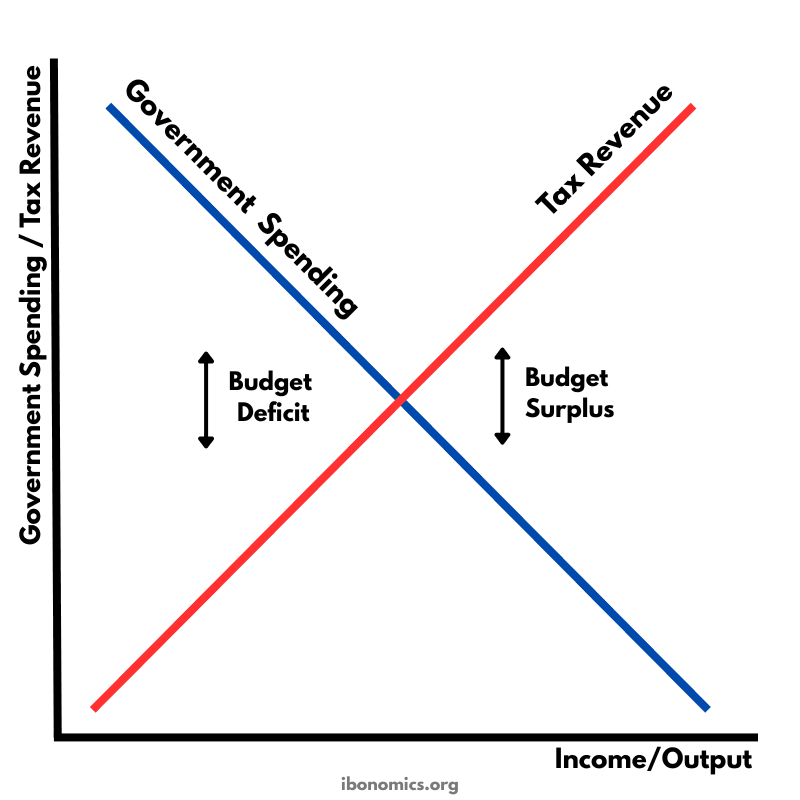
MacroeconomicsThis diagram illustrates automatic stabilisers by showing how tax revenue and government spending change automatically as national income (real GDP) changes. When income rises, tax revenue increases and some types of government spending fall, which reduces inflationary pressure. When income falls, tax revenue decreases and government spending rises, which supports aggregate demand. These automatic changes help smooth fluctuations in economic growth without new government policy decisions.
Curves and elements
- tax revenue
- Tax revenue line: As income and output rise, tax revenue rises automatically. As income falls, tax revenue falls automatically.
- government spending
- Government spending line: As income rises, some spending such as unemployment benefits falls. As income falls, this spending rises automatically.
- budget balance
- Budget deficit and surplus: At lower income levels, spending tends to exceed tax revenue creating a deficit. At higher income levels, tax revenue tends to exceed spending creating a surplus.
Key explanations
- 1
Automatic stabilisers are features of the government budget that automatically reduce the size of economic fluctuations, without requiring a new policy change.
- 2
As income and output increase, tax revenue rises because people and firms pay more taxes. This reduces disposable income and slows the growth of aggregate demand, helping limit demand pull inflation.
- 3
As income and output increase, government spending on transfer payments such as unemployment benefits tends to fall because fewer people are unemployed. This also reduces government spending and helps cool demand.
- 4
As income and output decrease, tax revenue falls, which increases disposable income relative to what it would otherwise be. This helps support consumption and aggregate demand during a downturn.
- 5
As income and output decrease, government spending on transfer payments rises automatically. This injects income into the economy and helps reduce the depth of a recession.
- 6
The diagram also links this to the budget balance. In a downturn, the budget is more likely to move into deficit as spending rises and tax revenue falls. In an upturn, the budget is more likely to move toward surplus as tax revenue rises and spending falls.
Example exam question
Using the diagram, explain how automatic stabilisers help reduce the size of recessions.
Show example answer
Automatic stabilisers help reduce the size of recessions because when income falls, tax revenue falls and government spending on transfer payments rises automatically. This supports household disposable income and helps maintain consumption, which increases aggregate demand compared to what it would be without stabilisers. As a result, the fall in real GDP is smaller and the recession is less severe.