Supply-Side Policies and Economic Growth (Outward Shift of PPC)SL
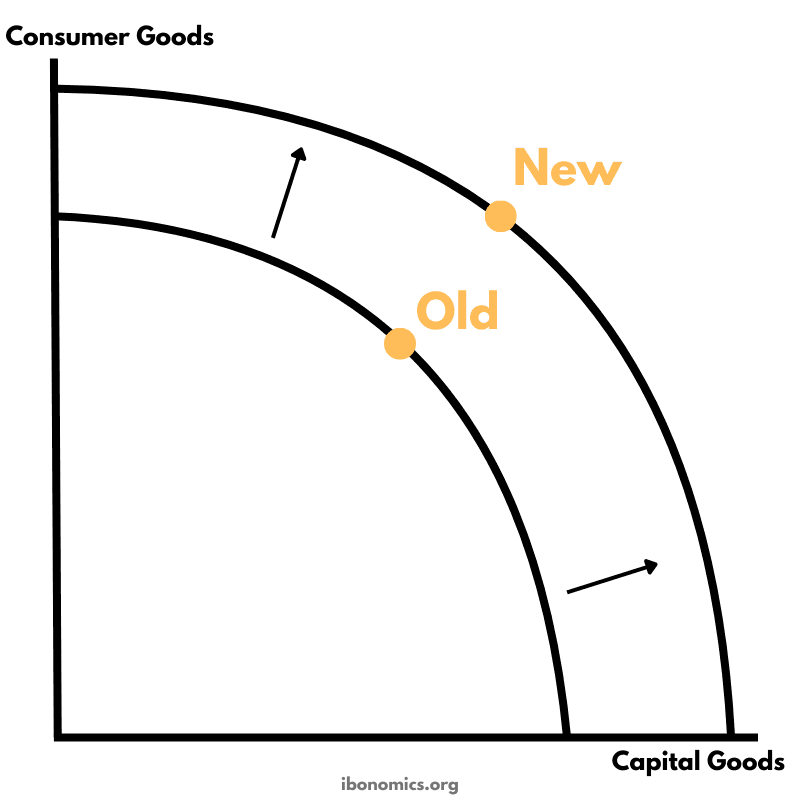
MacroeconomicsThis diagram shows an outward shift of the Production Possibility Curve (PPC), illustrating how supply-side policies can increase an economy’s productive capacity and long-run economic growth.
Curves and elements
- old ppc
- Old PPC: Shows the economy’s initial production possibilities.
- new ppc
- New PPC: Outward-shifted curve showing increased productive capacity.
- consumer goods axis
- Vertical axis measures output of consumer goods.
- capital goods axis
- Horizontal axis measures output of capital goods.
- growth notes
- Arrows indicate economic growth caused by successful supply-side policies.
Key explanations
- 1
The original PPC (Old) shows the maximum combinations of capital goods and consumer goods an economy can produce with its existing resources and technology.
- 2
The outward shift to the new PPC (New) represents economic growth, where the economy can produce more of both capital goods and consumer goods.
- 3
Supply-side policies such as investment in education and training, improvements in infrastructure, research and development, and market-oriented reforms increase productivity and efficiency.
- 4
When supply-side policies are successful, they expand the quantity and quality of factors of production, shifting the PPC outward rather than causing a movement along it.
- 5
Producing more capital goods can further increase future productive capacity, reinforcing long-run growth.
Example exam question
Using a PPC diagram, explain how supply-side policies can lead to long-run economic growth.
Show example answer
Supply-side policies improve the efficiency and quantity of factors of production, such as labour and capital. In the PPC diagram, this is shown by an outward shift of the curve, allowing the economy to produce more consumer goods and capital goods. This indicates an increase in productive capacity and long-run economic growth.