EU Countervailing Duties on Chinese Electric Vehicles
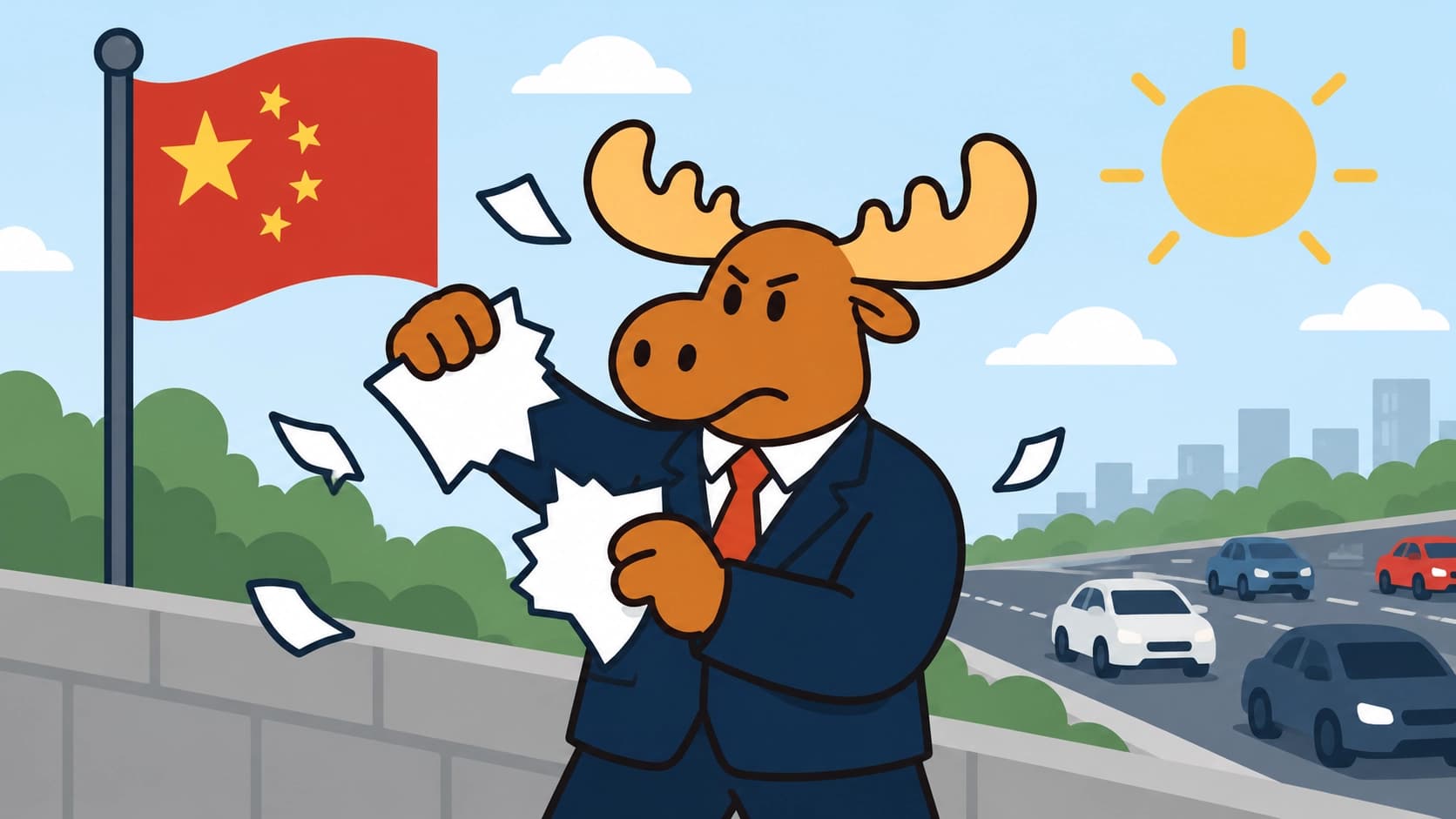
The EU imposed duties on Chinese EVs after finding subsidies that threatened economic injury to European producers.
Key figures
Definitive duty range
7.8% to 35.3%
Tesla (Shanghai) faces 7.8%, BYD 17.0%, Geely 18.8%, other cooperating companies 20.7%, and SAIC and other non-cooperating companies 35.3%.
Planned duration
5 years
The definitive measures entered into force on 30 October 2024.
At a glance
- In October 2024, the EU imposed definitive countervailing duties on battery electric vehicles imported from China for five years.
- The European Commission concluded that the Chinese battery electric vehicle value chain benefited from subsidies that created a threat of economic injury to EU producers.
- The definitive duty rates range from 7.8% to 35.3%, depending on the producer.
- The case shows how subsidies can make exports more competitive and lead an importing country to respond with trade protection.
- This is an anti-subsidy case, not a formal dumping case. It can be linked to export-subsidy theory, but the Commission investigated a wider set of countervailable subsidies.
Background
Chinese battery electric vehicle producers became increasingly important competitors in the European market. On 4 October 2023, the European Commission opened an anti-subsidy investigation into battery electric vehicles imported from China. The Commission investigated whether producers benefited from government support and whether subsidized imports threatened EU producers.
A subsidy is financial assistance or another economic benefit provided by a government to producers. A subsidy can lower a firm's costs, support investment or allow it to sell at a lower price than it otherwise could.
This case can also be connected to the IB Economics model of an export subsidy. An export subsidy is government support linked to exporting, which can make domestic firms more competitive in foreign markets. However, the Commission investigated a wider set of countervailable subsidies across the Chinese battery electric vehicle value chain. Students should therefore use export-subsidy theory to explain a related economic mechanism, but should not claim that every subsidy identified by the EU was specifically conditional on exporting.
The case should also not be described as a formal dumping case. Dumping concerns an exporter selling abroad below its normal value. Subsidization can contribute to very low export prices, but the EU measure in this case followed an anti-subsidy investigation.
What happened
The European Commission concluded its anti-subsidy investigation in October 2024 and imposed definitive countervailing duties on battery electric vehicles originating in China. A countervailing duty is an import duty intended to offset an advantage created by foreign government subsidies.
The definitive duties entered into force on 30 October 2024. The rates depend on the producer. Tesla (Shanghai) faces 7.8%, BYD 17.0%, Geely 18.8%, other cooperating companies 20.7%, and SAIC and other non-cooperating companies 35.3%.
The Commission stated that the Chinese battery electric vehicle value chain benefited from subsidization that created a threat of economic injury to EU producers. The measures were introduced for five years.
The policy continued to develop after 2024. In January 2026, the Commission issued guidance for Chinese exporters that wanted to offer a price undertaking, which is a commitment to sell at or above a minimum import price in exchange for possible exemption from the duty. In February 2026, the Commission accepted such an undertaking for Volkswagen (Anhui) and its CUPRA Tavascan model, subject to conditions including a minimum import price and import-volume limits.
Timeline
4 October 2023
The European Commission opened an anti-subsidy investigation into battery electric vehicles imported from China.
4 July 2024
The Commission imposed provisional countervailing duties while the investigation continued.
29 October 2024
The Commission concluded the investigation and adopted definitive countervailing duties.
30 October 2024
The definitive duties entered into force for a planned period of five years.
12 January 2026
The Commission issued guidance on price undertaking offers from Chinese battery electric vehicle exporters.
10 February 2026
The Commission accepted a price undertaking for Volkswagen (Anhui)'s CUPRA Tavascan, allowing qualifying imports to be exempt from the countervailing duty if the undertaking is followed.
Using this in the exam
Use this case in the real-world application paragraph after you have explained the relevant theory.
For a question on tariffs or trade protection, state that the EU imposed definitive countervailing duties of 7.8% to 35.3% on Chinese battery electric vehicles in October 2024 after the European Commission concluded that the Chinese BEV value chain benefited from subsidization that threatened economic injury to EU producers. Then use a tariff diagram. In the standard model, a tariff raises the domestic price above the world price, increases domestic production, reduces domestic consumption and reduces imports. Domestic producers gain, while consumers lose consumer surplus and deadweight welfare losses are created.
For a question on subsidies or export subsidies, use the case to show how government support can strengthen a firm's ability to compete in foreign markets. An export-subsidy diagram can illustrate the textbook mechanism by which support for exports increases domestic production and exports. However, add an important caution: the EU investigated a range of countervailable subsidies, not one single textbook export subsidy that was necessarily conditional on exporting.
For a 15-mark evaluation, compare the possible correction of a subsidy-created distortion with the costs of protection. The duties may protect EU producers and investment, but they can also raise prices, reduce consumer surplus and increase the risk of retaliation. You can strengthen the evaluation by noting that the actual effect depends on how much of the duty exporters absorb through lower profit margins and how much is passed on to consumers.
Syllabus topics
Test yourself
Questions this example can answer
- Using a real-world example, explain how subsidies can affect international trade.
- Using a real-world example, explain why a government may impose a tariff on subsidized imports.
- Evaluate the use of trade protection in response to subsidized imports.
- Discuss the effects of subsidies that increase the international competitiveness of domestic producers.
Evaluation
Arguments in favour
May offset the advantage created by subsidies
If government support lowers foreign producers' costs, subsidized imports can enter the EU at lower prices than would otherwise be possible. A countervailing duty raises the import cost and can reduce this price advantage, making competition with EU producers less distorted.
May support EU investment and employment
If subsidized imports rapidly take market share, EU producers may reduce output, investment or employment. Protection can give domestic firms more time to expand EV production and invest in technology, although the size of this effect depends on how firms respond.
May preserve domestic production capacity
Electric vehicles are a growing part of the car industry. If EU producers maintain production and supply chains during the transition to electric vehicles, the region may retain more industrial capacity and technological knowledge in the long run.
Arguments against
Consumers may face higher prices
The duty raises the cost of affected imports. If exporters pass much of this cost on to buyers, EV prices rise and consumer surplus falls, particularly for consumers who would otherwise have chosen lower-priced imported vehicles.
Protection can create welfare losses
In the standard tariff model, a higher domestic price reduces consumption and shifts some production toward higher-cost domestic firms. This creates consumption and production inefficiency, reducing allocative efficiency even if domestic producers gain.
Trade tensions and retaliation may increase
China can respond to EU trade restrictions with measures affecting European exports. If both sides introduce additional barriers, trade volumes may fall and producers that depend on international supply chains or foreign markets may face higher costs.
Context and assumptions
The effect depends on tariff pass-through
A 17% duty does not automatically mean the consumer price rises by 17%. Exporters may absorb part of the duty through lower profit margins, so the effect on EU prices depends on market structure, demand and firms' pricing decisions.
Short-run and long-run effects may differ
In the short run, protection may help EU producers retain market share. In the long run, it could encourage investment, but prolonged protection could also weaken competitive pressure to reduce costs and innovate.
The type of subsidy matters
The case is useful for understanding export-subsidy theory because subsidies can increase export competitiveness. However, the Commission investigated several countervailable subsidies, so students should not describe the entire case as a single textbook export subsidy.
Environmental and industrial objectives can conflict
Protecting EU EV production may support industrial policy, while higher prices for imported EVs could make electric cars less affordable. The overall effect therefore depends partly on whether domestic supply expands enough to keep EV prices competitive.
Price undertakings provide an alternative to paying the duty
The 2026 Volkswagen (Anhui) agreement shows that trade protection does not have to operate only through tariffs. A minimum import price and volume commitments can address the Commission's concerns while allowing qualifying imports to avoid the countervailing duty.
Key terms
- Subsidy
- Financial assistance or another economic benefit provided by a government to producers, lowering their costs or encouraging production.Taught in Unit 4.2: Types of Trade Protection
- Export Subsidy
- Government support given to domestic firms for goods they export, lowering export costs or increasing the return from exporting.Taught in Unit 4.2: Types of Trade Protection
- Countervailing Duty
- An import duty imposed to offset the advantage that foreign producers receive from government subsidies.Taught in Unit 4.2: Types of Trade Protection
- Tariff
- A tax imposed on imported goods, which raises the cost of bringing those goods into the domestic market.Taught in Unit 4.2: Types of Trade Protection
- Trade Protection
- Government policies that restrict imports or support domestic producers in order to reduce foreign competition.Taught in Unit 4.2: Types of Trade Protection
- Consumer Surplus
- The difference between the maximum price consumers are willing to pay for a good and the price they actually pay.
- Allocative Efficiency
- A situation where resources are allocated to produce the combination of goods and services that maximizes overall economic welfare.
References
Sources
- 01
Commission Implementing Regulation (EU) 2024/2754 imposing a definitive countervailing duty on battery electric vehicles from China
EUR-Lex
- 02
Commission Implementing Regulation (EU) 2026/330 amending Regulation (EU) 2024/2754
EUR-Lex
- 03
EU imposes duties on unfairly subsidised electric vehicles from China while discussions on price undertakings continue
European Commission
- 04
Commission issues Guidance Document on submission of price undertaking offers for battery electric vehicles from China
European Commission
- 05
Commission accepts price undertaking from Chinese electric car producer
European Commission
Related case studies
More global economics examples you can use in the same answer
The U.S. imposed new tariffs on EU imports in 2025, aiming to support domestic production and address trade imbalances.

Johor's data-centre boom shows how digital FDI can raise productive capacity while creating energy, water and sustainability trade-offs.
Malaysia and the EFTA states signed a free trade agreement that will cut tariffs and expand trade, while creating adjustment risks.