Malaysia–EFTA Free Trade Agreement: Trade Creation, Trade Diversion and Economic Integration
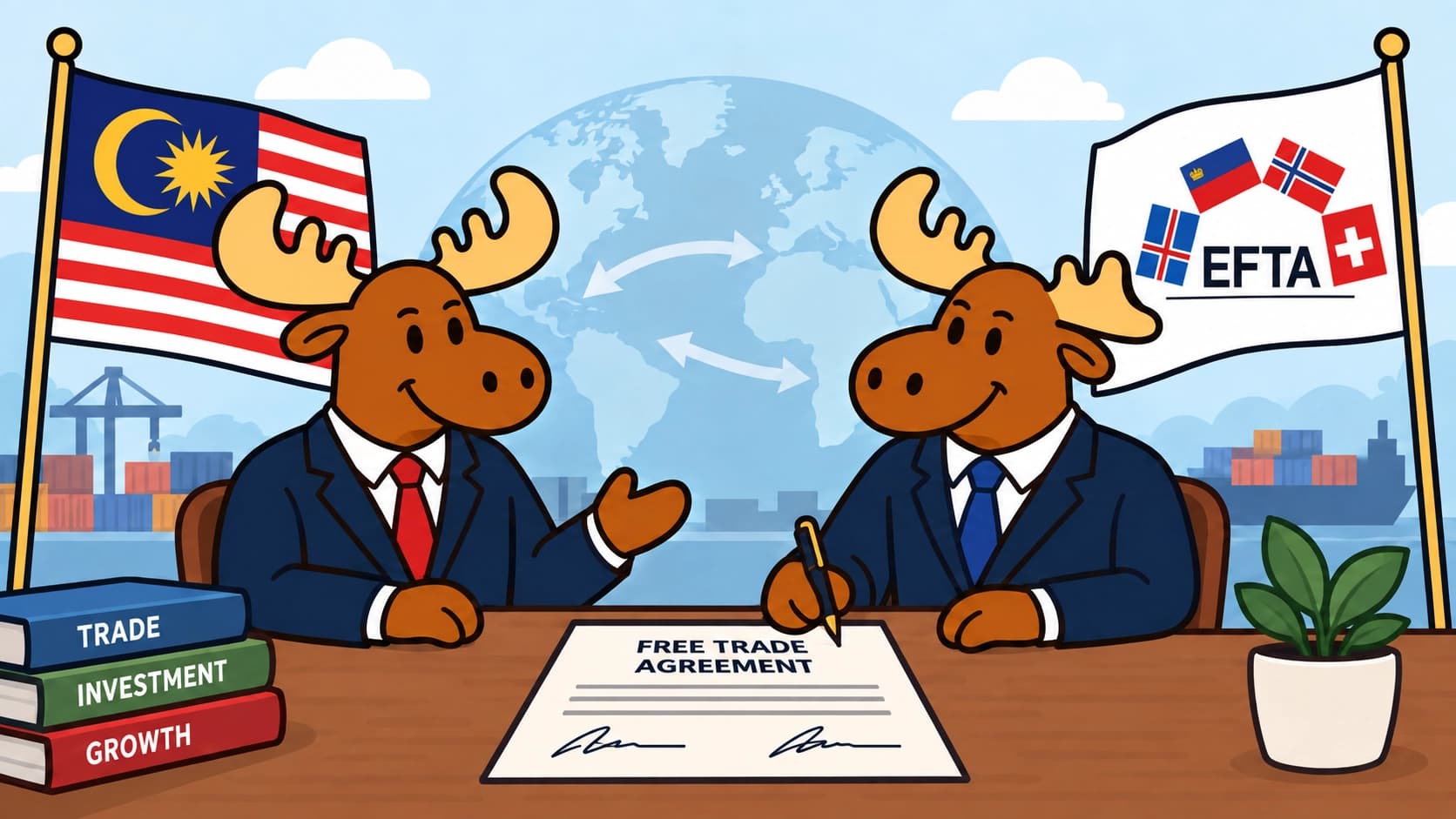
Malaysia and the EFTA states signed a free trade agreement that will cut tariffs and expand trade, while creating adjustment risks.
Economic relevance
Economic Integration
Key figures
Agreement signed
23 June 2025
Malaysia and the four EFTA states signed the agreement in Tromsø, Norway.
EFTA–Malaysia goods trade
€2.144 billion
Total merchandise trade between the EFTA states and Malaysia in 2024.
Malaysian exports with duty-free access
90%+
More than 90% of Malaysian exports are expected to receive long-term duty-free access to the EFTA states once the agreement enters into force.
Norwegian exports with duty-free access
99%
Share of current Norwegian goods exports by value expected to receive duty-free access to Malaysia once tariff reductions are fully introduced.
At a glance
- Malaysia and the EFTA states — Iceland, Liechtenstein, Norway and Switzerland — signed the Malaysia–EFTA Economic Partnership Agreement on 23 June 2025.
- The agreement creates a free trade area, meaning tariffs are reduced or removed between members, but each country keeps its own trade policy towards non-members.
- Once the agreement enters into force, more than 90% of Malaysian exports will receive long-term duty-free access to EFTA markets.
- For Norway, 99% of current goods exports by value are expected to receive duty-free access to Malaysia after the tariff reductions are fully introduced.
- The main IB Economics evaluation is whether trade creation and lower prices are greater than trade diversion, adjustment costs and losses for less competitive domestic producers.
Background
The European Free Trade Association (EFTA) consists of Iceland, Liechtenstein, Norway and Switzerland. Malaysia and the EFTA states had traded with each other for many years before reaching their new agreement.
In IB Economics, this agreement is an example of economic integration. More specifically, it creates a free trade area. A free trade area is a group of countries that reduce or remove trade barriers between themselves while keeping their own trade policies towards countries outside the agreement.
This is different from a customs union. The Malaysia–EFTA agreement does not create one common tariff against countries outside the agreement. Instead, Malaysia and each EFTA state keep control over their own external trade policies.
Before the agreement was signed, trade between the two sides was already important. In 2024, total goods trade between EFTA and Malaysia was €2.144 billion. EFTA imported €1.094 billion of goods from Malaysia and exported €1.050 billion to Malaysia.
What happened
Malaysia and the EFTA states concluded negotiations on the Malaysia–EFTA Economic Partnership Agreement in April 2025 and signed it in Tromsø, Norway, on 23 June 2025.
The treaty itself states that the countries establish a free trade area. It covers trade in goods and services, investment and other areas such as government procurement, competition and sustainable development.
The most important change for IB Economics is the reduction of tariffs. Once the agreement enters into force, more than 90% of Malaysian exports will receive long-term duty-free access to EFTA markets. Malaysia will also reduce or remove tariffs on many EFTA products.
Norway is one of the four EFTA members. According to the Norwegian government, 99% of current Norwegian goods exports by value will eventually receive duty-free access to Malaysia. Most Norwegian industrial and seafood exports will either become tariff-free immediately or after tariffs are gradually reduced.
The agreement has been signed, but it has not yet entered into force. EFTA still lists ratification as pending. Norway's parliament gave its consent to ratification on 2 June 2026. Because the agreement is not yet in force, its economic effects should be described as expected effects rather than proven outcomes.
Timeline
November 2012
Malaysia and EFTA launched negotiations for a trade agreement.
25–28 March 2014
The first formal round of negotiations took place in Geneva.
11 April 2025
Malaysia and the EFTA states concluded negotiations on the agreement.
23 June 2025
Malaysia, Iceland, Liechtenstein, Norway and Switzerland signed the agreement in Tromsø, Norway.
2 June 2026
Norway's parliament gave its consent to ratify the agreement.
September 2026
EFTA still listed ratification as pending and no entry-into-force date had been announced.
Using this in the exam
Use this example in an answer about free trade agreements or economic integration. Start by stating that Malaysia and the EFTA states signed an agreement in June 2025 that creates a free trade area. Then explain that tariffs between members will be reduced or removed.
For analysis, explain trade creation. If a cheaper EFTA product replaces a more expensive Malaysian product, or a cheaper Malaysian product replaces a more expensive EFTA product, resources are used more efficiently. Consumers may also benefit from lower prices and more choice.
For evaluation, explain trade diversion. A country inside the agreement may replace a cheaper producer outside the agreement simply because the member country receives a tariff advantage. This can reduce the efficiency gain from the agreement.
You can also discuss exporters. Malaysian firms gain easier access to EFTA markets, while Norwegian firms gain easier access to Malaysia. However, domestic firms that previously received protection from tariffs may face stronger competition.
Do not claim that the agreement has already caused trade to rise. As of September 2026, it had not yet entered into force. Use the figures as evidence of the size of the agreement and its expected effects, not as proof that those effects have already occurred.
Syllabus topics
Diagrams to use
Test yourself
Questions this example can answer
- Explain how a free trade area can increase trade between member countries.
- Using real-world examples, evaluate the possible effects of economic integration on consumers and producers.
- Discuss whether a free trade agreement is likely to improve economic welfare for all member countries.
Evaluation
Arguments in favour
Trade creation can improve efficiency
Lower tariffs can allow consumers and firms to buy from lower-cost producers inside the free trade area. This can move production towards firms with lower opportunity costs, reduce prices and increase consumer surplus.
Exporters gain better access to foreign markets
More than 90% of Malaysian exports are expected to receive long-term duty-free access to EFTA markets. Norwegian exporters will also receive major tariff reductions in Malaysia. Lower tariffs make these exports more price competitive and may increase sales.
Greater competition may benefit consumers
Domestic firms may face more competition from foreign producers. This can encourage firms to reduce costs, improve quality and innovate, while consumers may gain from lower prices and a wider choice of products.
Arguments against
Trade diversion can reduce the gains from free trade
A member country may start buying from another member even when a producer outside the agreement has lower production costs. If this happens only because the outside producer still faces a tariff, world resources may be used less efficiently.
Some domestic producers may lose
Firms that were previously protected by tariffs may lose market share when cheaper imports enter the market. Workers in less competitive industries may also face unemployment or need to move into other sectors.
Governments may lose some tariff revenue
Removing tariffs reduces the tax collected on affected imports. The importance of this depends on how much tariff revenue the government collected before the agreement and whether higher trade and economic activity create other tax revenues.
Context and assumptions
The size of the benefits depends on how much trade responds
A tariff cut does not guarantee a large rise in trade. The effect depends on factors such as consumer demand, transport costs, exchange rates and whether firms are able to enter each other's markets.
The agreement covers more than goods
The agreement also includes services, investment and government procurement. Its total economic effect may therefore be larger than the effect of tariff reductions alone.
The agreement has not yet entered into force
As of September 2026, EFTA still listed ratification as pending. This means the benefits and costs are expected effects rather than outcomes that can already be measured.
Sustainability is included in the agreement
The agreement includes rules on trade and sustainable development as well as a separate joint statement on sustainable palm oil. These rules may reduce some environmental concerns, but their effect will depend on how they are implemented.
Key terms
- Economic integration
- The process by which countries reduce barriers to trade and increase economic cooperation.Taught in Unit 4.4: Economic Integration
- Free trade area
- An agreement in which member countries reduce or remove trade barriers between themselves while keeping their own trade policies towards non-members.Taught in Unit 4.4: Economic Integration
- Tariff
- A tax placed on imported goods.Taught in Unit 4.2: Types of Trade Protection
- Trade creation
- The replacement of higher-cost domestic production by lower-cost imports from a member of a trading bloc after trade barriers are reduced.Taught in Unit 4.4: Economic Integration
- Trade diversion
- The replacement of lower-cost imports from a non-member by higher-cost imports from a member because the member receives preferential access.Taught in Unit 4.4: Economic Integration
- Consumer surplus
- The difference between the maximum price consumers are willing to pay and the price they actually pay.
References
Sources
- 01
Malaysia
European Free Trade Association
- 02
Malaysia–EFTA Economic Partnership Agreement (MEEPA)
Ministry of Investment, Trade and Industry Malaysia
- 03
Economic Partnership Agreement Between the EFTA States and Malaysia
Ministry of Investment, Trade and Industry Malaysia
- 04
Prop. 48 S (2025–2026): Ratification of the Economic Partnership Agreement between the EFTA States and Malaysia
Government of Norway
- 05
Consent to ratification of the Economic Partnership Agreement between the EFTA States and Malaysia
Stortinget
- 06
EFTA and Malaysia sign Economic Partnership Agreement – Joint communiqué
European Free Trade Association
Related case studies
More global economics examples you can use in the same answer

The EU imposed duties on Chinese EVs after finding subsidies that threatened economic injury to European producers.
The U.S. imposed new tariffs on EU imports in 2025, aiming to support domestic production and address trade imbalances.

Johor's data-centre boom shows how digital FDI can raise productive capacity while creating energy, water and sustainability trade-offs.