IBonomics
Inflationary and Deflationary Gaps on the Business CycleSL
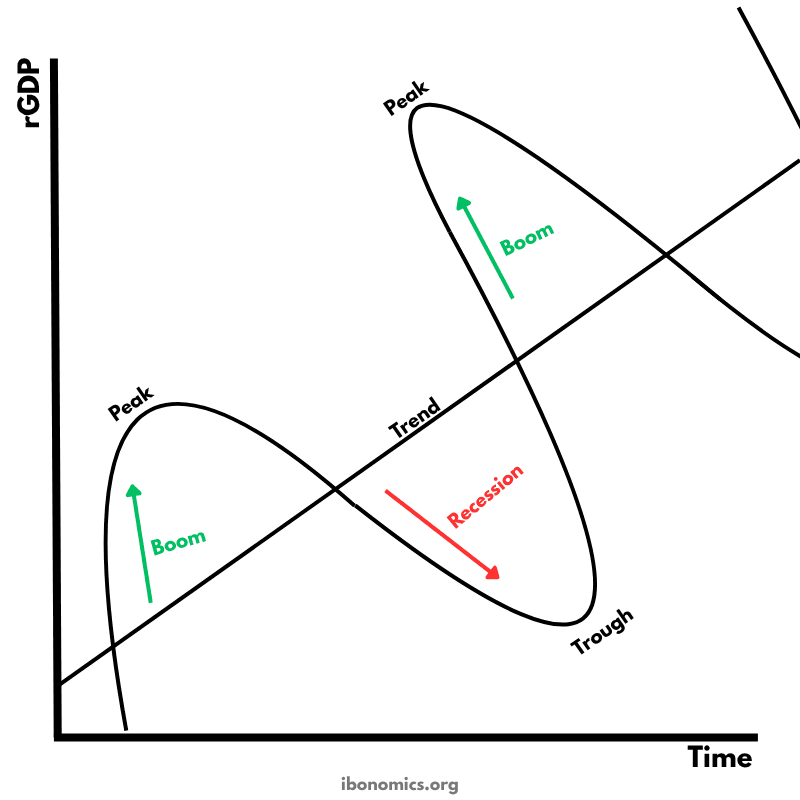
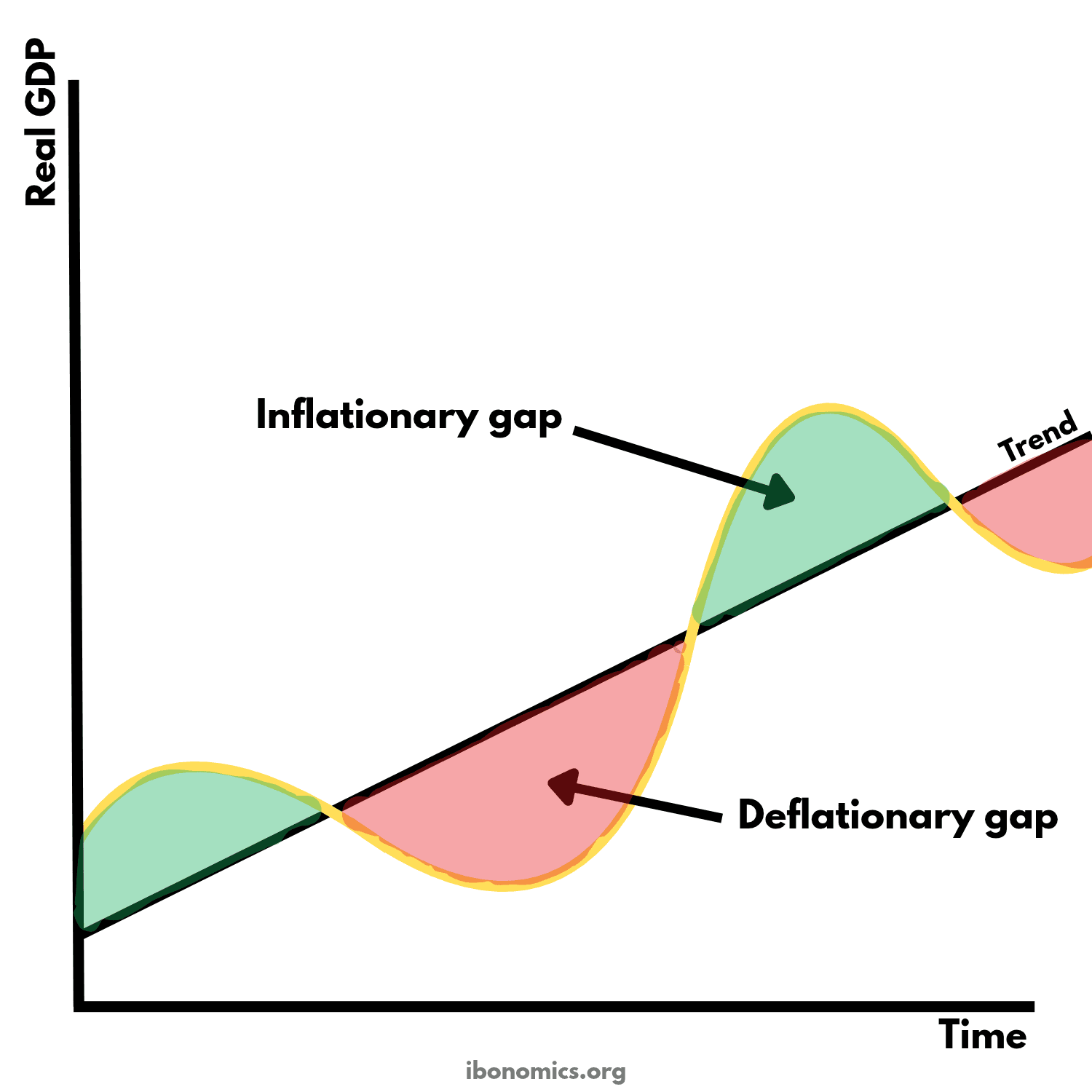
MacroeconomicsThis diagram shows output gaps on the business cycle. An inflationary gap appears when real GDP is above its long-term trend, and a deflationary gap appears when real GDP is below it.
Curves and elements
- Trend
- The long-term growth path of the economy's potential output.
- Real GDP
- The actual level of output, shown by the curve that moves above and below the trend.
- Inflationary gap
- The shaded areas above the trend, where real GDP is above potential output.
- Deflationary gap
- The shaded areas below the trend, where real GDP is below potential output.
Key explanations
- 1
The trend line shows the economy's potential output, and the curve shows its actual real GDP. The difference between the two at any point in time is the output gap.
- 2
An inflationary gap exists when real GDP is above the trend. The economy is producing beyond its normal capacity, so unemployment is below its natural rate and there is upward pressure on the price level.
- 3
A deflationary gap exists when real GDP is below the trend. The economy has spare capacity, so unemployment is above its natural rate and there is little pressure on the price level to rise.
- 4
Real GDP moves between the two gaps as the cycle turns. The output gap is zero at the points where real GDP crosses the trend line.
- 5
Governments can respond with demand-side policy. Contractionary policy aims to narrow an inflationary gap, and expansionary policy aims to narrow a deflationary gap.
Example exam question
Using a business cycle diagram, explain the difference between an inflationary gap and a deflationary gap.
Show example answer
The trend line shows potential output, and the curve shows actual real GDP. When real GDP is above the trend there is an inflationary gap, because the economy is producing beyond its normal capacity. This pushes unemployment below its natural rate and puts upward pressure on the price level. When real GDP is below the trend there is a deflationary gap, because the economy has spare capacity. This leaves unemployment above its natural rate and reduces the pressure on prices. Real GDP moves between the two gaps over the cycle, and the gap is zero where real GDP crosses the trend line.