IBonomics
Long Run Average Cost and Minimum Efficient ScaleHL
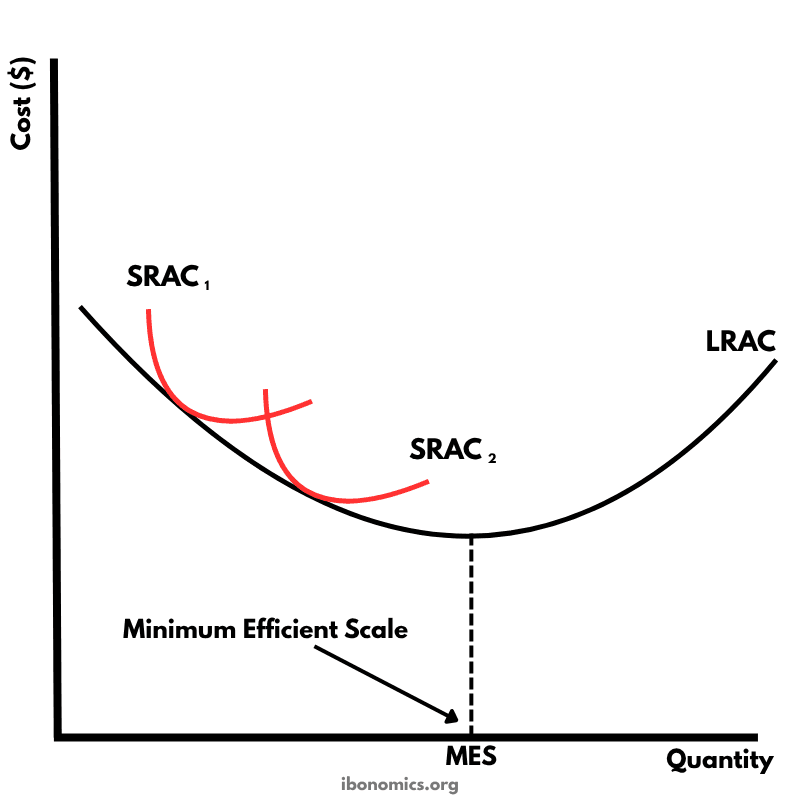
MicroeconomicsA diagram showing the long run average cost curve and the minimum efficient scale, where a firm reaches the lowest possible average cost in the long run.
Curves and elements
- srac 1
- SRAC1: A short run average cost curve showing average cost for one possible plant size.
- srac 2
- SRAC2: Another short run average cost curve showing average cost for a different plant size.
- lrac
- LRAC: The long run average cost curve, showing the lowest achievable average cost for each output level when all inputs are variable.
- mes
- Minimum Efficient Scale (MES): The level of output where the LRAC curve reaches its minimum point.
- economies of scale
- Economies of Scale: The range over which LRAC falls as output increases.
- diseconomies of scale
- Diseconomies of Scale: The range over which LRAC rises as output increases beyond MES.
Key explanations
- 1
The long run average cost curve shows the lowest average cost of production possible at each level of output when all factors of production are variable.
- 2
The short run average cost curves show average costs for different plant sizes or scales of operation in the short run.
- 3
As output increases, the firm may experience economies of scale, causing long run average cost to fall.
- 4
Minimum efficient scale is the level of output at which the firm reaches the lowest point on the long run average cost curve.
- 5
Beyond the minimum efficient scale, diseconomies of scale may cause long run average cost to rise.
Example exam question
Explain the relationship between the LRAC curve and minimum efficient scale, using a diagram.
Show example answer
The LRAC curve shows the lowest possible average cost at each level of output in the long run. The minimum efficient scale is the level of output where LRAC is at its minimum, meaning the firm has fully exploited economies of scale.