IBonomics
Long-Run Normal Profit in Perfect Competition – How Abnormal Profit DisappearsHL
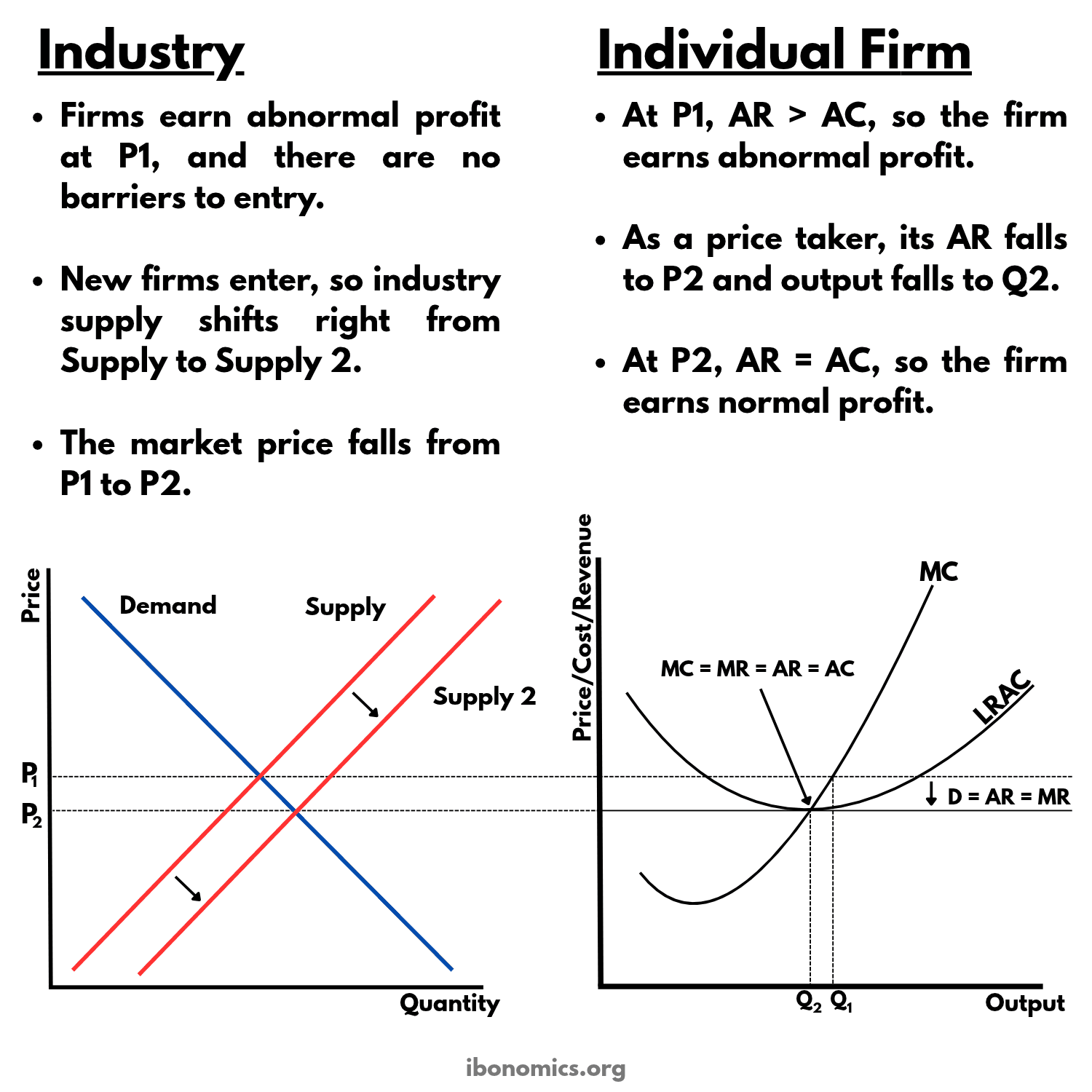
MicroeconomicsThis diagram shows how abnormal profit disappears in the long run in perfect competition. At the original price P1 firms earn abnormal profit, which attracts new firms into the industry. Industry supply shifts right and the price falls to P2, where each firm earns normal profit.
Curves and elements
- Demand
- Industry demand for the good, which stays the same.
- Supply
- The original industry supply, which sets the price at P1.
- Supply 2
- Industry supply after new firms enter, further to the right.
- MC
- The firm's marginal cost. The firm produces where it meets MR.
- LRAC
- The firm's long-run average cost.
- D = AR = MR
- The firm's perfectly elastic demand curve, set by the market price. It falls from P1 to P2.
- P1
- The original market price, at which firms earn abnormal profit.
- P2
- The long-run market price, at which firms earn normal profit.
- Q1
- The firm's output at P1, where MC = MR.
- Q2
- The firm's output at P2, which is lower than Q1.
- MC = MR = AR = AC
- The long-run equilibrium, at the lowest point of LRAC. Price equals both marginal cost and average cost.
Key explanations
- 1
At the original price P1, AR is above AC at the firm's output Q1, so each firm earns abnormal profit.
- 2
There are no barriers to entry in perfect competition, so the profit attracts new firms into the industry.
- 3
As new firms enter, industry supply shifts right from Supply to Supply 2, and the market price falls from P1 to P2.
- 4
Each firm is a price taker, so its D = AR = MR line falls to P2. It still produces where MC = MR, so its output falls from Q1 to Q2.
- 5
At P2, AR = AC, so each firm earns normal profit and new firms stop entering. This is the long-run equilibrium, with each firm producing at the lowest point of LRAC.
- 6
Each firm produces less than before, but industry output is higher because the lower price raises the quantity demanded and there are more firms supplying it.
Example exam question
Using diagrams, explain how abnormal profit in a perfectly competitive market is eliminated in the long run.
Show example answer
At price P1, AR is above AC, so firms in perfect competition earn abnormal profit. With no barriers to entry, this attracts new firms, and industry supply shifts right from Supply to Supply 2. The market price falls from P1 to P2. Each firm is a price taker, so its D = AR = MR line falls to P2 and its output falls from Q1 to Q2, where MC = MR. At P2, AR = AC at the lowest point of LRAC, so firms earn normal profit and new firms stop entering. The market is then in long-run equilibrium.