EU Emissions Trading System: Reducing Industrial Carbon Emissions
The EU uses tradable pollution permits to make firms pay for carbon emissions and reduce the negative externality from production.
Economic relevance
Regulation
Key figures
EU ETS launched
2005
The EU Emissions Trading System began operating in 2005.
One allowance
1 tonne CO₂e
One EU ETS allowance gives the holder the right to emit one tonne of carbon dioxide equivalent.
Emissions reduction
About 50%
By 2025, emissions in sectors covered by the EU ETS had fallen by about half compared with 2005.
2030 ETS target
-62%
The EU aims for emissions covered by the ETS to be 62% below 2005 levels by 2030.
At a glance
- Carbon emissions from factories and power stations create costs for third parties through climate change, making them a negative externality of production.
- The EU Emissions Trading System places a cap on total emissions and requires covered firms to hold an allowance for each tonne of carbon dioxide equivalent they emit.
- Firms that reduce emissions can sell spare allowances, while firms that continue polluting must buy more, creating a financial incentive to cut emissions.
- By 2025, emissions in sectors covered by the EU ETS were around 50% below 2005 levels.
- The main evaluation is whether the cap is strict enough and whether the cost of permits creates excessive costs for European firms.
Background
Carbon emissions from factories and power stations can create a negative externality of production. The firm pays its private production costs, but other people may face external costs from climate change, pollution and environmental damage.
This means the marginal social cost (MSC) of production is greater than the marginal private cost (MPC) faced by the firm. Without government intervention, too much pollution-intensive output may be produced compared with the socially efficient level.
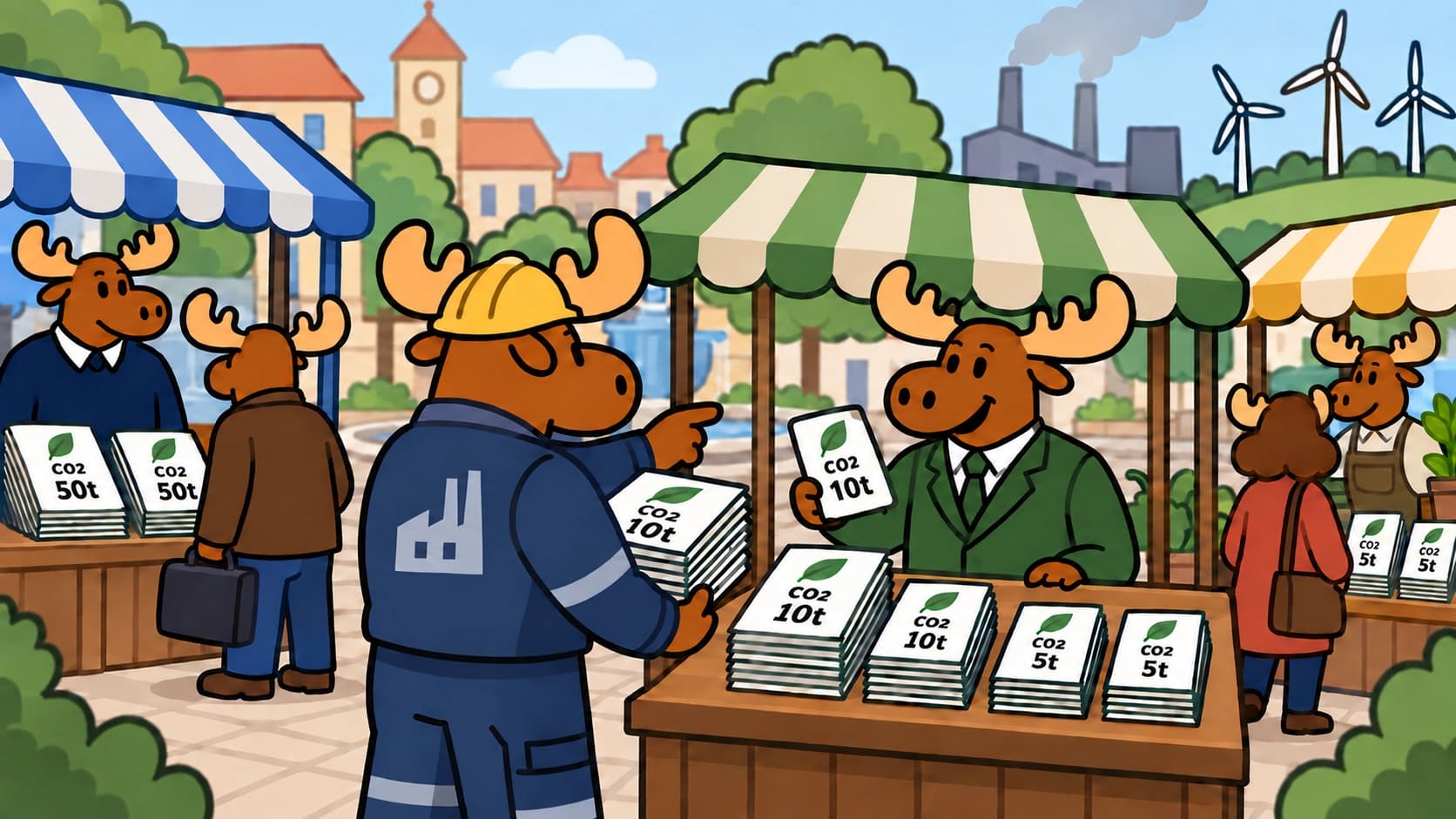
One way governments can respond is through tradable pollution permits. Instead of allowing unlimited emissions, the government limits the total amount of pollution and creates permits that firms can buy and sell.
What happened
The European Union launched the EU Emissions Trading System in 2005. It uses a cap-and-trade system for greenhouse gas emissions from major sectors including power generation and industry.
The EU sets a limit, or cap, on the total emissions allowed from covered firms. One allowance gives the holder the right to emit one tonne of carbon dioxide equivalent. Firms must monitor their emissions and surrender enough allowances to cover them.
The allowances can be traded. A firm that reduces its emissions can sell spare allowances, while a firm that continues to pollute may need to buy more. This creates a financial incentive to reduce emissions where it is cheapest to do so.
The EU reduces the overall cap over time. According to the European Commission, by 2025 emissions in sectors covered by the ETS were about 50% below their 2005 level. The current system is designed to reduce covered emissions by 62% by 2030 compared with 2005.
Timeline
2003
The EU adopted the law establishing a greenhouse gas emissions trading system.
1 January 2005
The EU Emissions Trading System began operating.
2023
The EU revised the ETS and tightened the emissions cap to support its 2030 climate targets.
2024
Emissions covered by the system fell further, including a large reduction from electricity generation.
2025
Covered emissions were about 50% below their 2005 level.
Using this in the exam
Use this case in an answer about negative externalities of production or tradable pollution permits.
First explain the market failure. Factories consider their private costs but may not pay the full external cost of their carbon emissions. Therefore, MSC is greater than MPC and the market produces more than the socially efficient quantity.
Then explain the EU response. The EU sets a cap on emissions and requires firms to hold permits. Because permits have a price, pollution becomes more costly to the firm. Firms can either reduce emissions or buy additional allowances.
In the negative production externality diagram, show MSC above MPC and the market quantity above the socially efficient quantity. You can then explain that pollution permits aim to reduce output or emissions towards the socially efficient level.
For evaluation, do not claim that the ETS alone caused the entire fall in emissions. Renewable energy, energy efficiency and other policies also contributed.
Syllabus topics
Diagrams to use
Questions this example can answer
- Explain why carbon emissions from production can cause market failure.
- Using a real-world example, evaluate tradable pollution permits as a response to negative externalities.
- Discuss whether government intervention can reduce the external costs of industrial production.
Evaluation
Arguments in favour
Polluters face a financial cost
Firms must hold allowances for their emissions. This increases the private cost of polluting and gives firms an incentive to reduce emissions or invest in cleaner technology.
Trading can reduce emissions at a lower cost
Firms that can cut emissions cheaply can do so and sell spare permits. Firms facing higher reduction costs can buy permits instead, allowing emissions cuts to take place where they are less expensive.
Arguments against
The system depends on the cap being strict enough
If too many allowances are available, permit prices may be low and firms have less incentive to reduce emissions. The effectiveness of the policy therefore depends on how quickly the cap is reduced.
Higher costs may reduce competitiveness
Buying permits raises production costs for pollution-intensive firms. If competitors outside the EU face weaker climate rules, some European firms may lose competitiveness or shift production abroad.
Context and assumptions
Several policies affect emissions at the same time
The fall in EU emissions cannot be attributed only to the ETS. Renewable energy growth, energy efficiency and other climate policies also affect emissions.
Some allowances are still given to firms for free
The EU gives some industries free allowances to reduce the risk that production moves to countries with weaker climate rules. This can protect competitiveness but may weaken the incentive to cut emissions.
Key terms
- Negative externality of production
- An external cost imposed on third parties as a result of producing a good or service, causing marginal social cost to exceed marginal private cost.Taught in Unit 2.8: Market Failure: Externalities and Common Pool Resources
- Marginal private cost (MPC)
- The additional cost to a producer of producing one more unit of a good or service.
- Tradable pollution permits
- Permits that give firms the right to emit a certain amount of pollution and can be bought and sold between firms.Taught in Unit 2.7: Role of Government in Microeconomics
- Cap and trade
- A system where the government limits total pollution and allows firms to trade permits giving them the right to emit.
- Market failure
- A situation where the free market fails to allocate resources efficiently.
References
Sources
Related case studies
More microeconomics examples you can use in the same answer

A US court found Google illegally maintained search monopolies and imposed rules designed to make it easier for rivals to compete.

EU transparency rules require AI-generated audio to be detectable, aiming to reduce information gaps between creators and listeners.
A US court blocked JetBlue's $3.8 billion takeover of Spirit, finding that the merger would reduce competition and harm many travellers.