Price Elasticity of Demand: How Responsive Consumers Are to Price Changes
A clear IB Economics explanation of price elasticity of demand, including elastic and inelastic demand, determinants of PED and total revenue effects.
Price Elasticity of Demand: How Responsive Consumers Are to Price Changes
Price elasticity of demand, usually shortened to PED, measures how responsive consumers are to a change in price. It is one of the most useful tools in IB Microeconomics because it helps explain how consumers react, how firms make pricing decisions and how governments predict the effects of taxes and subsidies.
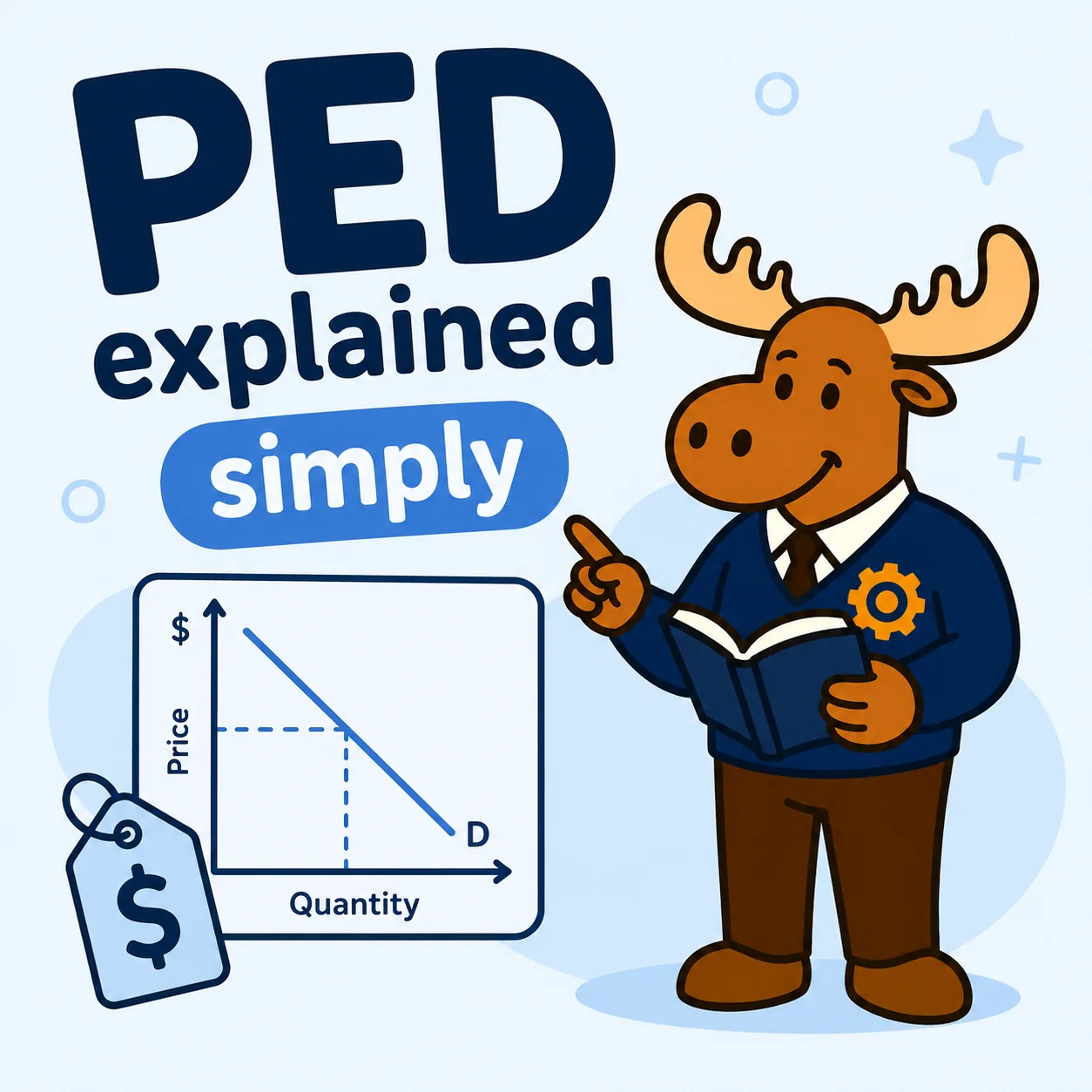
Demand curves show the relationship between price and quantity demanded. PED goes one step further. It asks: if price changes, by how much does quantity demanded change?
This matters because not all goods behave in the same way. A small increase in the price of a luxury holiday may cause a large fall in quantity demanded. A large increase in the price of an essential medicine may cause only a small fall in quantity demanded. PED helps economists compare these responses.
The definition of price elasticity of demand
Price elasticity of demand measures the responsiveness of quantity demanded to a change in price, ceteris paribus.
The formula is:
PED = percentage change in quantity demanded divided by percentage change in price
Because demand usually follows the law of demand, price and quantity demanded move in opposite directions. When price rises, quantity demanded usually falls. When price falls, quantity demanded usually rises.
This means PED is normally negative. However, in IB Economics, students often use the absolute value when discussing whether demand is elastic or inelastic. For example, a PED of -2 may be described as elastic because the absolute value is greater than 1.
The key interpretation is simple: PED tells us whether consumers react strongly or weakly to price changes.
What PED measures
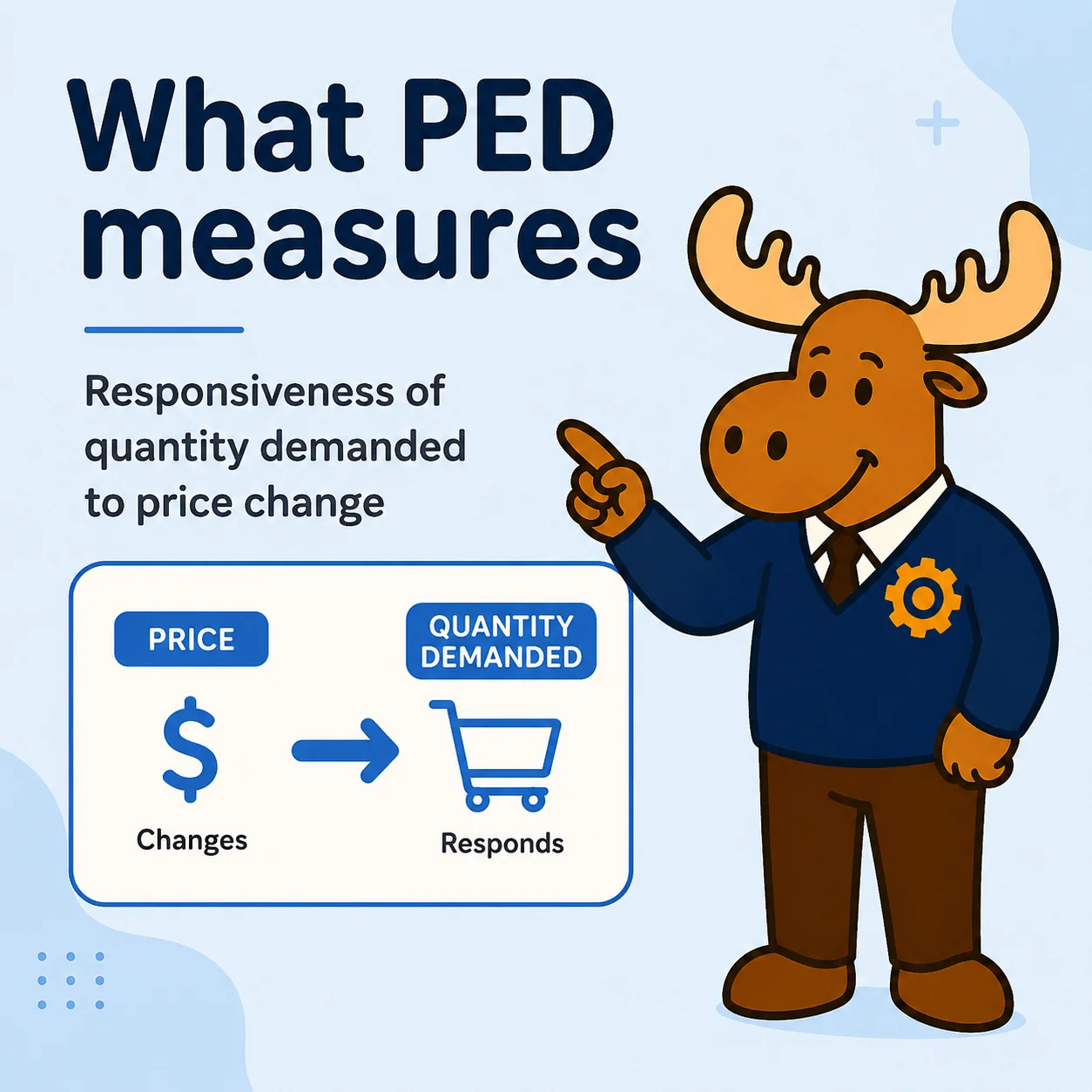
PED measures responsiveness along a demand curve. This is important. A change in the price of the good itself causes a movement along the demand curve, not a shift of the demand curve.
In a demand diagram, price is on the vertical axis and quantity is on the horizontal axis. The demand curve slopes downward because, ceteris paribus, a lower price leads to a higher quantity demanded.
If the price falls, there is an extension of demand: movement down along the demand curve. If the price rises, there is a contraction of demand: movement up along the demand curve.
PED measures how large that movement in quantity demanded is relative to the change in price. It does not measure what happens when income, tastes, advertising or the price of another good changes. Those factors shift demand instead.
You can connect this to the demand curve and the broader concept of elasticity.
Elastic and inelastic demand
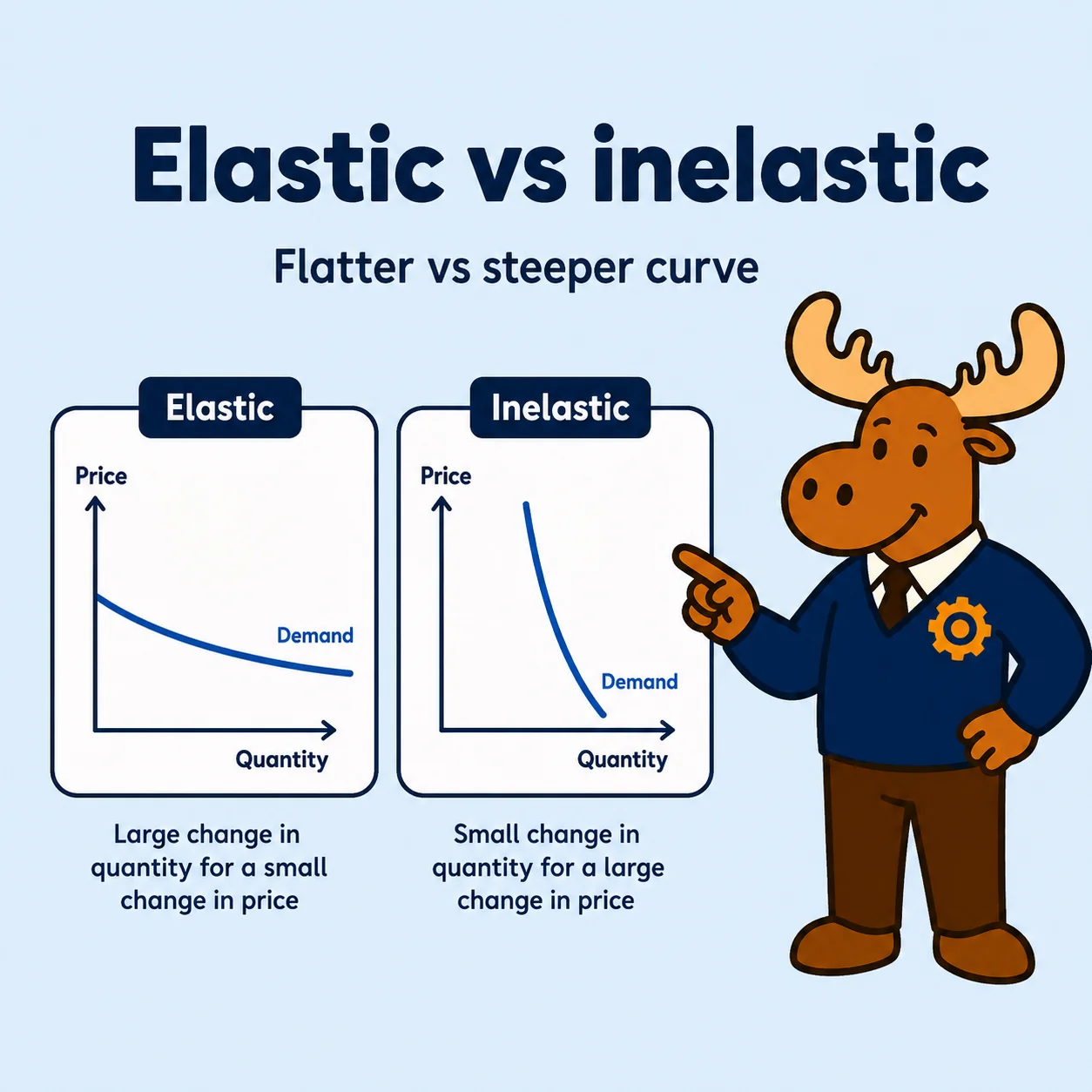
Demand is price elastic when quantity demanded responds proportionally more than price. This means the absolute value of PED is greater than 1.
For example, if price increases by 10 percent and quantity demanded falls by 25 percent, demand is elastic. Consumers are highly responsive to the price change.
Demand is price inelastic when quantity demanded responds proportionally less than price. This means the absolute value of PED is less than 1.
For example, if price increases by 10 percent and quantity demanded falls by 3 percent, demand is inelastic. Consumers are not very responsive to the price change.
Unit elastic demand occurs when quantity demanded changes by the same proportion as price. PED has an absolute value of 1.
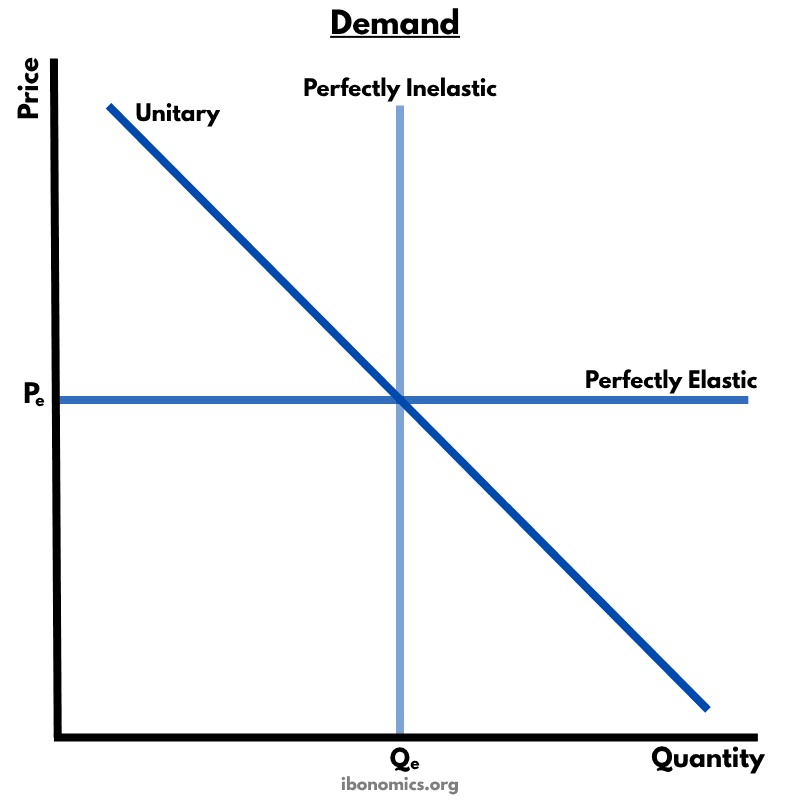
Perfectly elastic and perfectly inelastic demand are special cases. Perfectly elastic demand is shown as a horizontal demand curve, where consumers buy at one price but nothing above it. Perfectly inelastic demand is shown as a vertical demand curve, where quantity demanded does not change when price changes.
In most real-world IB examples, you will discuss elastic or inelastic demand rather than perfect elasticity.
Determinants of PED
The price elasticity of demand for a good depends on several factors. These determinants help explain why some goods have elastic demand while others have inelastic demand.
The availability of substitutes is usually the most important determinant. If a good has many close substitutes, demand is more elastic because consumers can switch away when price rises. For example, one brand of bottled water may have elastic demand because consumers can easily choose another brand.
The degree of necessity also matters. Necessities tend to have more inelastic demand because consumers continue buying them even when prices rise. Luxury goods tend to have more elastic demand because consumers can delay or avoid buying them.
The proportion of income spent on the good affects responsiveness. Goods that take up a small share of income, such as salt or matches, often have inelastic demand. Goods that take up a large share of income, such as cars or holidays, tend to have more elastic demand.
Time is also important. Demand is usually more inelastic in the short run because consumers need time to adjust. Over time, they may find substitutes, change habits or switch technologies. For example, demand for petrol may be inelastic in the short run, but more elastic in the long run if consumers buy electric cars or use public transport.
You can explore these factors in the determinants of PED.
PED and total revenue
PED is especially important for firms because it affects total revenue. Total revenue is calculated as price multiplied by quantity sold.
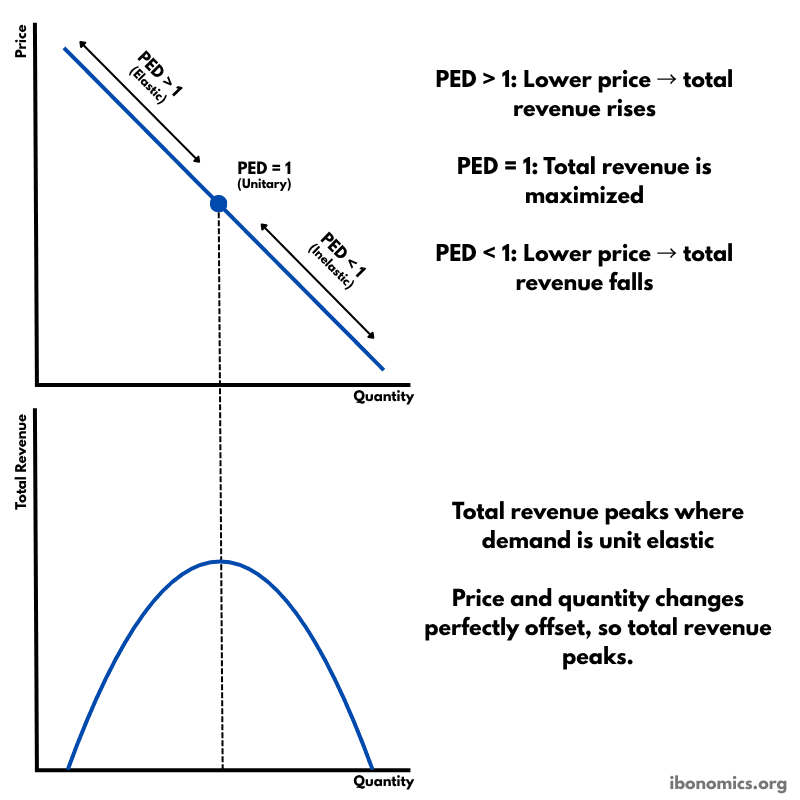
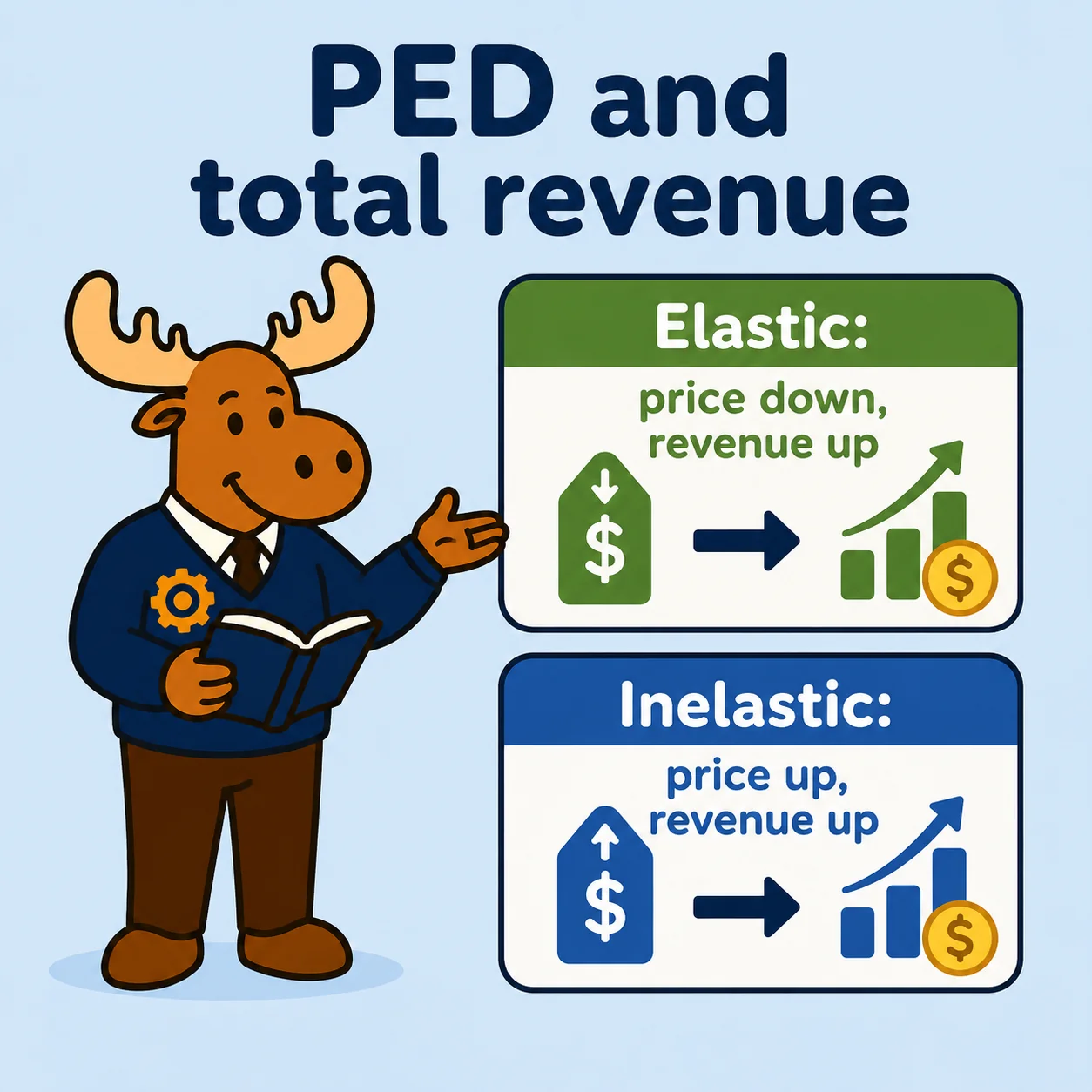
If demand is price elastic, a price increase causes quantity demanded to fall proportionally more than price rises. Total revenue decreases. A price decrease causes quantity demanded to rise proportionally more than price falls. Total revenue increases.
If demand is price inelastic, a price increase causes quantity demanded to fall proportionally less than price rises. Total revenue increases. A price decrease causes quantity demanded to rise proportionally less than price falls. Total revenue decreases.
This is why firms care about PED before changing prices. A business selling a good with elastic demand may be cautious about raising prices because consumers could switch to substitutes. A business selling a good with inelastic demand may have more pricing power, although it still needs to consider competition, reputation and fairness.
For IB exams, this relationship is often tested because it connects a numerical elasticity concept to real business decisions.
PED along a demand curve
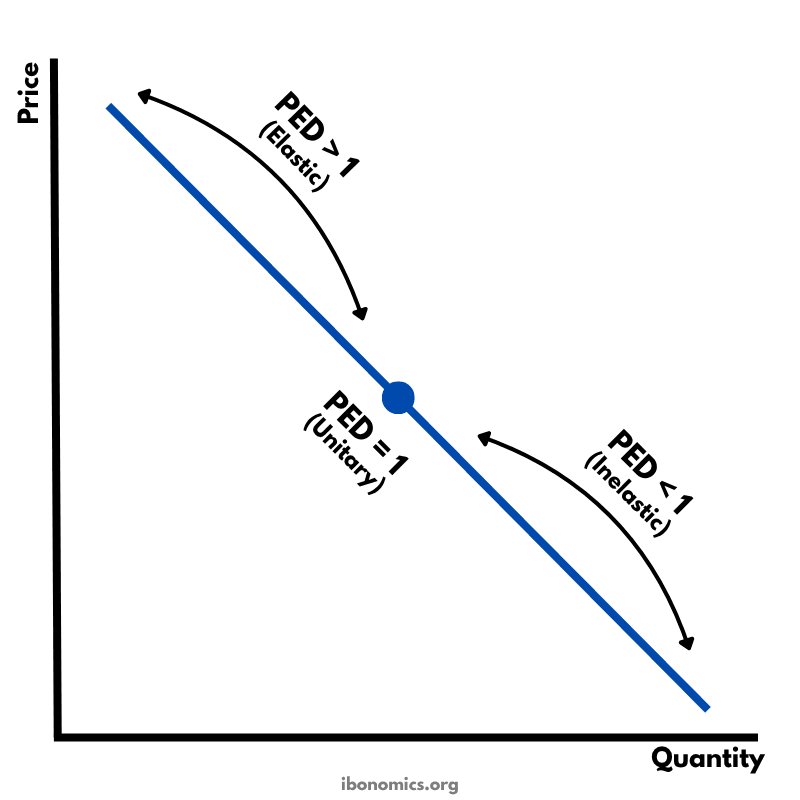
For Higher Level students, PED can change along a straight-line demand curve. This can feel confusing because the slope of the demand curve may stay constant, but elasticity changes.
The reason is that PED uses percentage changes, not absolute changes. At high prices and low quantities, a given price change may be a small percentage of price, while the quantity change may be a large percentage of quantity. Demand is more elastic.
At low prices and high quantities, the same absolute price change may be a large percentage of price, while the quantity change may be a small percentage of quantity. Demand is more inelastic.
This means slope and elasticity are not the same thing. Slope measures the absolute change between price and quantity. Elasticity measures proportional responsiveness.
Higher Level students can review this through changing PED along a demand curve.
Why PED matters for governments
Governments use PED when designing indirect taxes, subsidies and public health policies.
If demand for a good is price inelastic, an indirect tax may raise significant government revenue because quantity demanded falls only slightly. This is one reason governments often tax goods such as cigarettes, alcohol and fuel. However, if the aim is to reduce consumption, an inelastic demand curve means the tax may have only a limited effect on quantity consumed.
If demand is price elastic, a tax may reduce consumption more significantly, but it may raise less revenue because quantity demanded falls strongly.
PED is also relevant for subsidies. If demand is elastic, a subsidy that lowers price may lead to a relatively large increase in quantity demanded. If demand is inelastic, the increase in consumption may be smaller.
However, governments also need to consider equity. Taxes on goods with inelastic demand can be regressive if low-income households spend a larger share of their income on those goods. This is why PED should be used together with evaluation, not as a complete answer by itself.
This wider policy relevance is covered in the importance of PED for firms and government.
IB exam relevance and common mistakes
PED is highly exam-relevant because it can appear in definitions, calculations, diagrams, data-response questions and evaluation.
A strong IB answer should define PED accurately, use the formula correctly, interpret the value and apply it to a real market. If a question asks about a firm raising prices, you should explain whether demand is elastic or inelastic and what this means for total revenue.
A common mistake is forgetting that PED is usually negative. Since price and quantity demanded move in opposite directions, the calculated value normally has a negative sign. However, when classifying elasticity, students often refer to the absolute value.
Another common mistake is confusing a shift in demand with a movement along demand. PED measures responsiveness to a change in the price of the good itself, so it involves movement along the demand curve. It does not measure a demand shift caused by income, tastes or substitute prices.
Students also sometimes confuse elasticity with slope. A steep demand curve is often relatively inelastic, and a flat demand curve is often relatively elastic, but slope and elasticity are not identical. This matters especially for HL analysis of PED along a straight-line demand curve.
Finally, avoid saying that inelastic demand means quantity demanded does not change at all. Inelastic demand means quantity demanded changes proportionally less than price. Only perfectly inelastic demand means quantity demanded does not change.
Evaluation: PED is useful but not perfect
PED is powerful because it helps predict how consumers respond to price changes. Firms can use it to make pricing decisions. Governments can use it to estimate tax revenue and changes in consumption.
However, PED estimates are not always precise. Consumer behaviour may change over time. The availability of substitutes may increase. Brand loyalty may weaken. Incomes may change. A good that is inelastic in the short run may become more elastic in the long run.
PED also does not tell us whether a policy is fair or socially desirable. A tax on cigarettes may reduce consumption and raise revenue, but it may also affect low-income consumers more heavily. A firm may raise prices when demand is inelastic, but this could damage its reputation or invite competition later.
In IB Economics, PED should therefore be used as part of a wider analysis. It helps explain likely effects, but evaluation should consider time periods, stakeholders, market structure and the purpose of the policy or pricing decision.
Conclusion
Price elasticity of demand measures how responsive quantity demanded is to a change in price. If demand is elastic, consumers respond strongly. If demand is inelastic, consumers respond weakly.
PED matters because it links consumer behaviour to real market outcomes. It helps firms predict total revenue, helps governments design taxes and subsidies, and helps IB students evaluate how price changes affect consumers, producers and society.
The strongest answers do more than calculate PED. They interpret the value, connect it to diagrams and explain why responsiveness depends on substitutes, necessity, income share and time.
Related syllabus topics
Elasticities of Demand
Unit 2.5: Elasticities of Demand
Concept of Elasticity
Unit 2.5: Elasticities of Demand
Price Elasticity of Demand (PED)
Unit 2.5: Elasticities of Demand
Changing PED Along a Demand Curve (HL Only)
Unit 2.5: Elasticities of Demand
Determinants of PED
Unit 2.5: Elasticities of Demand
PED and Total Revenue
Unit 2.5: Elasticities of Demand