IBonomics
The Circular Economy and Sustainable Resource Use
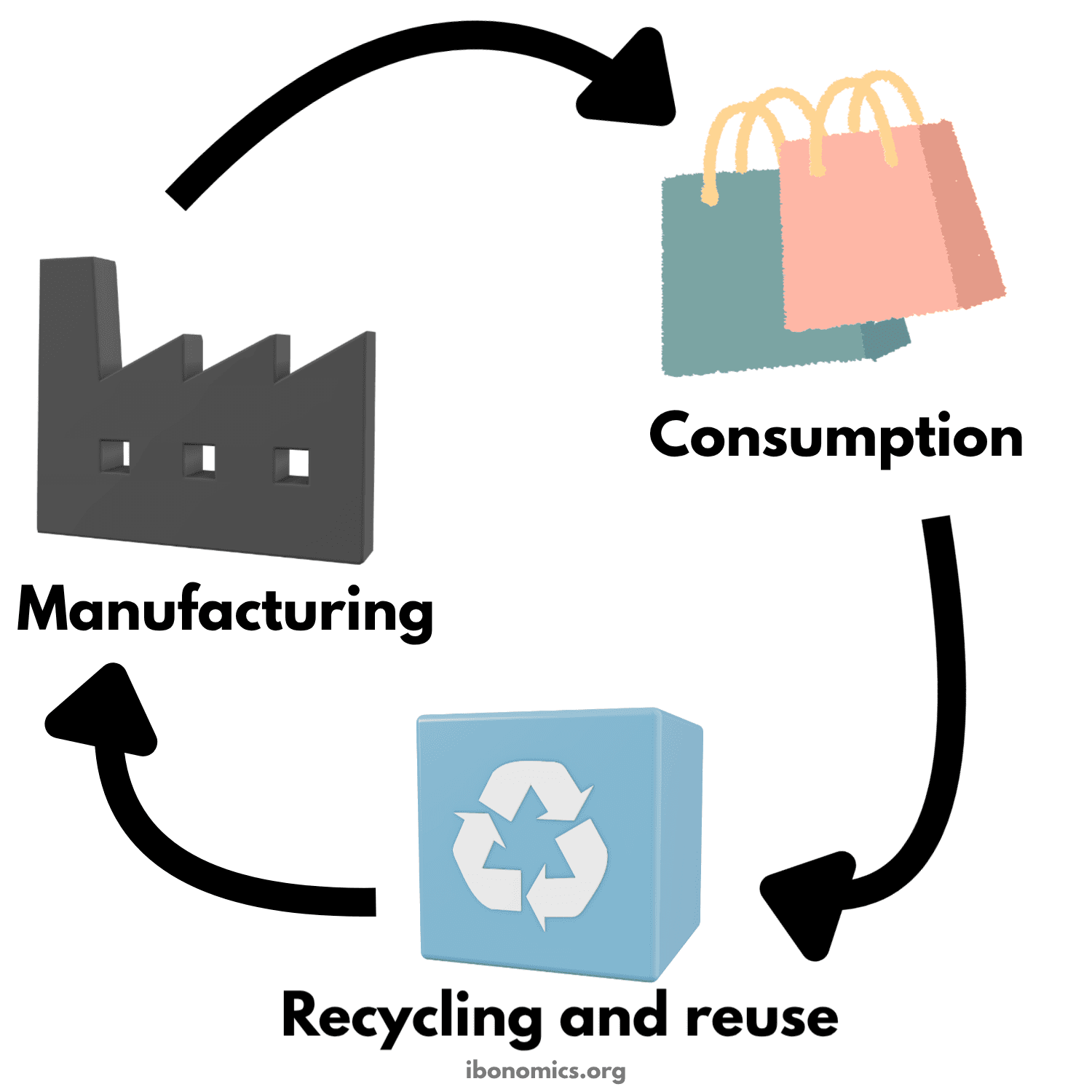
This diagram shows the circular economy, an economic system in which resources are kept in use for as long as possible. Goods are manufactured, consumed and then recycled or reused, so their materials return to production instead of being thrown away.
Curves and elements
- Manufacturing
- Firms turn raw materials and recovered materials into goods, designed to last and to be easy to repair or recycle.
- Consumption
- Households buy and use the goods until they no longer need them.
- Recycling and reuse
- Used products are repaired, passed on or broken down into materials, which go back into manufacturing.
- Arrows
- The direction of the cycle, from manufacturing to consumption, then to recycling and reuse, and back to manufacturing.
Key explanations
- 1
In a circular economy, raw materials, components and other resources are used sustainably to produce goods and services. The aim is to keep resources in use rather than use them once and discard them.
- 2
Manufacturing turns resources into goods. Firms design products so that they last longer and can be repaired, reused or recycled at the end of their life.
- 3
Consumption is where households use the goods. When a product is no longer wanted, it is passed on, returned or collected rather than thrown away.
- 4
Recycling and reuse send the materials back to manufacturing, so the cycle starts again. This reduces the need for new raw materials and the amount of waste that ends up in landfill.
- 5
This differs from a linear economy, where resources are extracted, made into products, used and then thrown away. The circular model relies on a shift to green and renewable energy, and over the long term it aims to create economic opportunities that also benefit the environment and society.
- 6
It is not the same as the circular flow of income, which shows flows of money, goods and factors of production between households and firms. The circular economy is about how physical resources are used and used again.
Example exam question
Using a diagram, explain how a circular economy can make the use of resources more sustainable.
Show example answer
A circular economy is an economic system in which resources are used sustainably to produce output. In the diagram, goods are manufactured, consumed and then recycled or reused, and the recovered materials go back into manufacturing. Because materials are used again, fewer new raw materials need to be extracted and less waste is created. This differs from a linear economy, where products are made, used and thrown away. Firms support the cycle by designing products that last longer and are easier to repair or recycle, and a shift to renewable energy reduces the environmental cost of production. Over the long term, this allows economic activity to continue while protecting natural resources for future generations.