IBonomics
Classical View of Government Spending – Higher Prices but No Lasting Growth
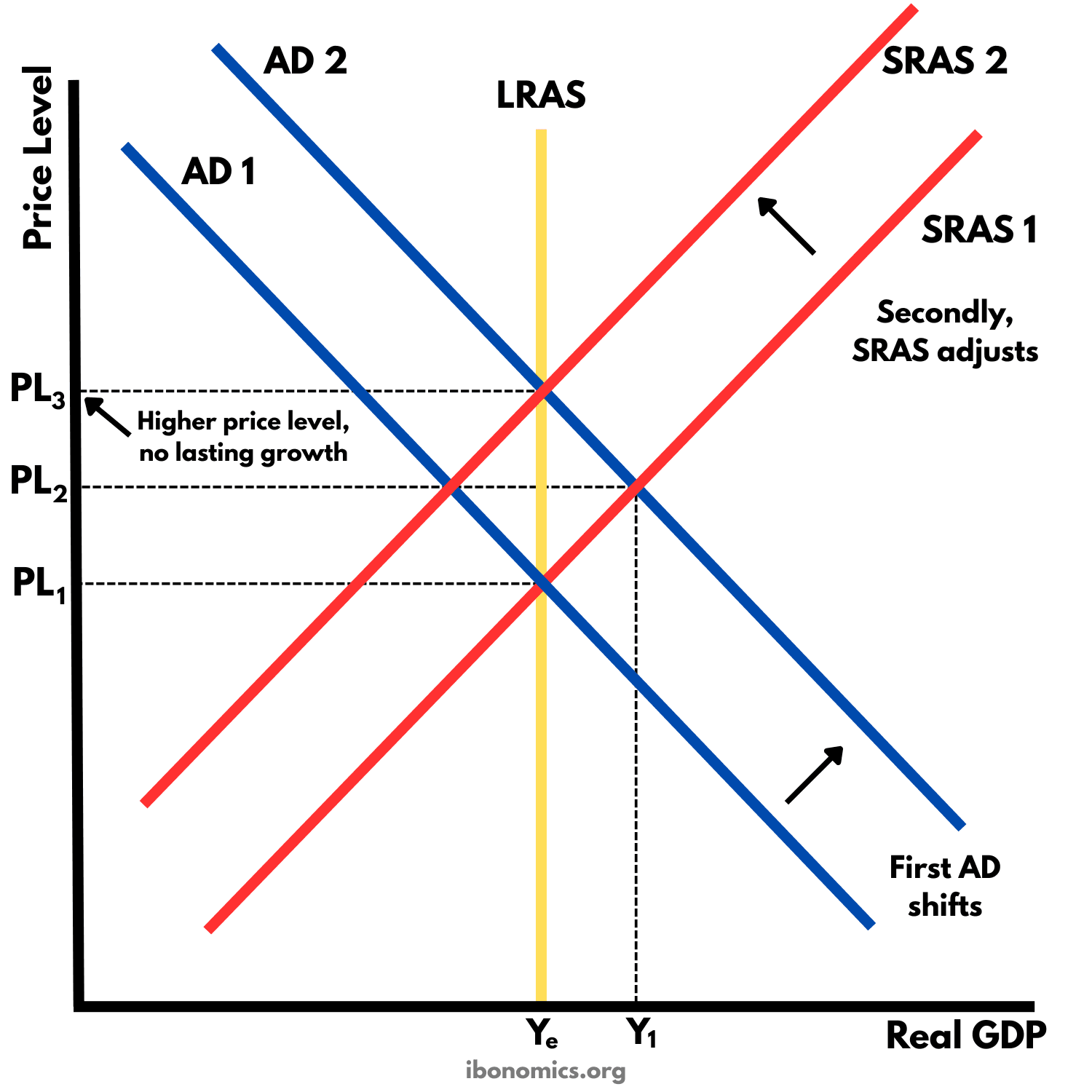
This diagram shows the new classical view of an increase in government spending when the economy is already at full employment. In the short run, AD rises and real GDP goes above Ye. In the long run, wages and other costs rise, SRAS shifts left, and real GDP returns to Ye at a higher price level, so the spending raises prices but not output.
Curves and elements
- AD 1
- Aggregate demand before the increase in government spending.
- AD 2
- Aggregate demand after the increase in government spending, shifted right.
- SRAS 1
- Short-run aggregate supply at the original level of wages and costs.
- SRAS 2
- Short-run aggregate supply after wages and other costs have risen, shifted left.
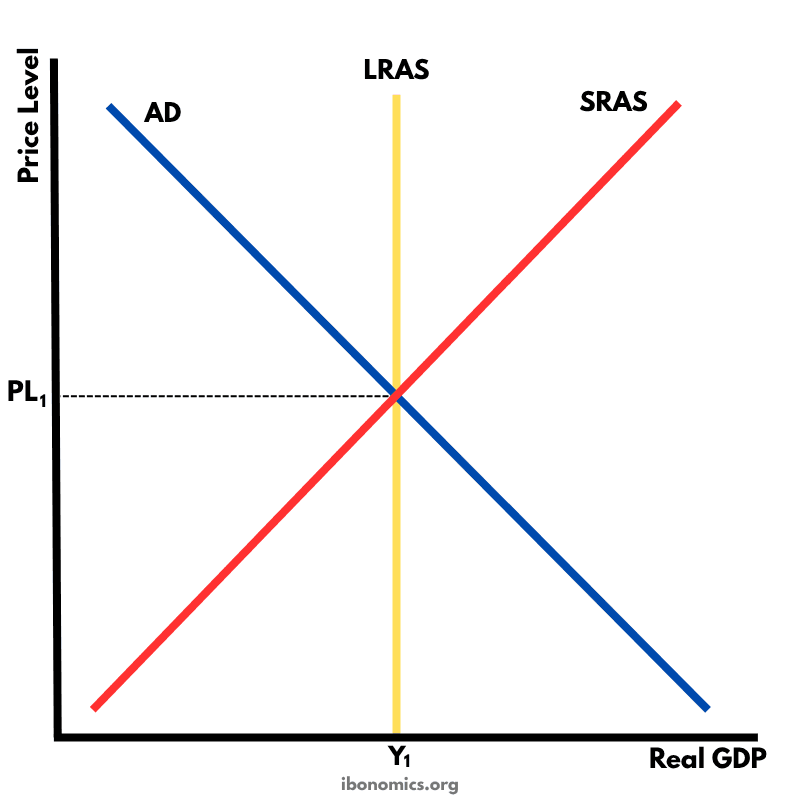
- LRAS
- Long-run aggregate supply, vertical at Ye. It does not move, because the spending adds nothing to productive capacity.
- PL1
- The starting price level, where AD 1 meets SRAS 1 on LRAS.
- PL2
- The short-run price level, where AD 2 meets SRAS 1.
- PL3
- The long-run price level, where AD 2 meets SRAS 2 on LRAS.
- Ye
- The full employment level of output, where the economy starts and ends.
- Y1
- Real GDP in the short run, above full employment.
- Higher price level, no lasting growth
- The long-run result. The price level ends at PL3, above PL1, while real GDP is back at Ye.
Key explanations
- 1
The economy starts in long-run equilibrium at Ye and PL1, where AD 1 meets SRAS 1 on the vertical LRAS curve.
- 2
The government increases its spending on things that do not add to the economy's productive capacity, such as day-to-day running costs. This raises aggregate demand from AD 1 to AD 2.
- 3
In the short run, firms respond to the extra demand by producing more, so real GDP rises from Ye to Y1 and the price level rises to PL2. Output is now above full employment, which opens an inflationary gap.
- 4
Workers and firms see that prices have risen and that labour is scarce, so wages and other costs rise. SRAS shifts left from SRAS 1 to SRAS 2.
- 5
The economy returns to LRAS at Ye, but at the higher price level PL3. In the long run, the extra spending has raised the price level without any lasting increase in real GDP.
- 6
New classical economists conclude that demand-side policy cannot keep output above its full employment level. Only policies that increase productive capacity, such as spending on education or infrastructure, shift LRAS and raise output for good.
- 7
Keynesian economists disagree when the economy starts below full employment. With spare capacity, higher government spending can raise real GDP with little inflation. New classical economists reply that the economy would recover on its own, and that the spending may crowd out private investment.
Example exam question
Using an AD/AS diagram, explain why new classical economists argue that an increase in government spending will not raise real GDP in the long run.
Show example answer
In the diagram, the economy starts at full employment, at Ye and PL1, where AD 1 meets SRAS 1 on LRAS. An increase in government spending that does not add to productive capacity shifts aggregate demand from AD 1 to AD 2. In the short run, real GDP rises to Y1 and the price level to PL2, creating an inflationary gap. Because output is above its sustainable level, workers demand higher wages and firms' costs rise, so SRAS shifts left from SRAS 1 to SRAS 2. The economy returns to Ye at the higher price level PL3. In the long run, the extra spending has only raised the price level, so new classical economists argue that demand-side policy cannot increase output beyond the full employment level. Only supply-side improvements that shift LRAS can do that.