IBonomics
Commodity Price Volatility – Inelastic Demand and Supply
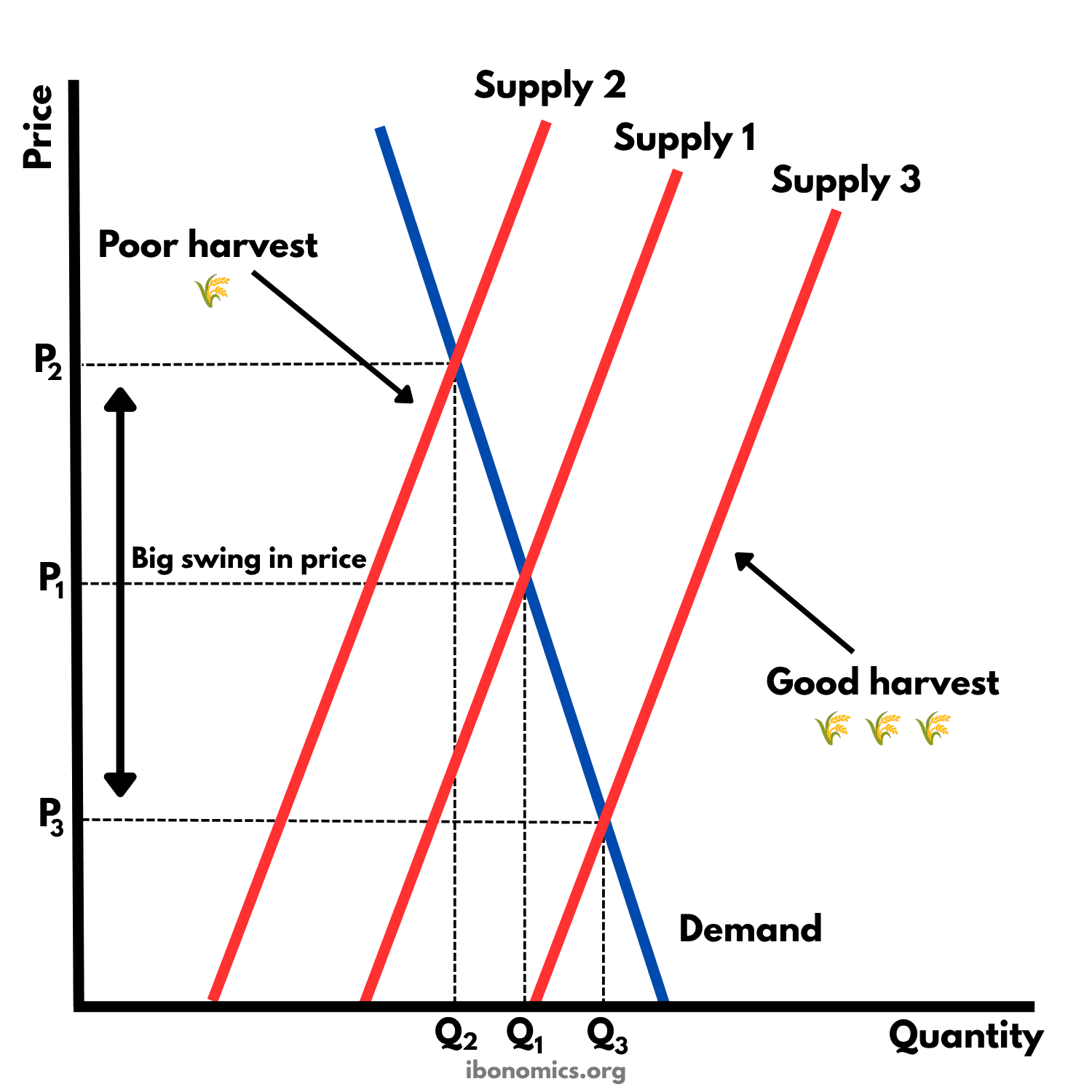
This diagram shows why the prices of primary commodities, such as wheat or coffee, are so volatile. Demand and supply are both price inelastic, so when a poor or good harvest shifts supply, the price swings a long way while the quantity sold changes only a little.
Curves and elements
- Demand
- Price inelastic, because commodities such as food and energy are necessities with few substitutes. A change in price changes the quantity demanded only a little.
- Supply 1
- Supply in a normal year. All three supply lines meet the quantity axis rather than the price axis, which makes them price inelastic, because output takes a long time to change.
- Supply 2
- Supply after a poor harvest, shifted left.
- Supply 3
- Supply after a good harvest, shifted right.
- Poor harvest
- Bad weather, pests or disease cut output, so supply shifts left from Supply 1 to Supply 2.
- Good harvest
- Good weather or higher yields raise output, so supply shifts right from Supply 1 to Supply 3.
- P1
- The price in a normal year, where Demand meets Supply 1.
- P2
- The price after a poor harvest, far above P1.
- P3
- The price after a good harvest, far below P1.
- Big swing in price
- The range from P3 to P2. It is large compared with the change in quantity, because both demand and supply are inelastic.
- Quantity effect
- The quantity sold changes only a little, from Q1 to Q2 after a poor harvest and from Q1 to Q3 after a good one.
Key explanations
- 1
The market for a primary commodity, such as wheat, starts in equilibrium at P1 and Q1, where Demand meets Supply 1. Both demand and supply are price inelastic.
- 2
Demand is price inelastic because many commodities, such as food and energy, are necessities with few substitutes. When the price changes, consumers change the amount they buy only a little.
- 3
Supply is price inelastic because output takes a long time to change. Crops have to be planted and grown, and new mines or plantations take years to open, so producers cannot respond quickly to a change in price.
- 4
A poor harvest, caused by drought or disease, shifts supply left from Supply 1 to Supply 2. Consumers keep buying almost as much, so the price rises sharply from P1 to P2 while the quantity falls only from Q1 to Q2.
- 5
A good harvest shifts supply right from Supply 1 to Supply 3. Consumers will buy only a little more, so the price has to fall sharply from P1 to P3 before the extra output is sold, and the quantity rises only from Q1 to Q3.
- 6
Harvests vary from year to year, so the price swings between levels such as P2 and P3. Manufactured products usually have more elastic demand and supply, so the same shifts would cause much smaller price changes.
- 7
Volatile prices make the incomes of farmers and miners unpredictable, which makes it hard for them to plan and invest. Because demand is inelastic, a good harvest can even lower farmers' total revenue, since the price falls by proportionally more than the quantity rises. Economies that depend on exporting a few primary commodities face the same uncertainty in their export revenue, which is a barrier to growth and development.
Example exam question
Using a diagram, explain why the prices of primary commodities tend to be more volatile than the prices of manufactured products.
Show example answer
Primary commodities such as wheat have price inelastic demand, because they are necessities with few substitutes, and price inelastic supply, because crops and mines take a long time to expand or cut back. In the diagram the market starts at P1 and Q1. A poor harvest shifts supply left from Supply 1 to Supply 2, and because consumers keep buying almost as much, the price rises sharply to P2 while the quantity falls only to Q2. A good harvest shifts supply right to Supply 3, and the price has to fall sharply to P3 before consumers buy the extra output. Since harvests vary from year to year, the price swings between levels such as P2 and P3. Manufactured products usually have more elastic demand and supply, so similar shifts cause much smaller price changes. This volatility makes the incomes of producers, and the export revenue of economies that depend on commodities, hard to predict.