IBonomics
Crowding Out – Government Borrowing in the Loanable Funds Market
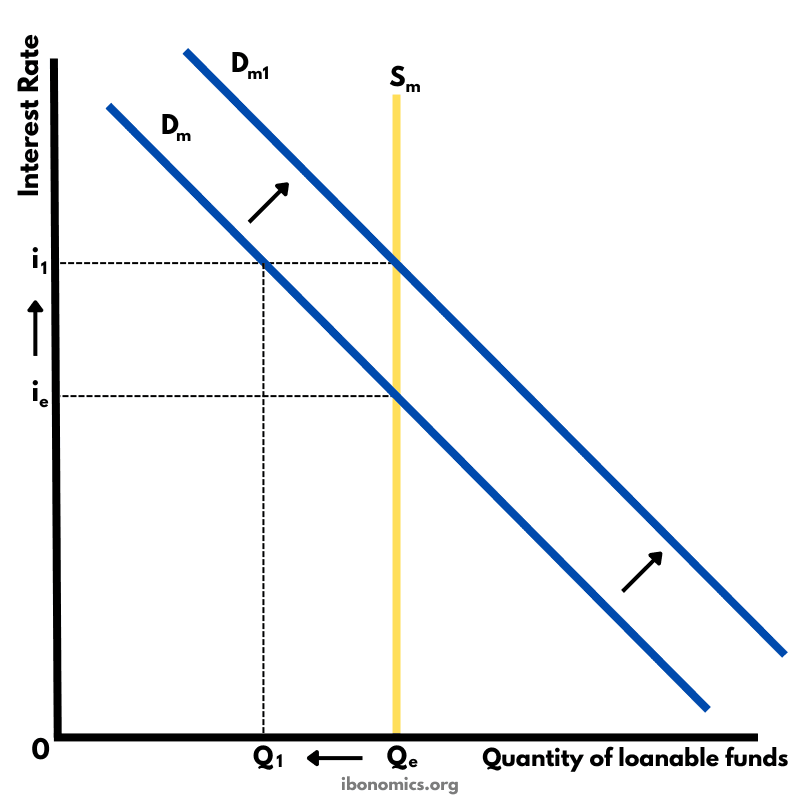
This diagram shows how government borrowing to finance a budget deficit raises the interest rate in the loanable funds market, which reduces borrowing for private investment.
Curves and elements
- Dm
- The demand for loanable funds from private borrowers, mainly firms that want to invest.
- Dm1
- The demand for loanable funds once the government borrows as well. It lies further right by the amount the government borrows.
- Sm
- The supply of loanable funds, which comes from savings. It is vertical because the amount saved is fixed at a point in time.
- ie
- The initial equilibrium interest rate, before the government borrows.
- i1
- The higher interest rate after government borrowing raises demand.
- Qe
- The initial quantity of loanable funds, all borrowed by private firms. Total borrowing stays at Qe after the government borrows, because the supply is fixed.
- Q1
- Private borrowing at i1. The gap between Q1 and Qe is the private investment crowded out.
Key explanations
- 1
In this market, Sm is the supply of loanable funds, which comes from the economy's savings, and Dm is the demand for them from private borrowers. The price of loanable funds is the interest rate, and the market starts in equilibrium at ie and Qe.
- 2
The supply is vertical because the amount saved is fixed at any point in time.
- 3
When the government runs a budget deficit, it borrows to finance it. Its borrowing adds to the demand for loanable funds, so demand shifts right from Dm to Dm1 and the interest rate rises from ie to i1.
- 4
Total borrowing stays at Qe, because the supply cannot increase. At the higher rate i1, private firms borrow only Q1, so the government's borrowing has taken the funds between Q1 and Qe away from private investment. This fall in private investment is crowding out.
- 5
Crowding out limits the effect of expansionary fiscal policy on aggregate demand, because the rise in government spending is offset by lower private investment. With a fixed supply of savings, the offset here is complete. In practice a higher interest rate encourages some extra saving, so crowding out is usually partial.
Example exam question
Using a loanable funds diagram, explain how government borrowing may crowd out private investment.
Show example answer
When a government finances a budget deficit by borrowing, it adds to the demand for loanable funds, so demand shifts right from Dm to Dm1. The supply of loanable funds (Sm) comes from savings and is fixed at a point in time, so the interest rate rises from ie to i1 instead of total borrowing increasing. At the higher interest rate, private firms borrow only Q1 instead of Qe, because fewer investment projects are profitable when borrowing costs more. Private investment therefore falls as government borrowing rises. This is crowding out, and it reduces the effect of expansionary fiscal policy on aggregate demand, since some or all of the rise in government spending is offset by lower private investment.