IBonomics
Cyclical Unemployment – A Fall in Demand with Sticky Wages
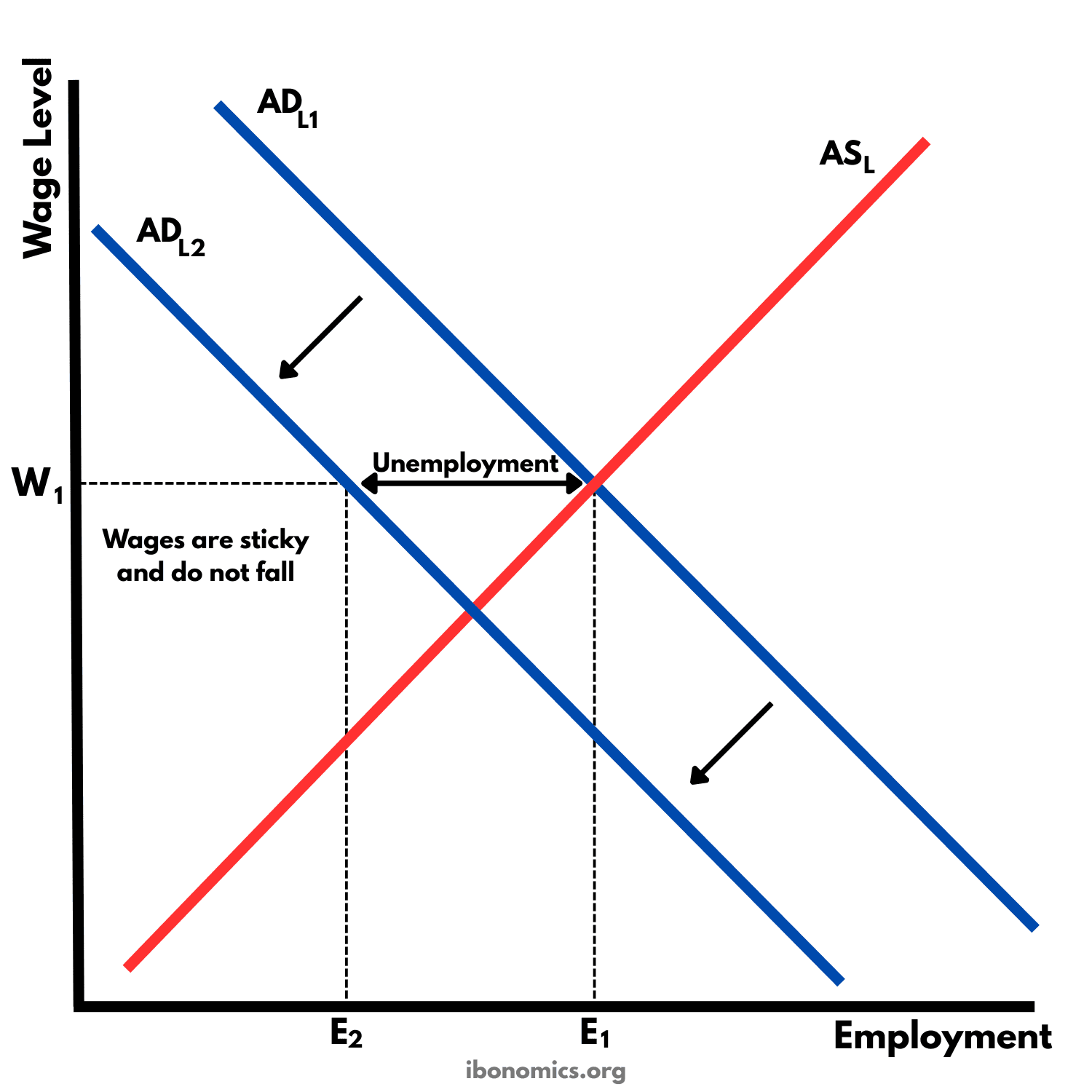
This diagram shows cyclical, or demand-deficient, unemployment. When aggregate demand falls in a downturn, firms need fewer workers, so the demand for labour falls from ADL1 to ADL2. Wages are sticky and stay at W1, so employment falls to E2 while the number of people willing to work at W1 stays at E1.
Curves and elements
- ADL1
- The demand for labour before aggregate demand falls.
- ADL2
- The demand for labour after aggregate demand falls. Firms need fewer workers at every wage, so the curve shifts left.
- ASL
- The supply of labour, the number of people willing to work at each wage.
- W1
- The wage, which stays at its original level because wages are sticky downward.
- E1
- Employment before the fall in demand, and the number of people still willing to work at W1.
- E2
- Employment after the fall in demand, where ADL2 meets the W1 line.
- Unemployment
- The gap between E2 and E1 at W1. These workers want jobs at the going wage, but firms no longer need them.
- Wages are sticky and do not fall
- Contracts, minimum wages and resistance to pay cuts stop the wage falling to where ADL2 meets ASL, which would have cleared the market.
Key explanations
- 1
Cyclical unemployment is caused by a fall in aggregate demand, usually in a recession. With less spending in the economy, firms produce less and need fewer workers.
- 2
The demand for labour comes from the demand for the goods and services workers produce, so it falls too, and the labour demand curve shifts left from ADL1 to ADL2.
- 3
Wages are sticky downward. Contracts, minimum wages and workers' resistance to pay cuts keep the wage at W1, rather than letting it fall to where ADL2 meets ASL.
- 4
At W1, firms now employ only E2 workers, while E1 workers are still willing to work at that wage. The gap between E2 and E1 is cyclical unemployment.
- 5
Unlike structural unemployment, it affects workers across the whole economy rather than in one industry, and it falls again when aggregate demand recovers.
- 6
Because the cause is too little demand, the usual remedy is demand-side policy, such as expansionary fiscal policy or lower interest rates. These raise aggregate demand and shift the demand for labour back to the right.
Example exam question
Using a labour market diagram, explain how a fall in aggregate demand can cause cyclical unemployment.
Show example answer
Cyclical unemployment is caused by a fall in aggregate demand, for example in a recession. As spending falls, firms cut output and need fewer workers, so the demand for labour, which comes from the demand for goods and services, shifts left from ADL1 to ADL2. Wages are sticky downward because of contracts, minimum wages and resistance to pay cuts, so the wage stays at W1. At W1, firms employ only E2 workers, but E1 workers still want to work, so E1 − E2 workers are unemployed. This is cyclical unemployment. The government can reduce it with expansionary fiscal or monetary policy, which raises aggregate demand and shifts the demand for labour back to the right.