IBonomics
Doughnut Economics – Meeting Everyone's Needs Within the Planet's Limits
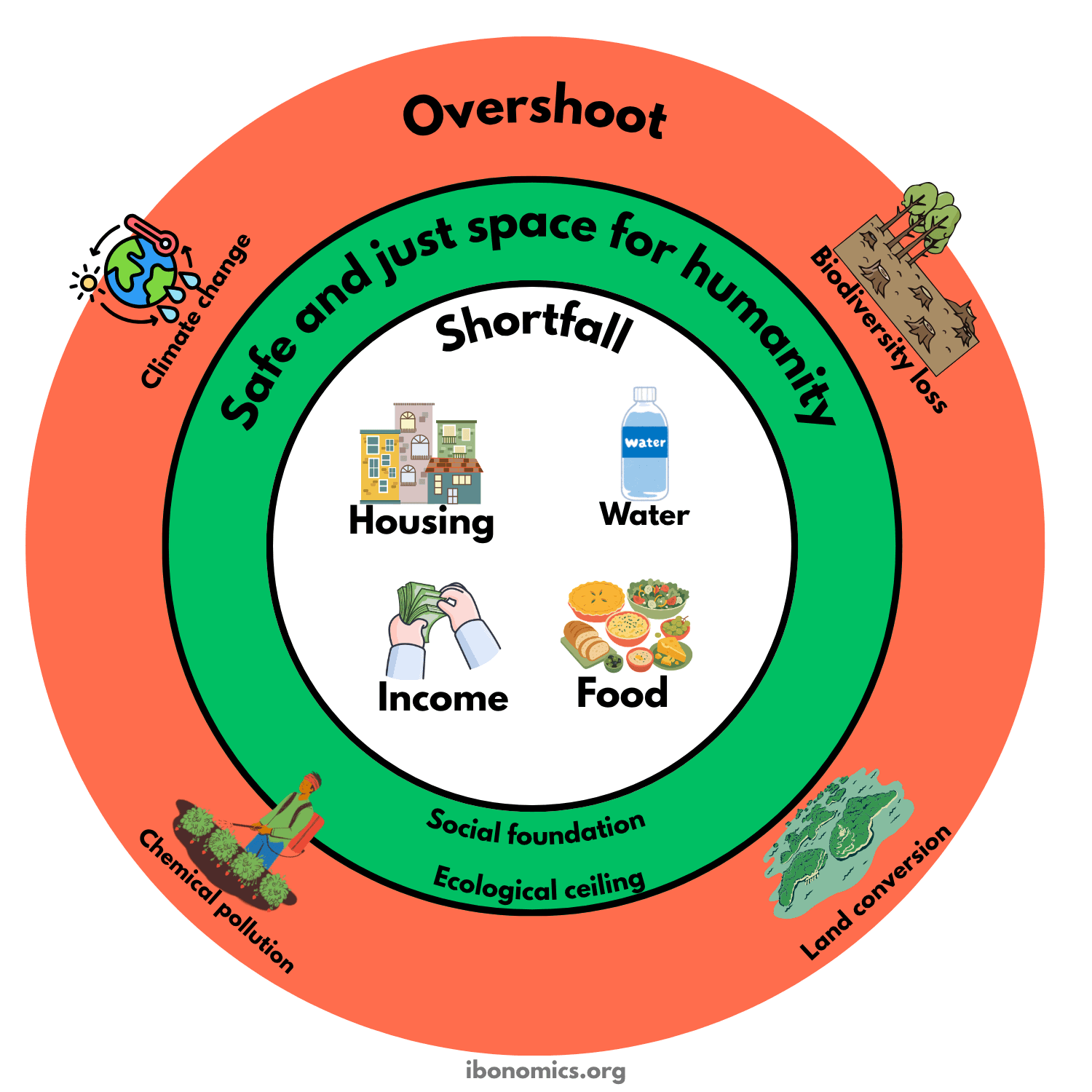
This diagram shows Kate Raworth's doughnut. Its inner edge, the social foundation, is the minimum everyone needs for a decent life, and its outer edge, the ecological ceiling, is the limit of what the planet can safely take. The green ring between them is the safe and just space for humanity, where an economy should aim to be. Falling below the foundation is a shortfall, and going past the ceiling is overshoot.
The English economist Kate Raworth first drew the doughnut in a 2012 paper for Oxfam and set it out in her 2017 book Doughnut Economics. Its ecological ceiling uses the planetary boundaries of Johan Rockström and others (2009), and studies in 2022 and 2023 found that the boundary for chemical pollution has also been crossed.
Curves and elements
- Social foundation
- The inner edge of the green ring. It marks the minimum everyone needs for a decent life, such as enough food, clean water, housing and income.
- Ecological ceiling
- The outer edge of the green ring. It marks the limit of the pressure the planet can safely take, such as on its climate, land and wildlife.
- Safe and just space for humanity
- The green ring between the two boundaries. It is just because everyone's needs are met, and safe because the planet's limits are respected.
- Shortfall
- The hole in the middle, inside the social foundation. People here lack some of the basics of a decent life.
- Overshoot
- The red ring outside the ecological ceiling. Here human activity puts more pressure on the planet than it can safely take.
- Housing
- A shortfall. Many people, especially in the cities of developing countries, live in slums without secure, decent housing.
- Water
- A shortfall. Many people still lack safe drinking water and proper sanitation.
- Income
- A shortfall. Many people live on incomes too low to meet their basic needs.
- Food
- A shortfall. Hundreds of millions of people don't have enough to eat.
- Climate change
- Overshoot. Greenhouse gas emissions, mostly from burning fossil fuels, have pushed the carbon dioxide in the atmosphere past its safe limit.
- Biodiversity loss
- Overshoot. Plant and animal species are dying out far faster than the natural rate, mainly as their habitats are cleared and polluted.
- Land conversion
- Overshoot. So much forest and other natural land has been cleared for farms, roads and cities that the planet's ability to regulate its climate and water is at risk.
- Chemical pollution
- Overshoot. Pesticides, plastics and other chemicals made by people are released faster than their effects can be tested and controlled.
Key explanations
- 1
Doughnut economics is one of the new ways of thinking about the economy in the IB course, alongside the circular economy. Instead of aiming for ever higher GDP, it judges an economy by whether it meets everyone's basic needs without damaging the natural systems that all life depends on.
- 2
The social foundation is the inner boundary. Raworth names twelve basic needs, taken from the United Nations' Sustainable Development Goals. They are food, water, health, education, income and work, housing, energy, networks, gender equality, social equity, political voice, and peace and justice. Anyone who lacks one of them is in the hole in the middle, in shortfall.
- 3
The ecological ceiling is the outer boundary. It uses the nine planetary boundaries identified by Johan Rockström and other Earth scientists, which are climate change, ocean acidification, chemical pollution, nitrogen and phosphorus loading, freshwater withdrawals, land conversion, biodiversity loss, air pollution and ozone layer depletion. Going past them, into overshoot, risks lasting damage to the Earth's systems that people depend on.
- 4
Today the world is in shortfall and overshoot at the same time. Hundreds of millions of people still lack enough food, clean water, decent housing or income, while humanity has already crossed several planetary boundaries, including climate change, biodiversity loss, land conversion and chemical pollution. The diagram shows four of each.
- 5
The aim is to bring everyone into the safe and just space. Raworth argues that economies should be distributive by design, so that the gains reach the people in shortfall, and regenerative by design, so that resources are reused rather than used up, as in a circular economy. She calls herself agnostic about growth, meaning that an economy should let people thrive whether or not GDP grows.
- 6
Supporters say the model makes clear that growth is a means, not an end, and puts sustainability and equity at the centre of economics. Critics say the boundaries are hard to measure, that it offers no single number to replace GDP, and that it says little about how to reach the safe space or how fast. In an IB answer, it can support an evaluation of economic growth as a goal, and of how sustainable an economy's growth is.
Example exam question
Explain how doughnut economics differs from the view that economic growth should be the main goal of an economy.
Show example answer
The traditional view judges an economy's success mainly by the growth of real GDP, because more output raises incomes and living standards. Doughnut economics, put forward by Kate Raworth, instead judges an economy by whether it meets everyone's needs within the planet's limits. Its inner boundary, the social foundation, is the minimum everyone needs for a decent life, such as enough food, water, housing and income. Its outer boundary, the ecological ceiling, is set by planetary boundaries such as a stable climate and enough land and species to sustain life. The green ring between them is the safe and just space for humanity. Falling below the social foundation is a shortfall, and going past the ecological ceiling is overshoot. Growth in GDP can reduce shortfalls by raising incomes, but if it relies on burning fossil fuels and clearing land, it pushes the economy further into overshoot, as is already happening with climate change and biodiversity loss. Raworth therefore argues that economies should be designed to share their gains with those in shortfall and to reuse resources, as in a circular economy, whether or not GDP grows. The goal of the economy becomes meeting people's needs within the planet's limits, rather than growth for its own sake.