Exchange Rate Appreciation – Increased Demand and Reduced Supply of CurrencySL
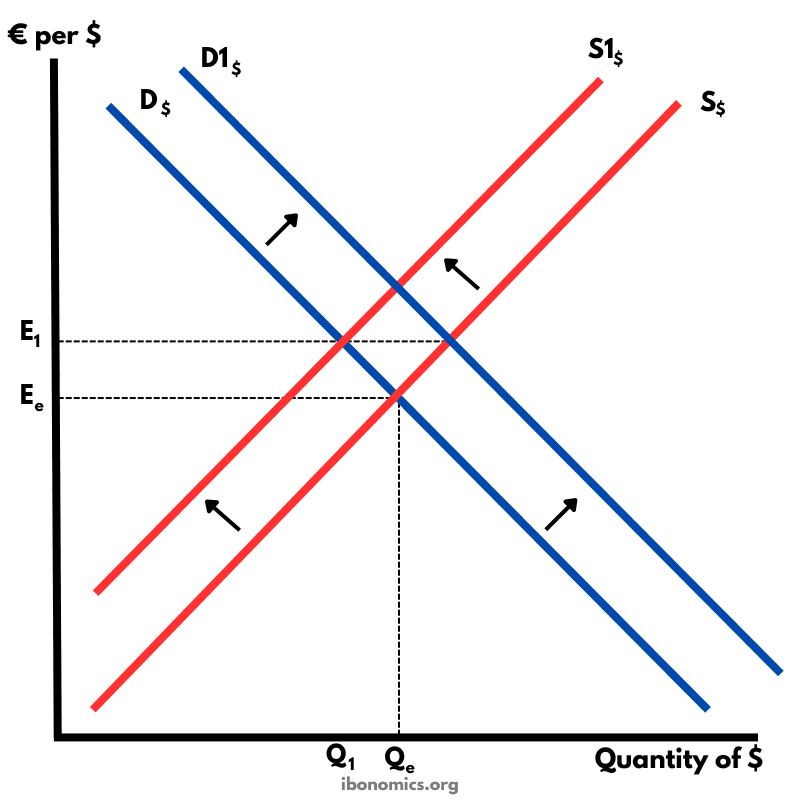
Global EconomicsThis diagram illustrates a general appreciation of a currency in the foreign exchange market. An appreciation occurs when the value of the currency rises due to an increase in demand and/or a decrease in supply of the currency.
Curves and elements
- demand currency
- Demand for the currency (D$): Downward-sloping; a rightward shift indicates higher demand at each exchange rate.
- supply currency
- Supply of the currency (S$): Upward-sloping; a leftward shift indicates fewer units supplied at each exchange rate.
- initial equilibrium
- Ee: The original equilibrium exchange rate before the shifts in demand and supply.
- new equilibrium
- E1: The higher equilibrium exchange rate after the shifts, showing currency appreciation.
Key explanations
- 1
The initial equilibrium exchange rate is shown at Ee, where demand for the currency (D$) intersects supply of the currency (S$).
- 2
An increase in demand for the currency, shown by a rightward shift from D$ to D1$, may occur due to higher foreign demand for exports, capital inflows, or higher interest rates.
- 3
A reduction in the supply of the currency, shown by a leftward shift from S$ to S1$, may occur when imports fall, meaning fewer units of the currency are sold in foreign exchange markets.
- 4
The combined effect of higher demand and lower supply leads to a higher equilibrium exchange rate (from Ee to E1).
- 5
The rise in the exchange rate represents an appreciation of the currency.
Example exam question
Using the exchange rate diagram, explain how an increase in demand and a decrease in supply can lead to a currency appreciation.
Show example answer
An appreciation occurs when demand for the currency increases and/or supply decreases. In the diagram, demand shifts right and supply shifts left, causing the equilibrium exchange rate to rise. This means the currency becomes more valuable relative to other currencies.