IBonomics
Quota Diagram – ProtectionismSL
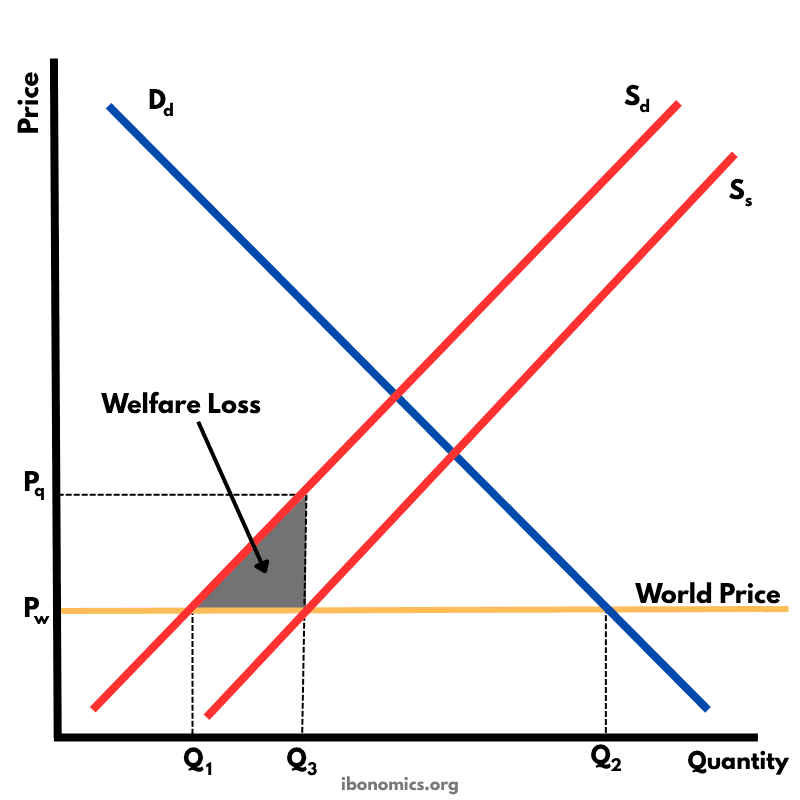
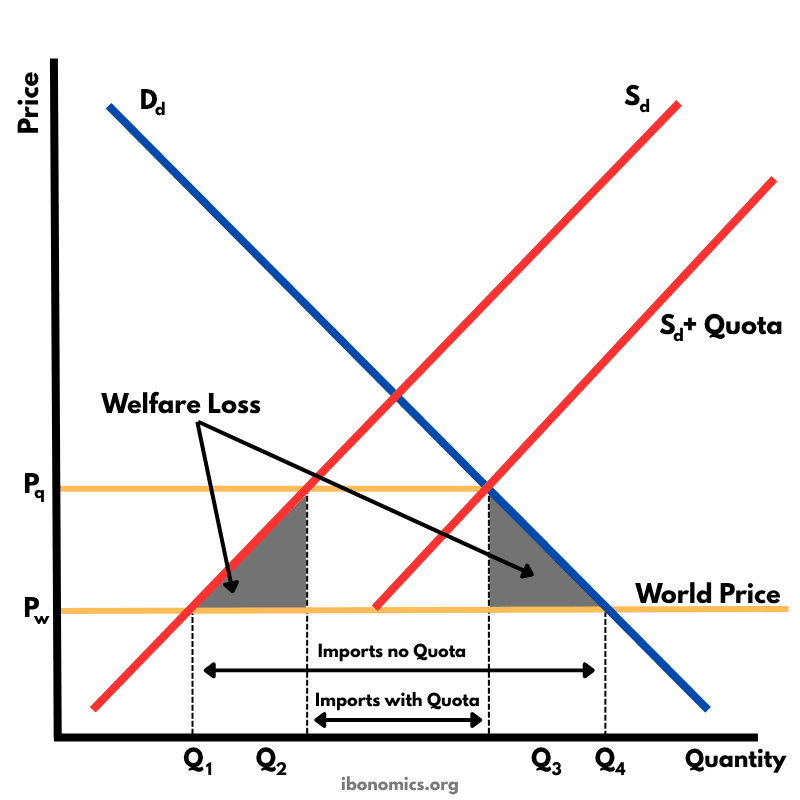
Global EconomicsThis diagram shows the impact of an import quota that limits how many units of a good can be imported. By restricting imports, the domestic price rises above the world price, domestic producers expand output, consumers buy less, and there is a net welfare loss.
Curves and elements
- dd
- Dd: Domestic demand curve for the good.
- sd
- Sd: Original domestic supply curve.
- sd quota
- Sd + Quota: Effective supply curve once quota-limited imports are added to domestic supply.
- pw
- Pworld: World price under free trade (perfectly elastic world supply).
- pq
- Pquota: Higher domestic price after the quota restricts imports.
- q1
- Q1: Domestic quantity supplied at Pworld.
- q2
- Q2: Domestic quantity supplied at Pquota.
- q3
- Q3: Domestic quantity demanded (and total quantity traded) at Pquota.
- q4
- Q4: Domestic quantity demanded at Pworld.
- imports no quota
- Imports before quota: Q4 − Q1.
- imports with quota
- Imports with quota: Q2 − Q1 (determined by the size of the quota).
- welfare loss
- Welfare Loss: Two shaded triangles showing deadweight loss from overproduction and underconsumption.
Key explanations
- 1
With free trade, the world price (Pworld) sets the domestic price: quantity demanded is Q4 and domestic supply is Q1, so imports are Q4 − Q1.
- 2
The quota limits the maximum volume of imports, creating scarcity and pushing the domestic price up from Pworld to Pquota.
- 3
At the higher price (Pquota), domestic producers increase output from Q1 to Q2 (they move up along Sd).
- 4
Consumers reduce quantity demanded from Q4 to Q3 (they move up along Dd) due to the higher price.
- 5
With the quota, total quantity traded is Q3, and imports are now Q3 − Q2, which is smaller than before (a fall in imports).
- 6
The welfare loss (deadweight loss) is shown by the two shaded triangles: one from higher-cost domestic production (overproduction) and one from reduced consumption (underconsumption).
- 7
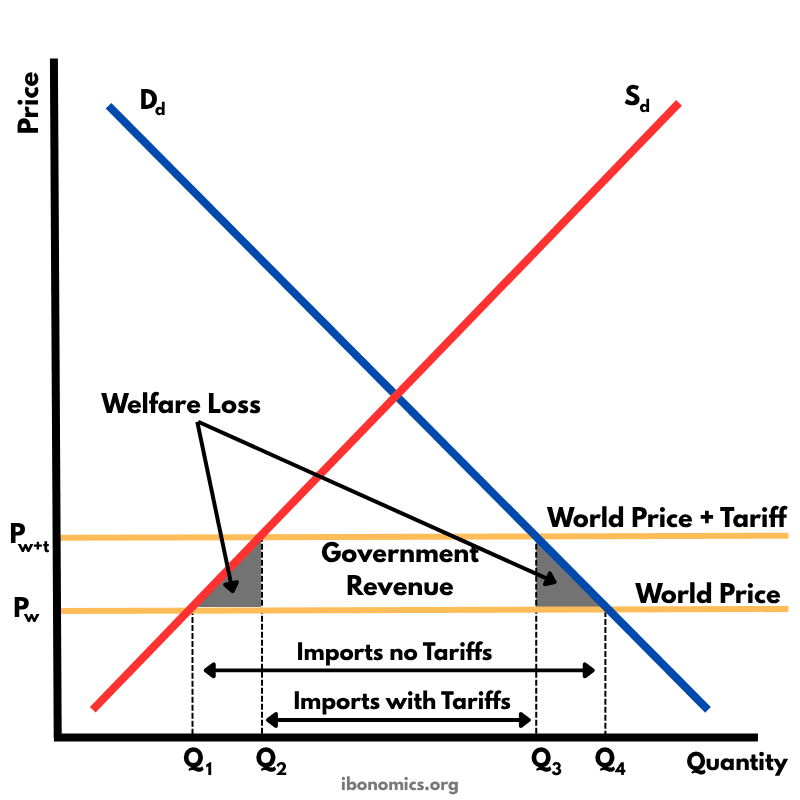
Unlike a tariff, a quota does not automatically create government revenue; any ‘quota rents’ depend on how import licences are allocated.
Example exam question
Using a quota diagram, explain how an import quota affects domestic price, domestic output, imports, and economic welfare.
Show example answer
At the world price (Pworld), domestic producers supply Q1 while consumers demand Q4, so imports are Q4 − Q1. A quota restricts imports, reducing supply and raising the domestic price to Pquota. At Pquota, domestic output rises to Q2 and quantity demanded falls to Q3. The quota is represented by Q2 − Q1. The quota creates a net welfare loss shown by the two shaded triangles due to inefficient extra domestic production and reduced consumption.