IBonomics
Comparative Advantage – Two-Country PPCSL
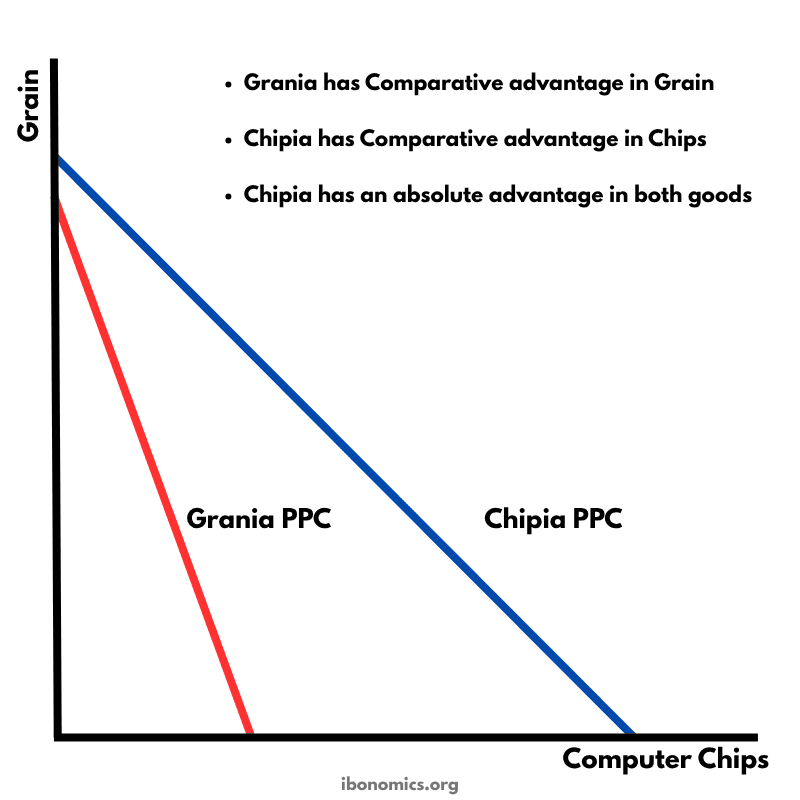
Global EconomicsThis diagram uses production possibility curves (PPCs) for two countries—Grania and Chipia—to illustrate absolute and comparative advantage and the potential gains from trade.
Curves and elements
- grania ppc
- Grania PPC (red): Shows Grania’s production possibilities; steeper, indicating comparative advantage in grain.
- chipia ppc
- Chipia PPC (blue): Shows Chipia’s production possibilities; flatter, indicating comparative advantage in computer chips.
- grain axis
- Vertical axis measures grain output.
- chips axis
- Horizontal axis measures computer chip output.
- comparative advantage notes
- Bulleted notes identify each country’s comparative and absolute advantages.
Key explanations
- 1
Chipia’s PPC lies outside Grania’s PPC, indicating that Chipia has an absolute advantage in producing both grain and computer chips (it can produce more of each good with the same resources).
- 2
The steeper slope of Grania’s PPC means it has a lower opportunity cost in grain production, giving Grania a comparative advantage in grain.
- 3
The flatter slope of Chipia’s PPC indicates a lower opportunity cost in chip production, giving Chipia a comparative advantage in computer chips.
- 4
By specializing according to comparative advantage—Grania in grain and Chipia in chips—and trading, both countries can consume beyond their individual PPCs.
- 5
This model underpins the principle that even if a country is less efficient at producing all goods (no absolute advantage), it can still gain from trade by specializing in goods where it has a lower opportunity cost.
Example exam question
Using a two-country PPC diagram, explain how comparative advantage leads to mutual gains from trade.
Show example answer
In the diagram, Chipia has an absolute advantage in both goods, but its PPC is flatter, meaning a lower opportunity cost for chips. Grania’s PPC is steeper, implying a lower opportunity cost for grain. If Grania specializes in grain and Chipia in chips, total output rises. Through trade, both countries can consume beyond their PPCs, demonstrating the gains from specialization based on comparative advantage.