IBonomics
Production Subsidy Diagram – ProtectionismSL
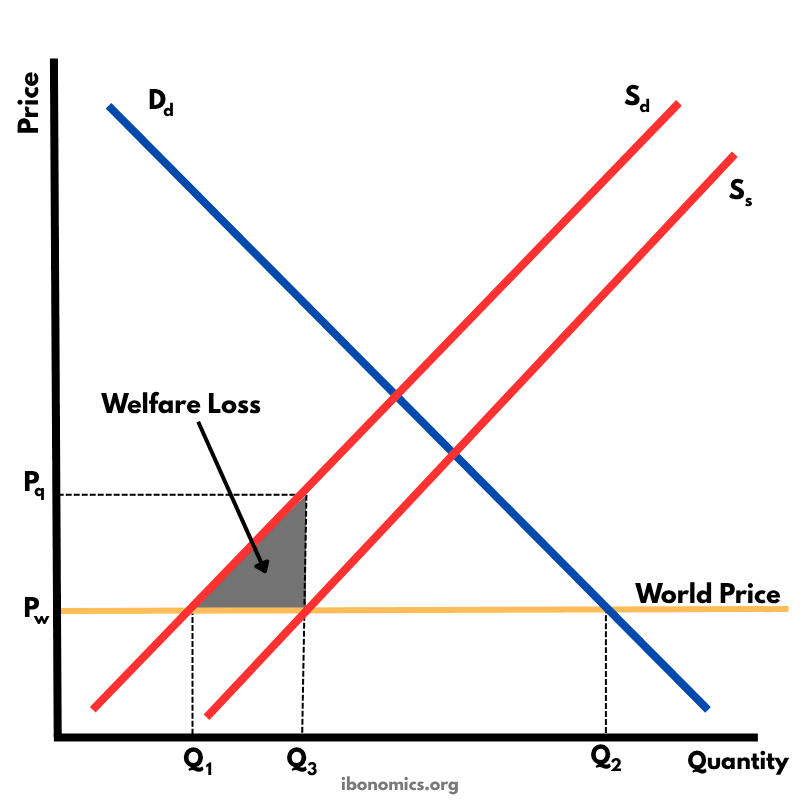
Global EconomicsThis diagram illustrates the effects of a production subsidy, where the government supports domestic producers to lower their costs and increase output. It is a form of protectionism without raising consumer prices directly.
Curves and elements
- dd
- Dd: Domestic demand for the good.
- sd
- Sd: Original domestic supply curve.
- ss
- Ss: New domestic supply curve after subsidy, showing increased output.
- pw
- Pw: World price of the good, unchanged by the subsidy.
- pq
- Pq: Price received by producers.
- q1
- Q1: Domestic output under free trade.
- q3
- Q3: Domestic output after subsidy.
- q2
- Q2: Total quantity demanded at world price.
- welfare loss
- Welfare Loss: Grey area showing inefficiencies from producing beyond the comparative advantage level with government support.
Key explanations
- 1
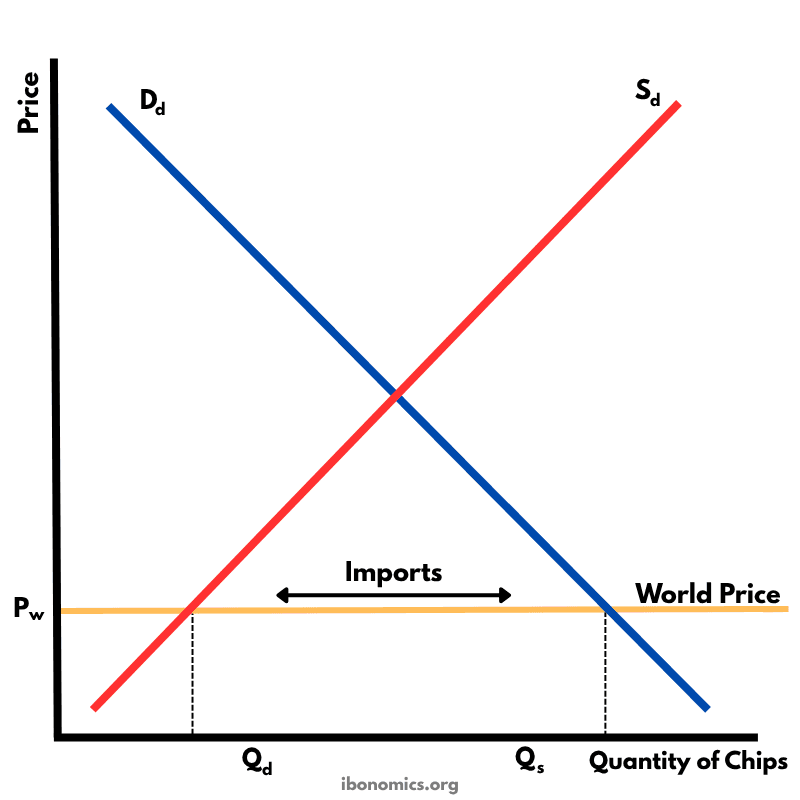
Under free trade, domestic producers supply Q1, and the remaining demand is fulfilled through imports (Q2 - Q1) at the world price Pw.
- 2
A production subsidy shifts the domestic supply curve from Sd to Ss, reducing production costs and allowing domestic firms to expand output from Q1 to Q3.
- 3
Imports fall from (Q2 - Q1) to (Q2 - Q3) as domestic output replaces part of the imported quantity.
- 4
The domestic price remains at Pw, so consumers are unaffected directly; however, the government must fund the subsidy.
- 5
A welfare loss arises due to inefficient allocation of resources, as subsidy-induced domestic production exceeds the efficient free trade level.
Example exam question
Using a diagram, explain the effects of a production subsidy on domestic producers, consumers, and economic efficiency.
Show example answer
A production subsidy shifts the domestic supply curve from Sd to Ss, increasing domestic output from Q1 to Q3 while keeping the price at Pw. Consumers are unaffected in price and quantity. Imports are reduced from (Q2 - Q1) to (Q2 - Q3). However, the subsidy creates a welfare loss due to inefficiencies in overproduction and the fiscal cost to the government.