IBonomics
Free Trade – Exporting CountrySL
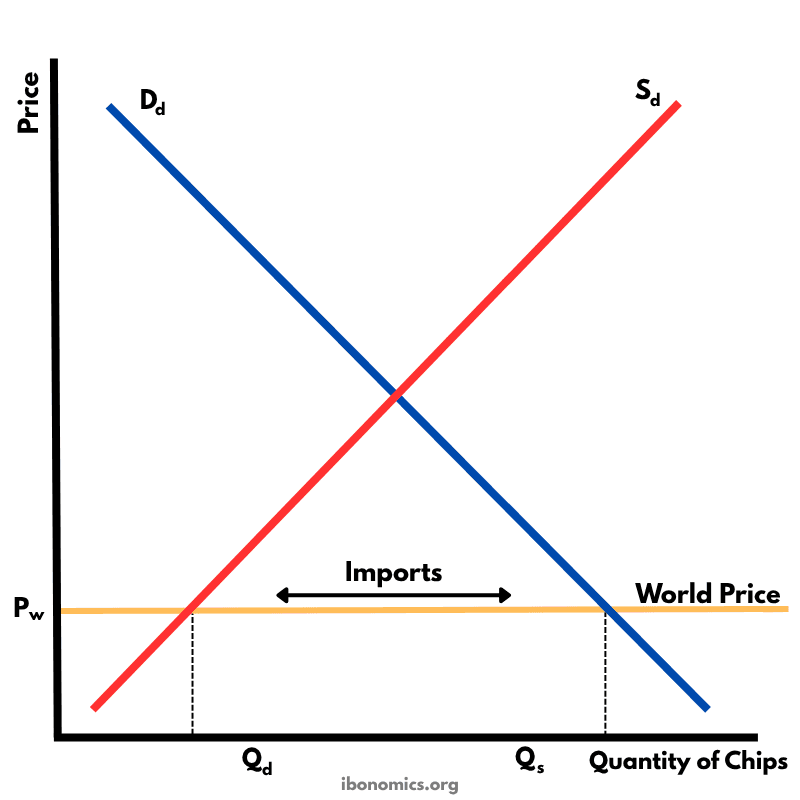
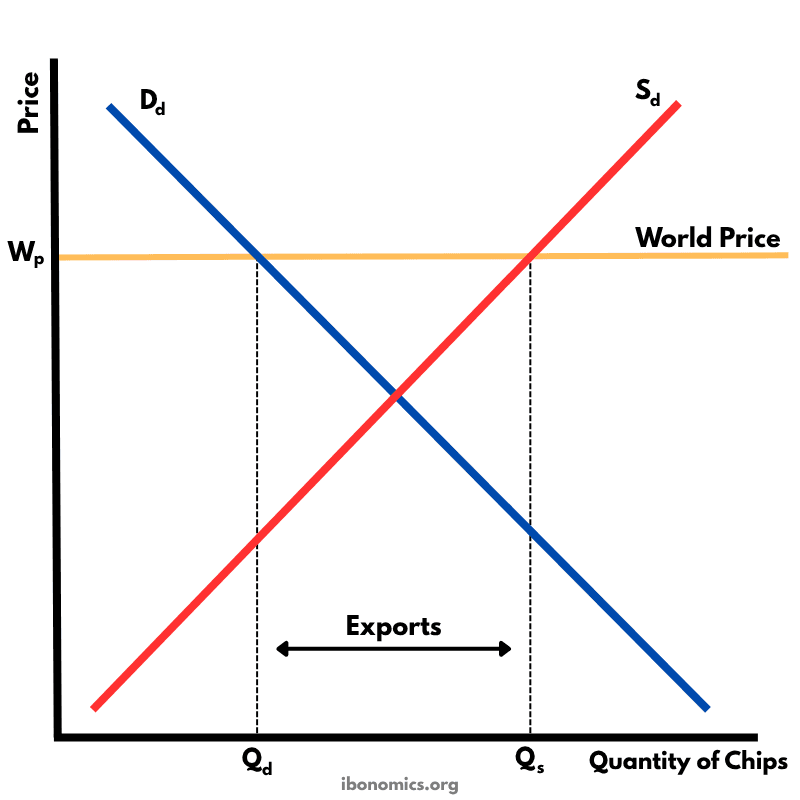
Global EconomicsThis diagram shows how a country exports goods under free trade when the world price is higher than the domestic equilibrium price.
Curves and elements
- dd
- Dd: Domestic demand for the good (e.g., chips).
- sd
- Sd: Domestic supply of the good.
- wp
- Wp: World price, higher than the domestic equilibrium price.
- qd
- Qd: Quantity demanded at the world price.
- qs
- Qs: Quantity supplied at the world price.
- exports
- Exports: The surplus of production (Qs − Qd) that is sold to foreign buyers.
Key explanations
- 1
In the absence of trade, the domestic equilibrium occurs where domestic supply (Sd) intersects domestic demand (Dd).
- 2
When the world price (Wp) is above the domestic equilibrium price, domestic producers are willing to supply more (Qs), while domestic consumers demand less (Qd).
- 3
The surplus of goods, represented by the difference between Qs and Qd, is exported to the rest of the world.
- 4
This benefits domestic producers who receive higher prices and increase production, but may harm domestic consumers who face higher prices and buy less.
- 5
Overall, the country specializes in the good it has a comparative advantage in, increasing global efficiency and welfare under free trade.
Example exam question
Using a supply and demand diagram, explain how a country benefits from exporting goods in a free trade environment.
Show example answer
When the world price is above the domestic equilibrium price, domestic producers increase output from Qd to Qs, while consumers reduce their quantity demanded. The excess supply is exported. This benefits producers through higher revenues and expands national output in the export sector, aligning with the theory of comparative advantage.