IBonomics
Kinked Demand Curve – Why Prices Are Sticky in Oligopoly
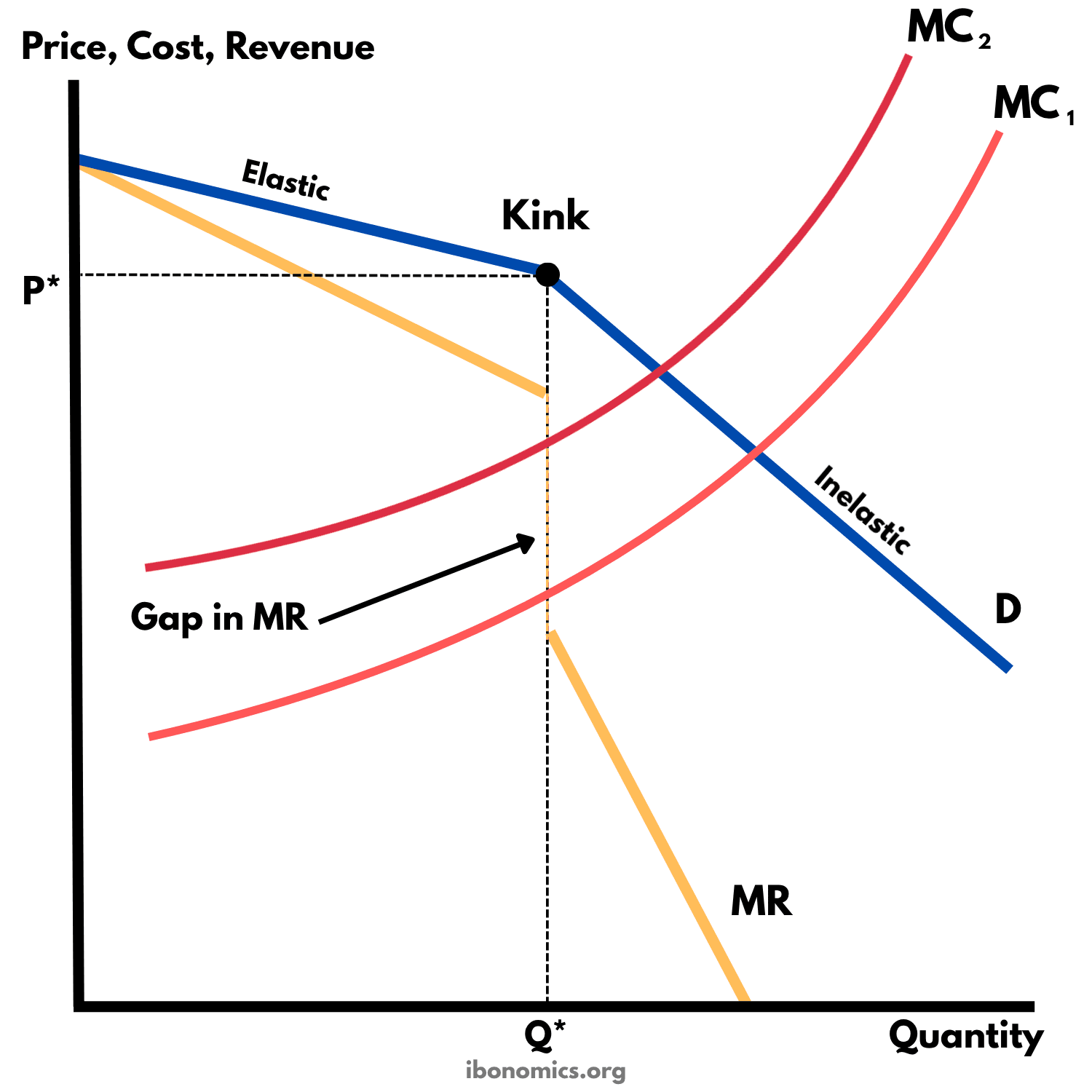
This diagram shows the kinked demand curve model of a non-collusive oligopoly. A firm expects rivals to ignore a price rise but to match a price cut, so demand is relatively elastic above the current price, P*, and relatively inelastic below it. The kink leaves a gap in marginal revenue, so marginal cost can change within the gap without changing the profit-maximising price and output.
This diagram goes beyond the IB Economics syllabus, so you don't need to learn it for your exams. It is here to deepen your understanding of the topic.
The kinked demand curve was put forward independently in 1939 by the American economist Paul Sweezy and by the Oxford economists Robert Hall and Charles Hitch.
Curves and elements
- D
- Demand, the firm's kinked demand curve. It is flatter above P*, where rivals ignore a price rise, and steeper below it, where rivals match a price cut.
- Elastic
- The part of demand above P*. Rivals don't follow a price rise, so the firm loses many customers to them, and demand is relatively elastic.
- Inelastic
- The part of demand below P*. Rivals match a price cut, so the firm wins few customers from them, and demand is relatively inelastic.
- Kink
- The point where the two parts of demand meet, at the current price P* and output Q*.
- MR
- Marginal revenue, the extra revenue from selling one more unit. It has two parts, one for each part of demand, with a gap between them at Q*.
- Gap in MR
- The vertical break in marginal revenue at Q*, caused by the kink. Marginal cost can move anywhere within it without changing the profit-maximising output.
- MC1
- Marginal cost before costs rise. It passes through the gap in MR, so the firm produces Q* and charges P*.
- MC2
- Marginal cost after costs rise. It still passes through the gap in MR, so output and price don't change.
- P*
- The current price, at the kink. The firm keeps it because neither raising nor cutting it would raise its profit.
- Q*
- The profit-maximising output, where MC passes through the gap in MR.
Key explanations
- 1
In an oligopoly, a few large firms dominate the market, and each must think about how its rivals will react to what it does. The kinked demand curve model assumes the firms don't collude, and that the price has settled at P*.
- 2
If one firm raises its price above P*, rivals keep their prices where they are and win its customers. The firm loses many sales, so demand above P* is relatively elastic, and the price rise lowers its profit.
- 3
If the firm cuts its price below P*, rivals match the cut to protect their market share. The firm gains few extra sales, so demand below P* is relatively inelastic, and the price cut lowers its profit too. With neither a rise nor a cut worth making, the price stays at P*, which explains why prices in oligopolies tend to be stable.
- 4
Marginal revenue has two parts, one for each part of demand. For a straight-line demand curve, MR is twice as steep, so when demand becomes much steeper at the kink, MR drops sharply, leaving a vertical gap at Q*.
- 5
A firm maximises profit where MR = MC. If costs rise from MC1 to MC2, both curves still pass through the gap in MR, so the profit-maximising output stays at Q* and the price at P*. The firm absorbs the change in costs rather than change its price and risk a reaction from its rivals.
- 6
The model has limits. It explains why the price stays at P* but not how P* was reached in the first place, and in practice rivals often match a price rise too, for example when costs rise for every firm. Because price competition is risky, oligopolies tend to compete through advertising, branding and product quality instead.
- 7
Oligopoly is part of the HL syllabus on market power, but the kinked demand curve isn't, so you won't be asked to draw it. The guide uses game theory instead to show how rivals react to each other.
Example exam question
Explain why prices in a non-collusive oligopoly may stay the same even when a firm's costs rise.
Show example answer
In a non-collusive oligopoly, each firm must consider how its rivals will react to a change in its price. The kinked demand curve model assumes that rivals will not follow a price rise, because they can win the firm's customers, but will match a price cut to protect their market share. Demand is therefore relatively elastic above the current price, P*, and relatively inelastic below it, so a firm that raises its price loses many sales and one that cuts it gains few. Neither change raises its profit. The kink in demand creates a vertical gap in marginal revenue (MR) at the output Q*. A profit-maximising firm produces where MR = MC, so if its marginal cost rises from MC1 to MC2 but stays within the gap, the profit-maximising output stays at Q* and the price at P*. This is why prices in oligopolies tend to be sticky. However, the model does not explain how P* was set, and if costs rise for every firm, rivals may all raise their prices together.