IBonomics
The Liquidity Trap – Why More Money Stops Lowering Interest Rates
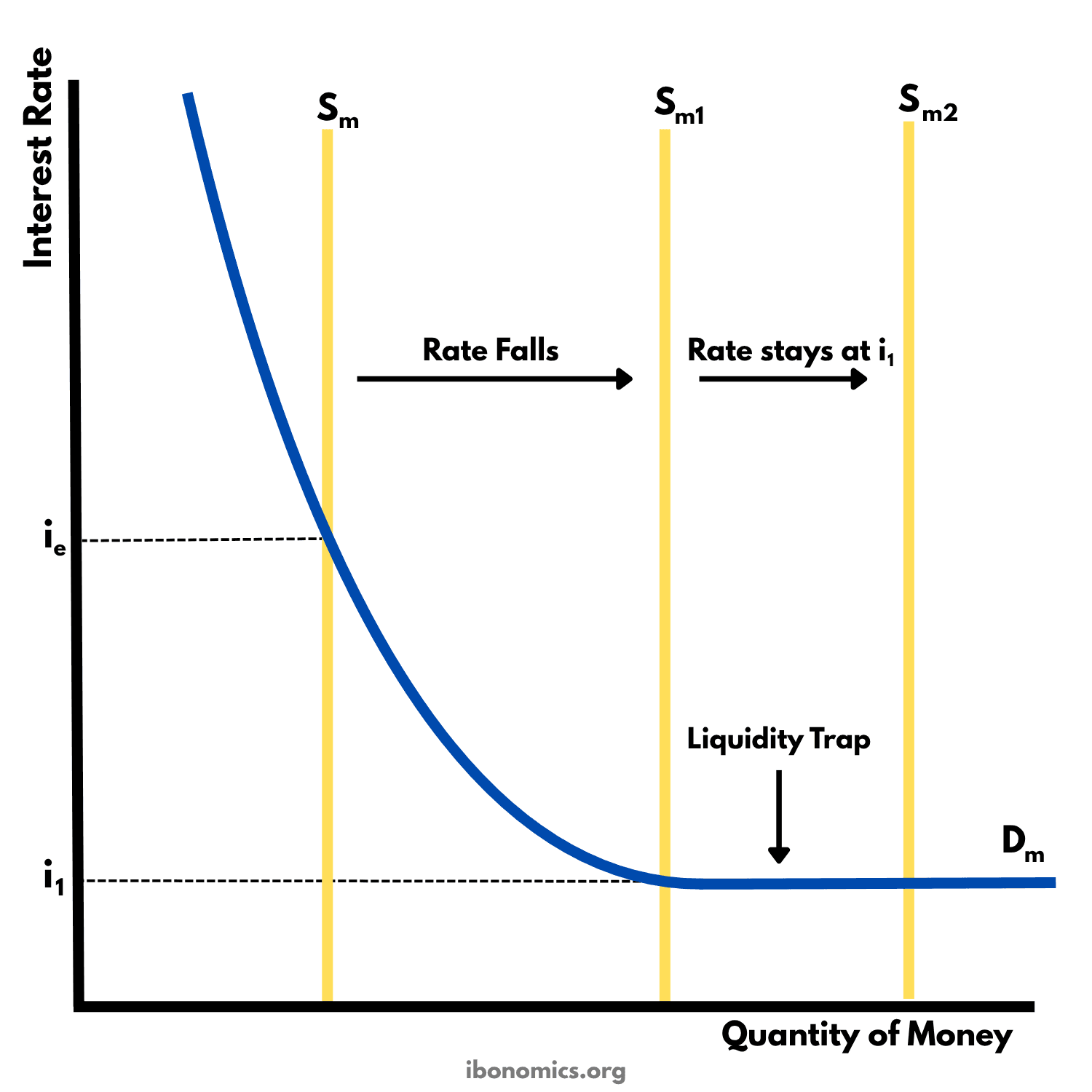
This diagram shows a liquidity trap in the money market. At very low interest rates the demand for money becomes flat, because people hold any extra money instead of buying bonds. A further increase in the money supply then leaves the interest rate where it is, so expansionary monetary policy can no longer lower interest rates to raise aggregate demand.
Curves and elements
- Sm
- The money supply at the start, set by the central bank. It is vertical because it does not depend on the interest rate.
- Sm1
- The money supply after the central bank increases it. It meets Dm where the curve is just becoming flat.
- Sm2
- A further increase in the money supply. It meets Dm on its flat part, so the interest rate does not fall.
- Dm
- The demand for money. It slopes downward at higher interest rates and becomes flat at very low ones, where people hold any extra money rather than buy bonds.
- ie
- The interest rate where Sm meets Dm.
- i1
- The lowest interest rate, close to zero. Both Sm1 and Sm2 meet Dm here, so the rate stays at i1 however much the money supply rises.
- Rate Falls
- The first increase in the money supply, from Sm to Sm1, meets the sloping part of Dm, so the interest rate falls from ie to i1.
- Rate stays at i1
- The second increase, from Sm1 to Sm2, meets the flat part of Dm, so the interest rate does not fall any further.
- Liquidity Trap
- The flat part of Dm. Here extra money is held rather than spent or lent, so a bigger money supply cannot lower interest rates.
Key explanations
- 1
The money market sets the interest rate where the money supply meets the demand for money, Dm. The central bank controls the money supply, so it is vertical. The demand for money slopes downward, because holding money means giving up the interest it could earn, and that cost is smaller when interest rates are low.
- 2
Normally, more money lowers the interest rate. When the central bank raises the money supply from Sm to Sm1, the interest rate falls from ie to i1. Cheaper borrowing encourages consumption and investment, which raises aggregate demand.
- 3
At very low interest rates, the demand for money becomes flat. Bond prices are already high, and people expect interest rates to rise, which would make bond prices fall, so they hold any extra money rather than buy bonds.
- 4
This flat part of Dm is the liquidity trap. When the money supply rises again, from Sm1 to Sm2, the extra money is simply held, and the interest rate stays at i1.
- 5
In a liquidity trap, the central bank cannot push interest rates any lower, so monetary policy loses its power to raise aggregate demand. A deep recession makes this worse, because low confidence means households and firms may not borrow even at very low rates.
- 6
This is why Keynesian economists argue for expansionary fiscal policy in a deep recession. Government spending raises aggregate demand directly, instead of relying on lower interest rates to encourage private spending.
Example exam question
Using a money market diagram, explain why expansionary monetary policy may be ineffective in a deep recession.
Show example answer
In the money market, the interest rate is set where the money supply meets the demand for money. Normally, when the central bank increases the money supply from Sm to Sm1, the interest rate falls from ie to i1, which encourages borrowing, consumption and investment and raises aggregate demand. In a deep recession, however, interest rates may already be very low. People expect them to rise, and bond prices to fall, so they hold any extra money rather than buy bonds, and the demand for money becomes flat. This is a liquidity trap. A further increase in the money supply, from Sm1 to Sm2, leaves the interest rate at i1, so monetary policy cannot lower borrowing costs any further. Low confidence also means households and firms may not borrow even at very low rates. Expansionary fiscal policy may then be more effective, because government spending raises aggregate demand directly.