IBonomics
Long-Run Self-Correction – How Wages Close Output Gaps in the New Classical Model
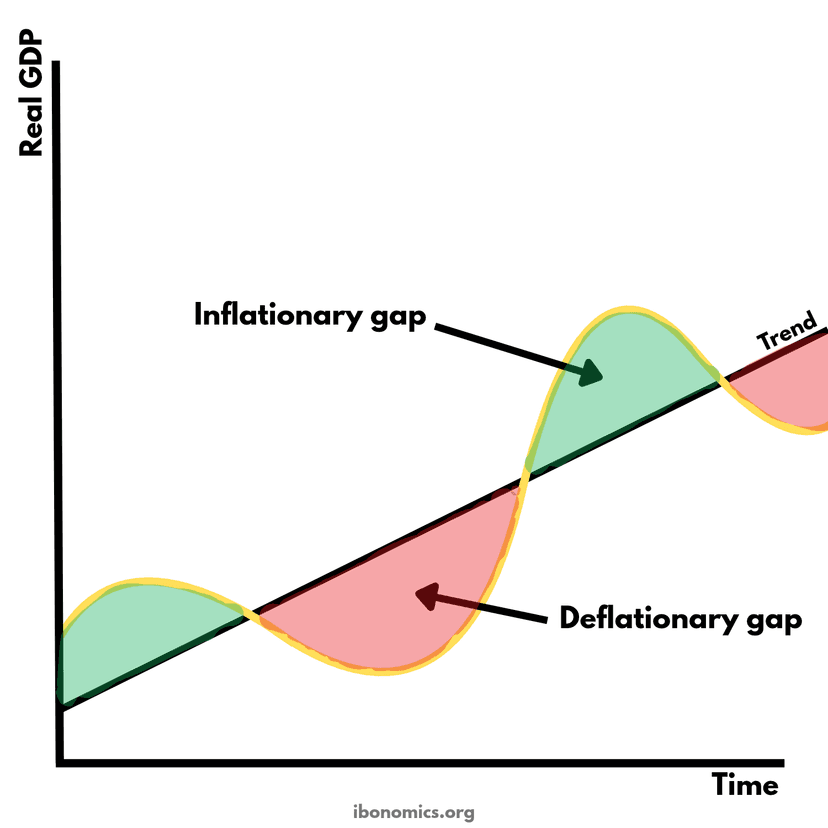
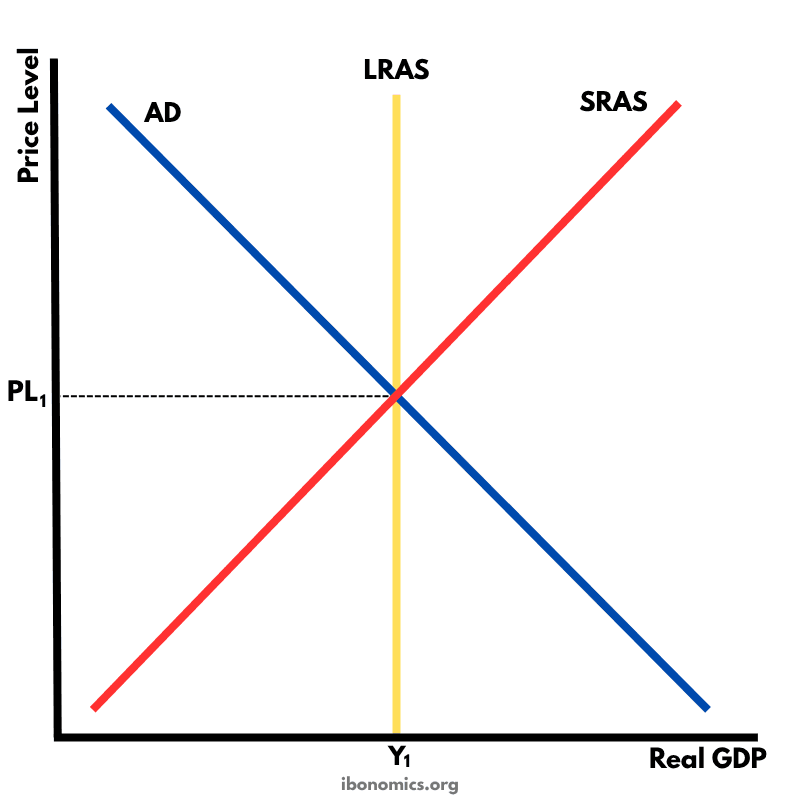
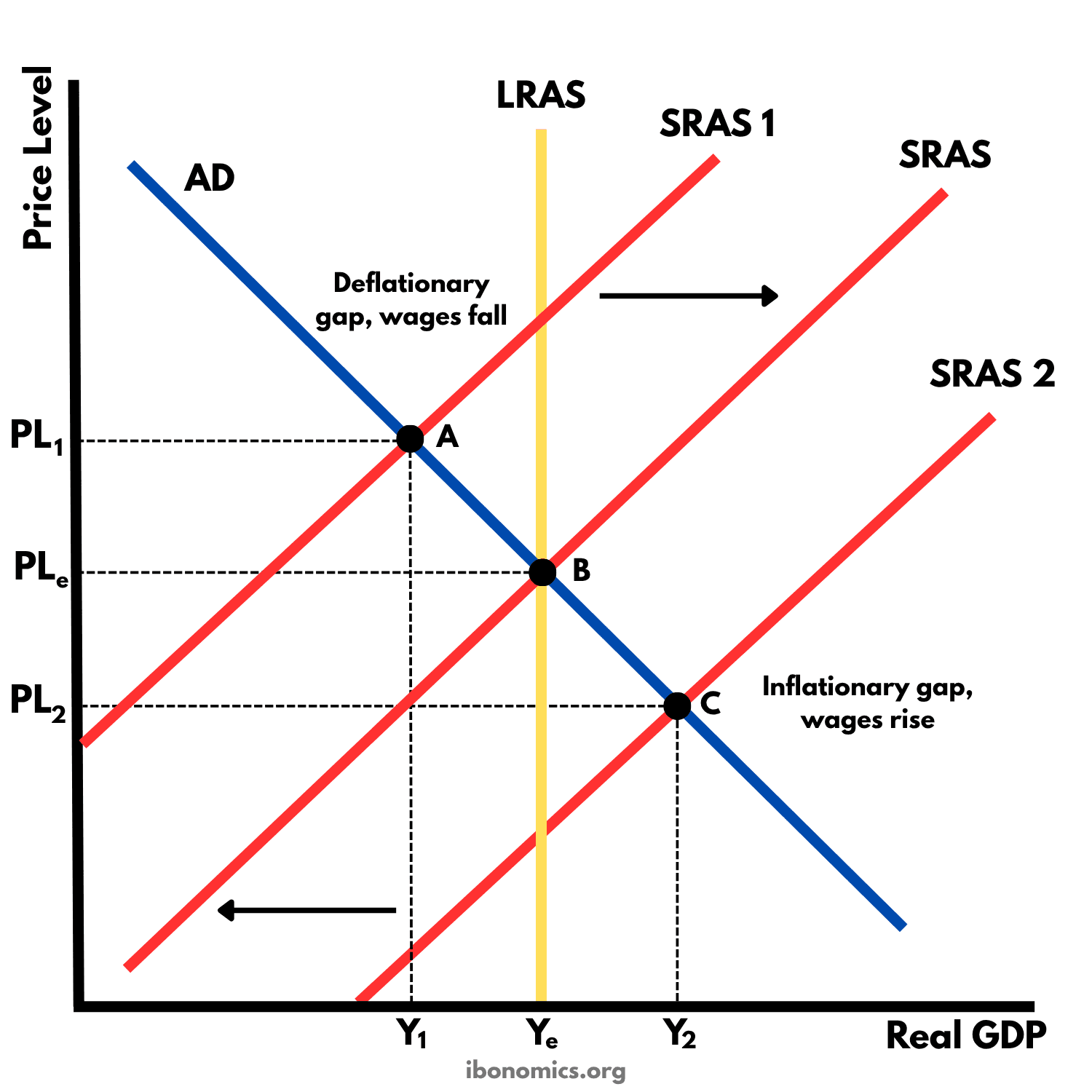
This diagram shows how, in the new classical model, the economy closes an output gap on its own. At A there is a deflationary gap and at C an inflationary gap. In each case wages and other costs adjust, SRAS shifts, and the economy returns to B, where AD meets LRAS at the full employment level of output Ye.
Curves and elements
- AD
- Aggregate demand, which stays fixed throughout.
- LRAS
- Long-run aggregate supply, vertical at the full employment level of output Ye.
- SRAS 1
- Short-run aggregate supply when wages and costs are high, giving a deflationary gap at A.
- SRAS
- Short-run aggregate supply once wages and costs have adjusted. It passes through B, where AD meets LRAS.
- SRAS 2
- Short-run aggregate supply when wages and costs are low, giving an inflationary gap at C.
- A
- The deflationary gap, where real GDP is Y1, below Ye, and the price level is PL1.
- B
- Long-run equilibrium at Ye and PLe, where both gaps end.
- C
- An inflationary gap, where real GDP is Y2, above Ye, and the price level is PL2.
- Deflationary gap, wages fall
- With output below Ye and unemployment high, wages and costs fall, so SRAS 1 shifts right to SRAS.
- Inflationary gap, wages rise
- With output above Ye and labour scarce, wages and costs rise, so SRAS 2 shifts left to SRAS.
Key explanations
- 1
AD and LRAS stay fixed. The economy's long-run equilibrium is at B, where AD meets LRAS at the full employment level of output Ye and the price level PLe.
- 2
At A, AD meets SRAS 1 at Y1, below Ye, so there is a deflationary gap and unemployment is above its natural rate. With many workers looking for jobs, wages and other costs fall.
- 3
Lower costs shift SRAS right from SRAS 1 to SRAS. The price level falls from PL1 to PLe, and real GDP rises from Y1 back to Ye.
- 4
At C, AD meets SRAS 2 at Y2, above Ye, so there is an inflationary gap. Labour is scarce, so wages and other costs rise.
- 5
Higher costs shift SRAS left from SRAS 2 to SRAS. The price level rises from PL2 to PLe, and real GDP falls from Y2 back to Ye.
- 6
The inflationary gap at C has the lowest price level of the three points, and the deflationary gap at A the highest. That is because the price level rises as an inflationary gap closes and falls as a deflationary gap closes.
- 7
Self-correction depends on wages being flexible. Keynesian economists argue that wages are sticky downward, so a deflationary gap can last a long time, which is why they support government intervention.
Example exam question
Using an AD/AS diagram, explain how the economy returns to full employment in the long run in the new classical model.
Show example answer
In the new classical model, the economy's long-run equilibrium is where AD meets the vertical LRAS curve, at Ye. If the economy is at A, with real GDP at Y1 below Ye, there is a deflationary gap and unemployment is high. Workers accept lower wages and firms' costs fall, so SRAS shifts right from SRAS 1 to SRAS, and the economy moves back to Ye at the lower price level PLe. If the economy is at C, with real GDP at Y2 above Ye, there is an inflationary gap. Labour is scarce, so wages and costs rise, SRAS shifts left from SRAS 2 to SRAS, and output falls back to Ye at the higher price level PLe. In both cases the economy corrects itself without government intervention. However, this relies on flexible wages, and Keynesian economists argue that wages rarely fall, so a deflationary gap may persist.