IBonomics
Market for Lemons – Adverse Selection in the Used Car Market
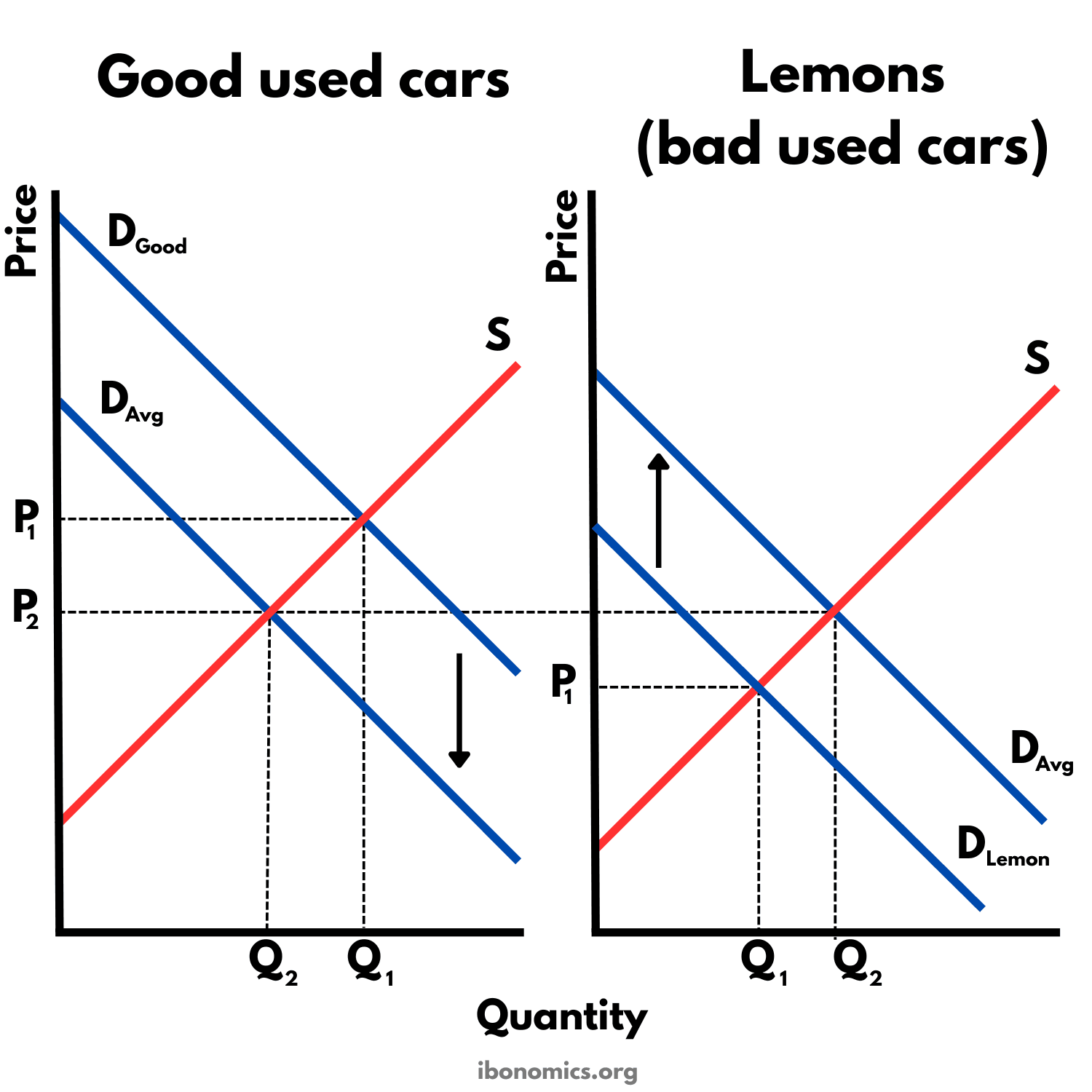
This diagram shows how asymmetric information can make a market fail. Sellers of used cars know whether a car is good or a lemon, a car with hidden faults, but buyers can't tell. Buyers will only pay for average quality, so fewer good cars and more lemons are sold than if buyers could tell them apart. This is adverse selection.
This diagram goes beyond the IB Economics syllabus, so you don't need to learn it for your exams. It is here to deepen your understanding of the topic.
George Akerlof described the market for lemons in 1970. He shared the Nobel Prize in Economics in 2001 with Michael Spence and Joseph Stiglitz for their work on markets with asymmetric information.
Curves and elements
- DGood
- Demand for good cars when buyers can see their quality. Buyers value a car without hidden faults highly, so this demand is high.
- DLemon
- Demand for lemons when buyers know they are buying one. Buyers will pay little for a car with hidden faults, so this demand is low.
- DAvg
- Demand when buyers can't tell good cars from lemons, based on average quality. It lies below DGood and above DLemon, so demand for good cars falls and demand for lemons rises.
- S
- Supply, the cars owners are willing to sell at each price. Each panel has its own supply curve, one for good cars and one for lemons.
- P1
- The price each kind of car would sell for if buyers could see its quality. It is higher for good cars than for lemons.
- P2
- The single price buyers pay for any car when they can't tell them apart. It is below P1 for good cars and above P1 for lemons.
- Q1
- The quantity of each kind of car sold when buyers can see its quality.
- Q2
- The quantity sold when buyers pay only for average quality. It is lower than Q1 for good cars and higher than Q1 for lemons.
Key explanations
- 1
Asymmetric information means one side of a market knows more than the other. In the used car market, the seller knows whether a car has hidden faults and the buyer doesn't. A car with hidden faults is called a lemon.
- 2
If buyers could tell the cars apart, each kind would sell in its own market at its own price, P1. Good cars would sell where DGood meets supply, at a high price, and lemons where DLemon meets supply, at a low one. Each market would sell its own quantity, Q1.
- 3
Because buyers can't tell the cars apart, they offer the same price for any car, based on the average quality of the cars for sale. Demand for good cars falls from DGood to DAvg, and demand for lemons rises from DLemon to DAvg. Both kinds now sell at the single price P2, which is why one dashed line runs across both panels.
- 4
At P2, owners of good cars are paid less than their cars are worth, so many keep them, and the quantity of good cars sold falls from Q1 to Q2. Owners of lemons are paid more than theirs are worth, so the quantity of lemons sold rises from Q1 to Q2. This is adverse selection, as the cars offered for sale are mostly the ones buyers would least want.
- 5
The process can feed on itself. As lemons take a bigger share of the cars for sale, average quality falls, so DAvg falls further and even fewer good cars are offered. In the extreme, the market for good used cars disappears, and trades that would make both buyer and seller better off never happen. Resources are misallocated, so the market fails.
- 6
The fixes close the information gap. Sellers can signal quality with warranties and a dealer's reputation, buyers can screen cars with independent inspections, and governments can require sellers to disclose faults or give buyers the right to return a faulty car. Adverse selection also affects insurance and lending, where the buyer knows more about the risk than the seller.
- 7
Adverse selection is part of the HL syllabus on asymmetric information, so you need the idea, but you won't be asked to draw this diagram. Drawing good cars and lemons in two panels is a simplification, since in reality both sell in one market at one price.
Example exam question
Explain how asymmetric information can lead to market failure in the market for used cars.
Show example answer
Asymmetric information exists when one side of a market knows more than the other. A seller of a used car knows whether it is a good car or a lemon, a car with hidden faults, but a buyer cannot tell. Buyers are therefore only willing to pay a price based on the average quality of the cars for sale, P2. This is below what a good car is worth and above what a lemon is worth. Owners of good cars are unwilling to sell at P2, so fewer good cars are sold, while owners of lemons are glad to sell, so more lemons are sold. This is adverse selection. As the share of lemons rises, the average quality of cars for sale falls, so buyers offer even less and more owners of good cars withdraw. Trades that would benefit both the buyer and the seller of a good car do not take place, so resources are not allocated efficiently and the market fails. Warranties, independent inspections and laws requiring sellers to disclose faults can reduce the problem.