IBonomics
Monetary Transmission Mechanism – How an Interest Rate Cut Increases Aggregate Demand
This diagram shows the monetary transmission mechanism, the chain of effects by which a change in interest rates reaches the economy. A cut works through four channels (interest rates, asset prices, the exchange rate and confidence), which raise consumption, investment and net exports. Aggregate demand increases, so real GDP and the price level rise and unemployment falls.
No single economist drew this chain. Central banks, such as the Bank of England in 1999, set out these channels to explain how their interest rate decisions reach the economy, and Milton Friedman showed in 1961 that monetary policy works with 'long and variable lags'.
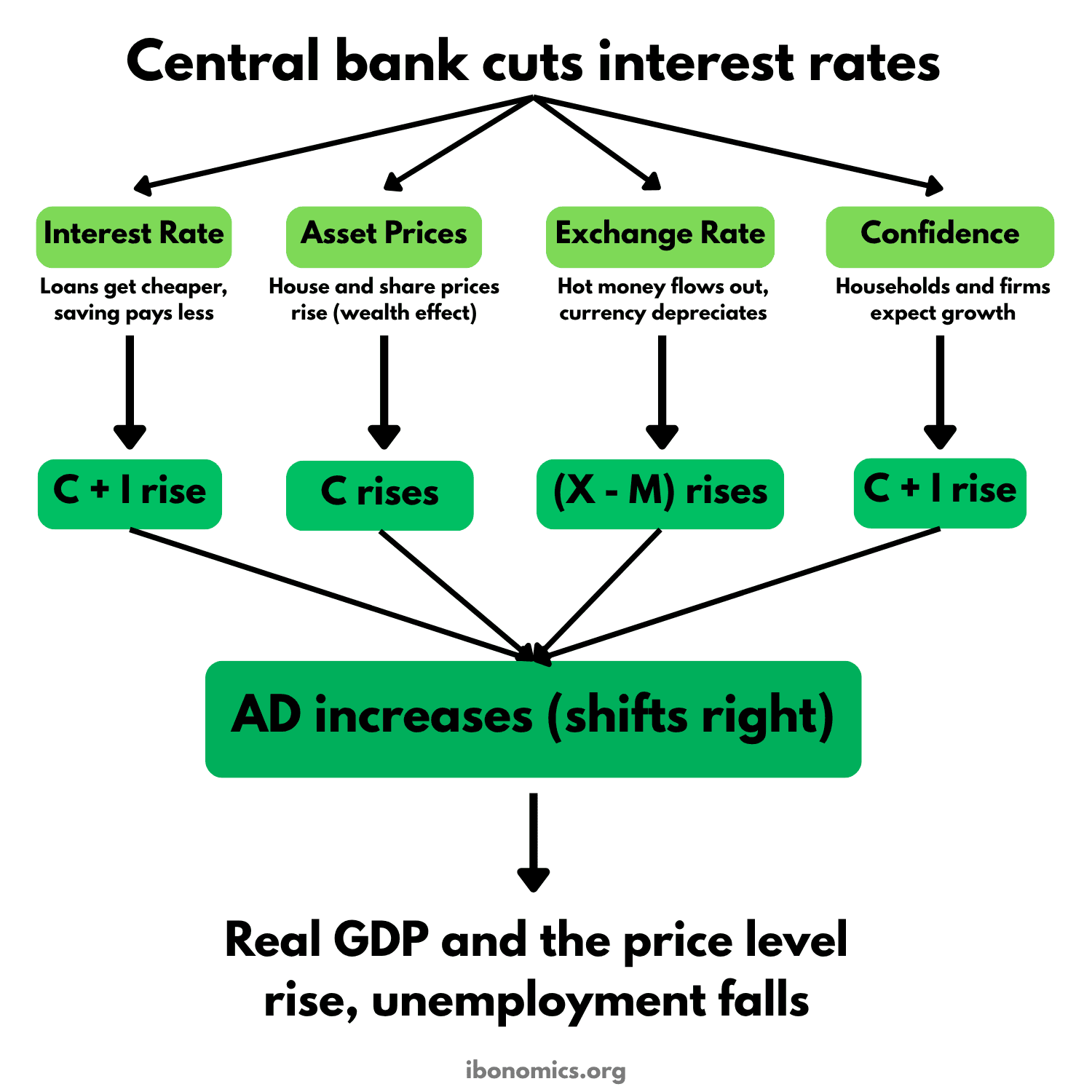
Curves and elements
- Central bank cuts interest rates
- The starting point, expansionary monetary policy. Commercial banks follow the cut, so the interest rates they charge on loans and pay on savings fall too.
- Interest Rate
- The first channel. Loans are cheaper and saving pays less, so households spend more and firms invest more.
- Asset Prices
- The second channel. Lower interest rates push up house and share prices, so the households that own them feel wealthier and spend more, the wealth effect.
- Exchange Rate
- The third channel. Saving in the country now earns less than saving abroad, so hot money flows out and the currency depreciates, making exports cheaper and imports dearer.
- Confidence
- The fourth channel. Households and firms expect the economy to grow, so they spend and invest more.
- C + I rise
- Consumption and investment rise. Both the interest rate channel and the confidence channel lead here.
- C rises
- Consumption rises, as households who own houses and shares feel wealthier.
- (X - M) rises
- Net exports, exports minus imports, rise, because the weaker currency makes exports cheaper for foreign buyers and imports dearer at home.
- AD increases (shifts right)
- Aggregate demand is C + I + G + (X − M). Three of its four parts rise, so AD increases and the AD curve shifts to the right.
- Real GDP and the price level rise, unemployment falls
- The result. Firms produce more and hire more workers, so real GDP rises and unemployment falls. The price level rises too, by more the closer the economy is to full employment.
- Arrows
- The order of cause and effect, from the rate cut through the four channels and the parts of AD they raise, to the increase in AD and its effects.
Key explanations
- 1
Monetary policy is the central bank's use of interest rates and the money supply to influence aggregate demand (AD). When the economy is producing below its potential output, the central bank can cut interest rates, which is expansionary monetary policy. Commercial banks follow, so the interest rates on loans, mortgages and savings fall too.
- 2
The interest rate channel. Loans become cheaper, so households borrow more to buy cars and other expensive goods, and consumption (C) rises. Firms find more investment projects worth doing at the lower cost of borrowing, so investment (I) rises. Saving pays less, which also encourages households to spend, and households with variable-rate mortgages have more left to spend each month.
- 3
The asset price channel. Lower interest rates make houses easier to buy with a mortgage and make shares more attractive than savings accounts, so house and share prices rise. Households that own them feel wealthier and spend more, so consumption rises. This is the wealth effect.
- 4
The exchange rate channel. Lower interest rates mean that money saved in the country earns less than it would abroad, so hot money, short-term financial capital, flows out. Investors sell the currency to move their money, so it depreciates. Exports become cheaper for foreign buyers and imports dearer at home, so net exports (X − M) rise.
- 5
The confidence channel. A cut can make households and firms more optimistic, as they expect the economy to grow and incomes to rise. Households spend more and firms invest more, so C and I rise again.
- 6
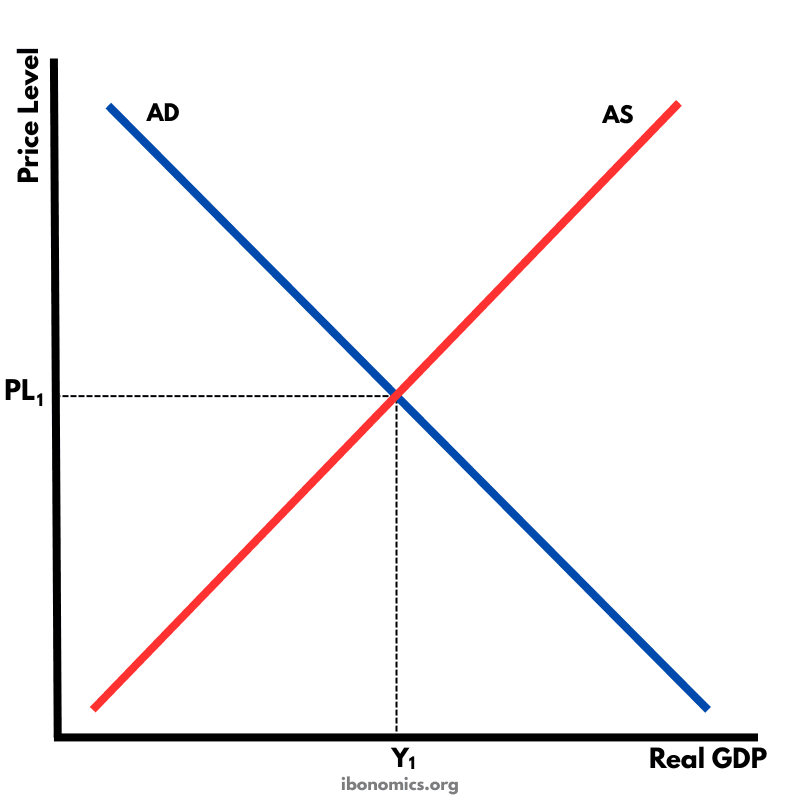
AD is C + I + G + (X − M), so with C, I and (X − M) all higher, AD increases and the AD curve shifts to the right. Firms produce more, so real GDP rises, and they hire more workers, so unemployment falls. The price level rises too, by more the closer the economy is to full employment.
- 7
A rise in interest rates, contractionary monetary policy, runs every channel the other way. Borrowing costs more and saving pays more, asset prices fall, hot money flows in and the currency appreciates, and confidence falls, so AD decreases and the AD curve shifts to the left. Central banks raise rates in this way to bring inflation down.
- 8
The mechanism takes time. Central banks expect the full effect on output and inflation to take up to about two years, so they have to act on forecasts. It can also be weak. When confidence is low, households and firms may not borrow even at low rates, banks may not pass a cut on in full, and when rates are already close to zero there is little room to cut them further. A depreciation also raises the price of imports, which adds to inflation.
Example exam question
Explain how expansionary monetary policy can increase aggregate demand.
Show example answer
Expansionary monetary policy is a cut in interest rates by the central bank to increase aggregate demand (AD), which is made up of consumption (C), investment (I), government spending (G) and net exports (X − M). When the central bank cuts its interest rate, commercial banks lower the rates they charge on loans and pay on savings. Borrowing becomes cheaper, so households spend more on goods bought on credit, such as cars, and firms invest in more projects, so C and I rise. Saving also pays less, which encourages spending. Lower interest rates raise house and share prices, and households who own them feel wealthier and spend more, so C rises further. Lower rates also make saving in the country less attractive than saving abroad, so hot money flows out and the currency depreciates. Exports become cheaper and imports dearer, so (X − M) rises. Finally, a cut can raise the confidence of households and firms, who expect growth and so spend and invest more. With C, I and (X − M) all higher, AD increases and the AD curve shifts to the right, which raises real GDP and the price level and reduces unemployment. However, the full effect can take up to about two years, and if confidence is very low, households and firms may not borrow even when rates are cut.