IBonomics
Money Creation by Commercial Banks – How Lending Creates Deposits
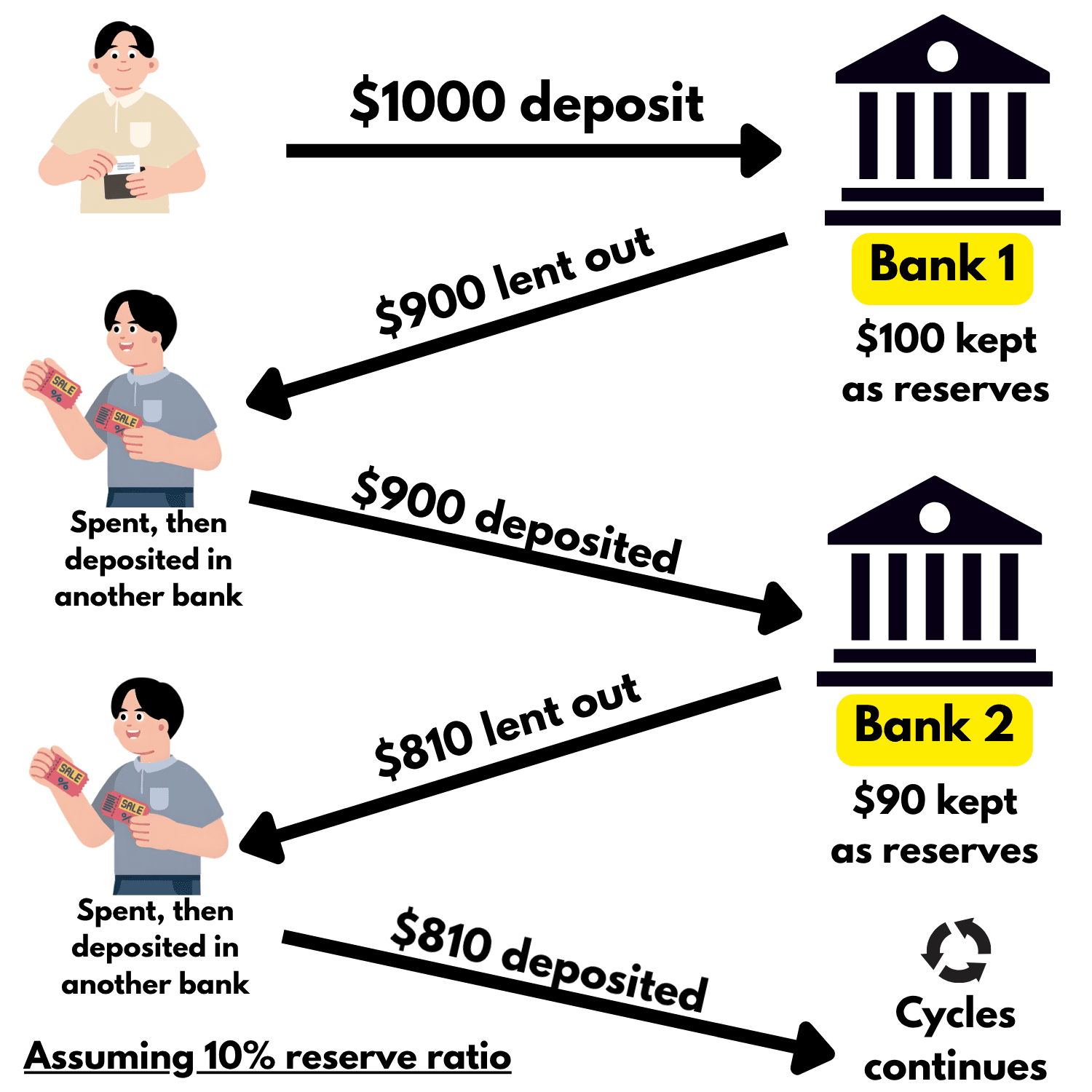
This diagram shows how commercial banks create money. With a 10% reserve ratio, each bank keeps a tenth of every deposit as reserves and lends out the rest. The loans are spent and deposited in other banks, so one $1,000 deposit leads to a chain of new deposits.
Curves and elements
- $1000 deposit
- A customer deposits $1,000 in Bank 1, the starting point of the process.
- Bank 1
- Keeps $100, 10% of the deposit, as reserves and lends out the other $900.
- $900 lent out
- The loan is spent, for example on goods. The money does not disappear, because it passes to whoever is paid.
- Spent, then deposited in another bank
- Whoever receives the money deposits it in their own bank, so the loan becomes a new deposit.
- Bank 2
- Receives the $900 deposit, keeps $90 as reserves and lends out $810.
- $810 lent out
- The second loan, which is spent and deposited again, starting the next round.
- Assuming 10% reserve ratio
- Each bank keeps 10% of every deposit as reserves and lends the rest. A higher reserve ratio means less is lent in each round, so less money is created.
Key explanations
- 1
Commercial banks create money when they lend. A bank keeps only a fraction of each deposit as reserves and lends out the rest.
- 2
With a reserve ratio of 10%, Bank 1 keeps $100 of the $1,000 deposit and lends out $900. The borrower spends it, and whoever receives the $900 deposits it in Bank 2.
- 3
Bank 2 keeps $90 as reserves and lends out $810, which is spent and deposited again. Each round adds new deposits, each 10% smaller than the one before.
- 4
Adding up all the rounds, the first $1,000 can support up to $10,000 of deposits, because $1,000 ÷ 0.10 = $10,000. The extra $9,000 is new money created by bank lending.
- 5
That is the most that can be created. Less is created if banks keep more than the required reserves, or if people hold some of the money as cash instead of depositing it.
- 6
Central banks can use this process in monetary policy. Raising the minimum reserve requirement leaves banks less to lend, which slows money creation, and lowering it does the opposite.
Example exam question
Explain the process of money creation by commercial banks.
Show example answer
Commercial banks create money by lending out part of their deposits. Suppose the reserve ratio is 10% and a customer deposits $1,000 in Bank 1. The bank keeps $100 as reserves and lends out $900. The borrower spends the $900, and the person who receives it deposits it in Bank 2, which keeps $90 and lends out $810. This continues, with each new deposit 10% smaller than the last. In total, the original $1,000 can support up to $1,000 ÷ 0.10 = $10,000 of deposits, so up to $9,000 of new money is created. In practice less is created, because banks may keep extra reserves and people hold some money as cash. A central bank can slow money creation by raising the minimum reserve requirement.