IBonomics
Indirect Tax to Correct a Negative Externality of Consumption
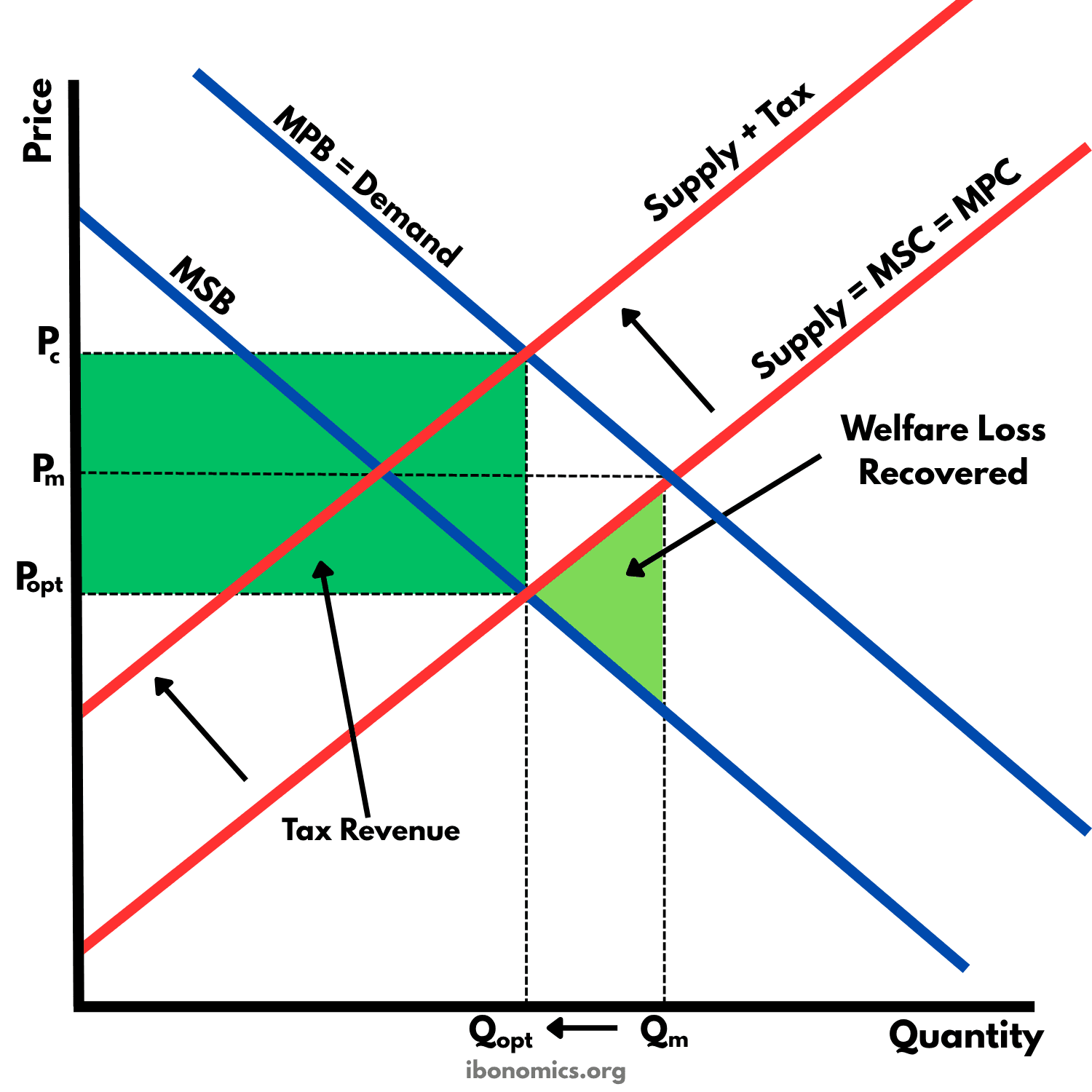
This diagram shows how an indirect tax on a good such as cigarettes or alcohol can correct a negative externality of consumption. A tax equal to the external cost shifts supply up, so consumption falls from Qm to the socially optimal level Qopt and the welfare loss is recovered.
Curves and elements
- MPB = Demand
- Marginal private benefit, the benefit consumers get from each unit. It leaves out the cost their consumption imposes on others.
- MSB
- Marginal social benefit, which lies below MPB by the external cost of each unit, such as the harm from secondhand smoke.
- Supply = MSC = MPC
- Supply before the tax. There is no externality in production, so marginal private cost and marginal social cost are the same.
- Supply + Tax
- Supply after the tax, shifted up by the tax per unit. It meets MPB = Demand at Qopt.
- Price effect
- Consumers pay Pc, above the free market price Pm, while producers keep Popt, below it. The gap between Pc and Popt is the tax per unit.
- Quantity effect
- Consumption falls from Qm to the socially optimal quantity Qopt.
- Tax Revenue
- Equal to (Pc − Popt) × Qopt, the tax per unit times the quantity sold. Consumers pay the part above Pm and producers the part below it.
- Welfare Loss Recovered
- The welfare loss the tax removes, between the supply curve and MSB from Qopt to Qm. Those units cost society more than they were worth to it.
Key explanations
- 1
Consuming goods such as cigarettes and alcohol imposes external costs on third parties, so the marginal social benefit (MSB) lies below the marginal private benefit (MPB). The free market consumes Qm at price Pm, more than the socially optimal quantity Qopt.
- 2
The government places an indirect tax on the good equal to the external cost of each unit, the vertical distance between MPB and MSB. The tax raises firms' costs, so the supply curve shifts up from Supply = MSC = MPC to Supply + Tax.
- 3
The new equilibrium is where Supply + Tax meets MPB = Demand. The quantity demanded falls from Qm to Qopt, the quantity at which MSB equals MSC.
- 4
Consumers now pay Pc, which is above Pm, and producers keep Popt, which is below it. The tax per unit is the gap between Pc and Popt, so consumers pay part of the tax and producers pay the rest.
- 5
The government collects tax revenue equal to the tax per unit times Qopt, shown by the dark green rectangle. The light green triangle is the welfare loss recovered, because the units between Qopt and Qm, which cost society more than they were worth to it, are no longer consumed.
- 6
In practice the external cost is hard to measure, so the tax may be set too high or too low. Demand for goods such as cigarettes is price inelastic, so the tax has to be large to reduce consumption much, and it takes a bigger share of income from low-income households, which makes it regressive.
Example exam question
Using a diagram, explain how an indirect tax can be used to correct a negative externality of consumption.
Show example answer
In the diagram, consuming the good imposes external costs on third parties, so MSB lies below MPB and the free market overconsumes at Qm instead of Qopt. The government can place an indirect tax on the good equal to the external cost of each unit. This shifts supply up from Supply = MSC = MPC to Supply + Tax, so the price consumers pay rises from Pm to Pc and the quantity demanded falls to Qopt, where MSB = MSC. Producers keep Popt, so the burden of the tax is shared between consumers and producers, and the government collects the tax revenue shown by the rectangle. The welfare loss between Qopt and Qm is recovered. However, the external cost is hard to measure, and because demand for goods such as cigarettes is price inelastic, the tax has to be large to reduce consumption much and it falls hardest on low-income households.