IBonomics
Public and Private Goods – Classifying Goods by Rivalry and Excludability
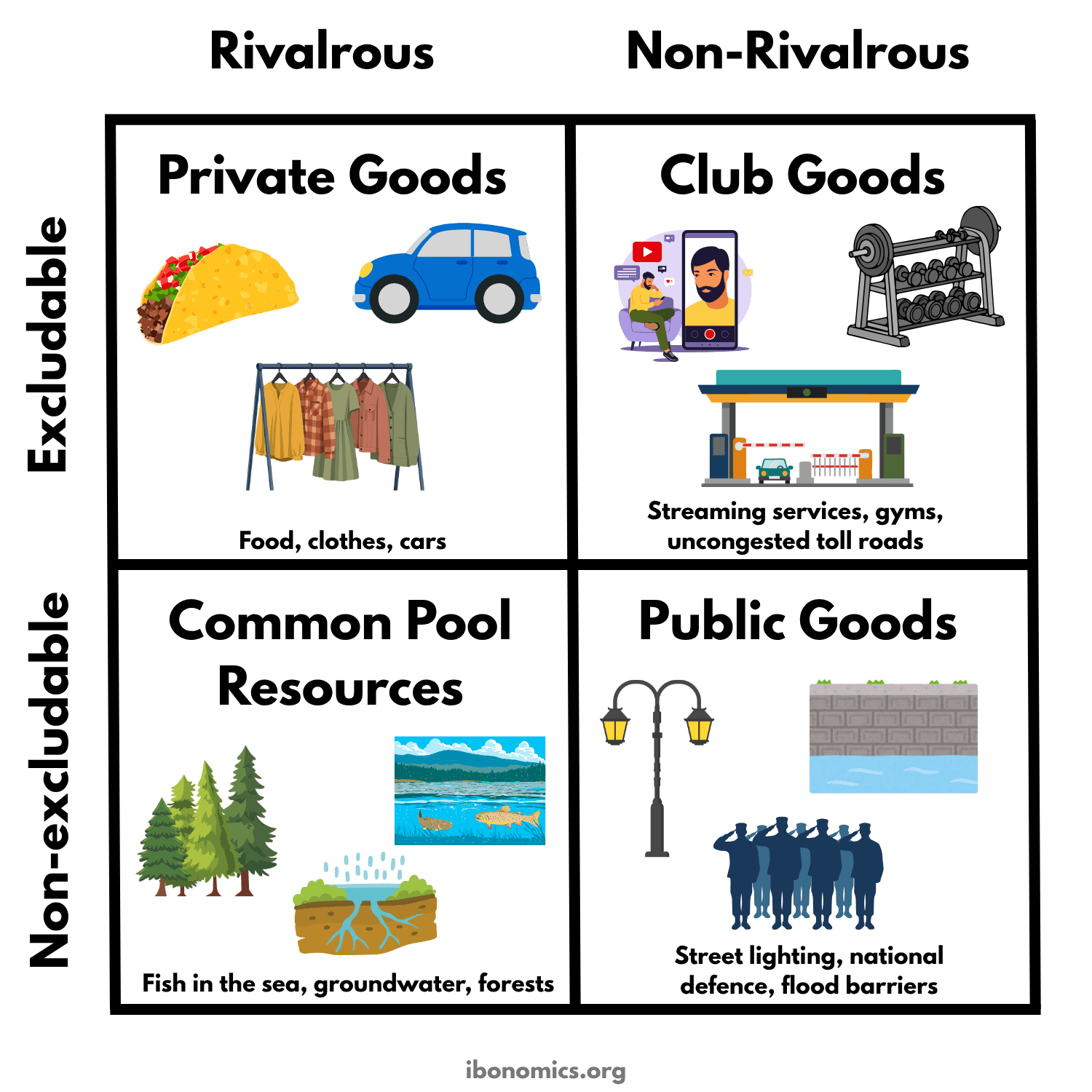
This diagram sorts goods by two features. A good is rivalrous if one person's use leaves less for others, and excludable if people who don't pay can be kept from using it. The four combinations give private goods, club goods, common pool resources and public goods.
Paul Samuelson defined public goods in 1954, James Buchanan described club goods in 1965 and Garrett Hardin named the tragedy of the commons in 1968. The grid of four types comes from Vincent and Elinor Ostrom (1977), and Elinor Ostrom won the Nobel Prize in Economics in 2009 for showing how communities can manage common pool resources themselves.
Curves and elements
- Rivalrous
- The left column. One person's use of the good leaves less for everyone else, so people compete for it.
- Non-Rivalrous
- The right column. One more person can use the good without leaving less for anyone else, so another user costs little or nothing.
- Excludable
- The top row. People who don't pay can be kept from using the good, so a firm can charge for it.
- Non-excludable
- The bottom row. People who don't pay can't be kept out, or keeping them out would cost too much.
- Private Goods
- Rivalrous and excludable, such as food, clothes and cars. Firms can charge for them, so markets provide them.
- Club Goods
- Excludable but non-rivalrous, such as streaming services, gyms and uncongested toll roads. Firms can charge for them, and extra users cost little until the good gets crowded.
- Common Pool Resources
- Rivalrous but non-excludable, such as fish in the sea, groundwater and forests. Nobody can be charged for using them, so they are overused, the tragedy of the commons.
- Public Goods
- Non-rivalrous and non-excludable, such as street lighting, national defence and flood barriers. People can use them without paying, so the market fails to provide them.
Key explanations
- 1
Rivalry asks whether one person's use of a good leaves less for everyone else. Food eaten by one person can't be eaten by another, so it is rivalrous, but a street light lights the road for every passer-by, so it is non-rivalrous. Excludability asks whether people who don't pay can be kept from using the good. A shop can keep its clothes until they are paid for, but a country can't defend some of its citizens and leave out the ones who haven't paid their taxes.
- 2
Private goods are rivalrous and excludable, like most of what households buy. Firms can charge a price, and each buyer pays for what they use, so a free market provides them, unless there is some other market failure, such as an externality.
- 3
Public goods are non-rivalrous and non-excludable. Because nobody can be kept out, people can enjoy them without paying, which is the free rider problem. Firms can't earn enough revenue to cover their costs, so the market provides none of the good, a missing market, even though people value it. Governments provide public goods directly, paid for out of taxes, or pay private firms to provide them.
- 4
Common pool resources are rivalrous but non-excludable. Anyone can fish in the sea or pump groundwater, but every fish caught leaves fewer for others. Each user gains the whole benefit of taking more but bears only a small part of the cost of the shrinking stock, so the resource is used faster than it can renew itself and may run out. This is the tragedy of the commons, and it threatens sustainability. Governments respond with laws, quotas, taxes and tradable permits, and communities can also manage a shared resource themselves.
- 5
Club goods are excludable but non-rivalrous, at least until they get crowded. A streaming service can lock out anyone who doesn't subscribe, but one more viewer costs it almost nothing, so firms can charge for club goods and markets provide them. A toll road is a club good only while it is uncongested. Once traffic builds up, each extra car slows the others down, so the road becomes rivalrous. Club goods go beyond the IB syllabus, but they complete the grid.
- 6
Many goods sit between the boxes. An empty road with no toll is a public good, but once it is congested it behaves like a common pool resource, because each extra car slows everyone else down. Goods that are only partly non-rivalrous or non-excludable are often called quasi-public goods.
Example exam question
Using examples, explain why the free market fails to provide public goods but overuses common pool resources.
Show example answer
Goods can be classified by rivalry, whether one person's use leaves less for others, and excludability, whether people who don't pay can be kept from using them. Public goods, such as street lighting and national defence, are non-rivalrous and non-excludable. Because people who don't pay can't be kept out, each person has an incentive to be a free rider and let others pay. Private firms can't collect enough revenue to cover their costs, so the market provides none of the good, a missing market, even though society values it. Common pool resources, such as fish in the sea and groundwater, are also non-excludable, so nobody can be charged for using them, but they are rivalrous, so every fish caught leaves fewer for others. Each user gains the whole benefit of taking more but bears only a small part of the cost of the shrinking stock, so the resource is used faster than it can renew itself. This is the tragedy of the commons. Both are market failures caused by non-excludability. With public goods it leads to too little being provided, and with common pool resources to too much being used up. Governments respond by providing public goods out of taxes, and by limiting the use of common pool resources through quotas, tradable permits or taxes.