IBonomics
Shifts in the Money Supply – Expansionary and Contractionary Monetary Policy
This diagram shows how the central bank changes the equilibrium interest rate by shifting the money supply. An increase in the money supply lowers the interest rate, and a decrease raises it.
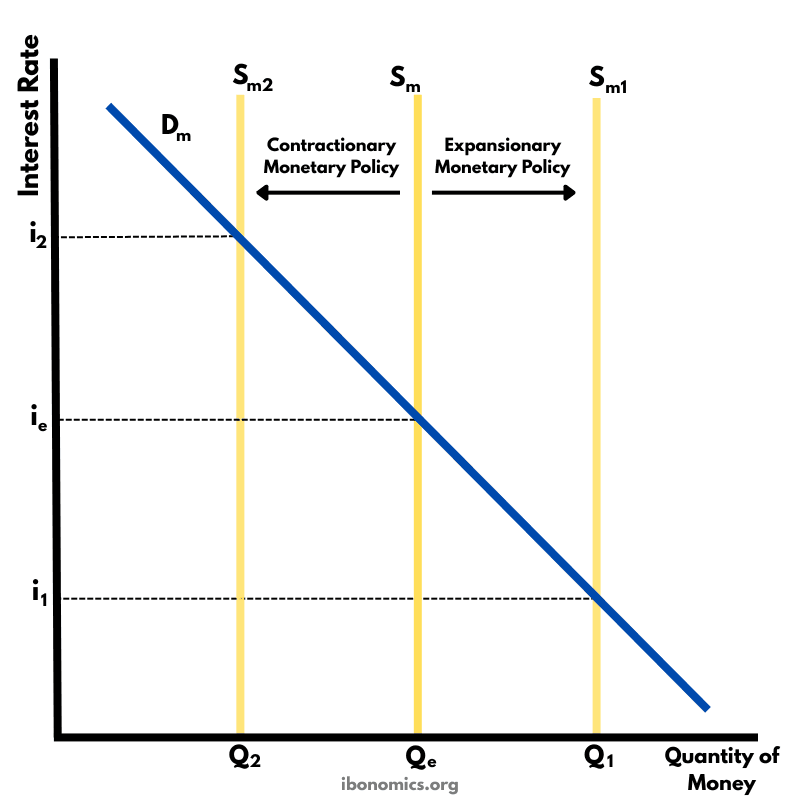
Curves and elements
- Dm
- The demand for money. It slopes downward because holding money means giving up the interest it could earn, so people hold more money when interest rates are low.
- Sm
- The initial money supply, set by the central bank. It is vertical because it does not depend on the interest rate.
- Sm1
- The larger money supply after expansionary monetary policy.
- Sm2
- The smaller money supply after contractionary monetary policy.
- ie
- The initial equilibrium interest rate, where Sm crosses Dm.
- i1
- The lower equilibrium interest rate, where Sm1 crosses Dm.
- i2
- The higher equilibrium interest rate, where Sm2 crosses Dm.
- Qe
- The initial quantity of money.
- Q1
- The quantity of money after the money supply rises to Sm1.
- Q2
- The quantity of money after the money supply falls to Sm2.
- Expansionary Monetary Policy
- The rightward shift from Sm to Sm1, which lowers the interest rate.
- Contractionary Monetary Policy
- The leftward shift from Sm to Sm2, which raises the interest rate.
Key explanations
- 1
The central bank controls the money supply, so Sm is vertical. The market starts in equilibrium at the interest rate ie, where Sm crosses the demand for money (Dm) at Qe.
- 2
Expansionary monetary policy increases the money supply from Sm to Sm1. At ie there is now more money than people want to hold, so the interest rate falls until they are willing to hold all of it, at i1 and Q1.
- 3
Contractionary monetary policy reduces the money supply from Sm to Sm2. At ie people now want to hold more money than there is, so the interest rate rises to i2 and the quantity of money falls to Q2.
- 4
The demand for money does not shift. Each new equilibrium is a movement along Dm, so the interest rate moves in the opposite direction to the money supply.
- 5
The change in the interest rate is how monetary policy reaches the rest of the economy. A lower rate makes borrowing cheaper and encourages consumption and investment, so aggregate demand rises, while a higher rate does the opposite.
Example exam question
Using a money market diagram, explain how a change in the money supply affects the equilibrium interest rate.
Show example answer
In the money market, the money supply (Sm) is vertical because the central bank sets it, and the demand for money (Dm) slopes downward because the interest rate is the opportunity cost of holding money. The market starts in equilibrium at ie and Qe. If the central bank increases the money supply to Sm1, there is more money than people want to hold at ie, so the interest rate falls to i1, where the quantity of money demanded equals the new supply at Q1. This is expansionary monetary policy, and the lower interest rate encourages borrowing for consumption and investment, which raises aggregate demand. If instead the central bank reduces the money supply to Sm2, there is a shortage of money at ie, so the interest rate rises to i2. This contractionary policy discourages borrowing and reduces aggregate demand.