Stagflation – Short Run Phillips Curve Shifts OutwardsSL
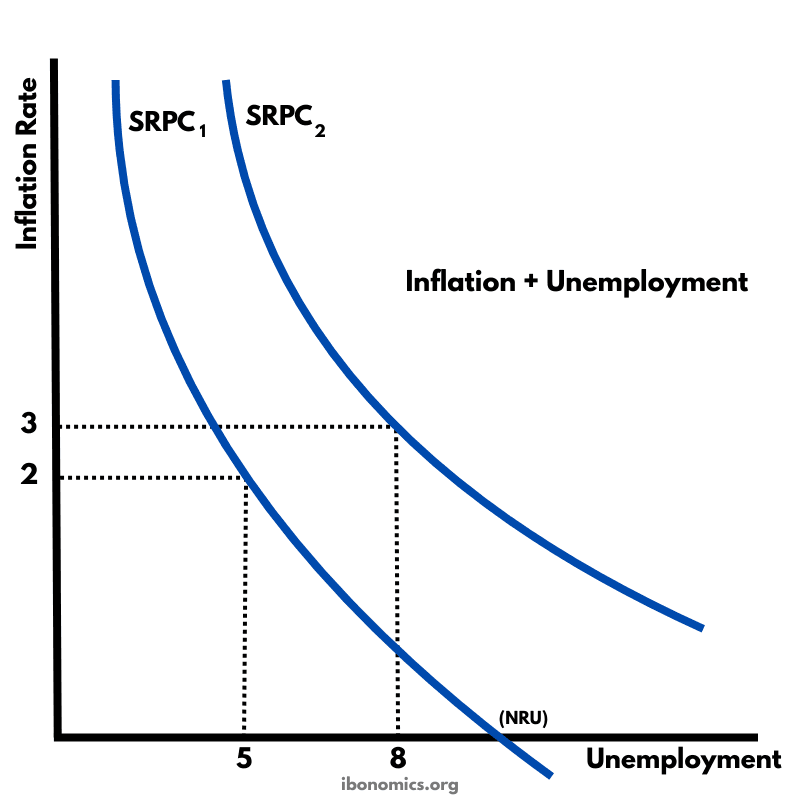
MacroeconomicsThis diagram shows stagflation using the short run Phillips curve (SRPC). Stagflation occurs when an economy experiences both higher inflation and higher unemployment at the same time. The outward shift of the SRPC from SRPC1 to SRPC2 shows that for any given unemployment rate, inflation is now higher, and for any given inflation rate, unemployment is now higher. This can happen after a negative supply shock that raises production costs.
Curves and elements
- srpc1
- SRPC1: The original short run Phillips curve showing the initial trade off between inflation and unemployment.
- srpc2
- SRPC2: The outward shifted short run Phillips curve showing higher inflation for any unemployment rate.
- nru
- NRU: The natural rate of unemployment, the long run level of unemployment when the labour market is in equilibrium.
Key explanations
- 1
The short run Phillips curve (SRPC1) shows an initial trade off between inflation and unemployment.
- 2
A negative supply shock shifts the SRPC outwards from SRPC1 to SRPC2.
- 3
After the shift, the economy moves to a point with higher inflation and higher unemployment compared to before.
- 4
This combination of rising inflation and rising unemployment is called stagflation.
- 5
The NRU (natural rate of unemployment) is shown as a reference level of unemployment, but stagflation can occur even when unemployment moves further away from it.
Example exam question
Using the diagram, explain why stagflation involves both higher inflation and higher unemployment.
Show example answer
Stagflation occurs when the short run Phillips curve shifts outwards due to a negative supply shock. In the diagram, SRPC shifts from SRPC1 to SRPC2, meaning inflation is higher at each level of unemployment. As a result, the economy experiences an increase in inflation and an increase in unemployment at the same time. This is why stagflation is different from normal demand driven movements along the SRPC.