IBonomics
Marshall–Lerner Condition and the J-CurveHL
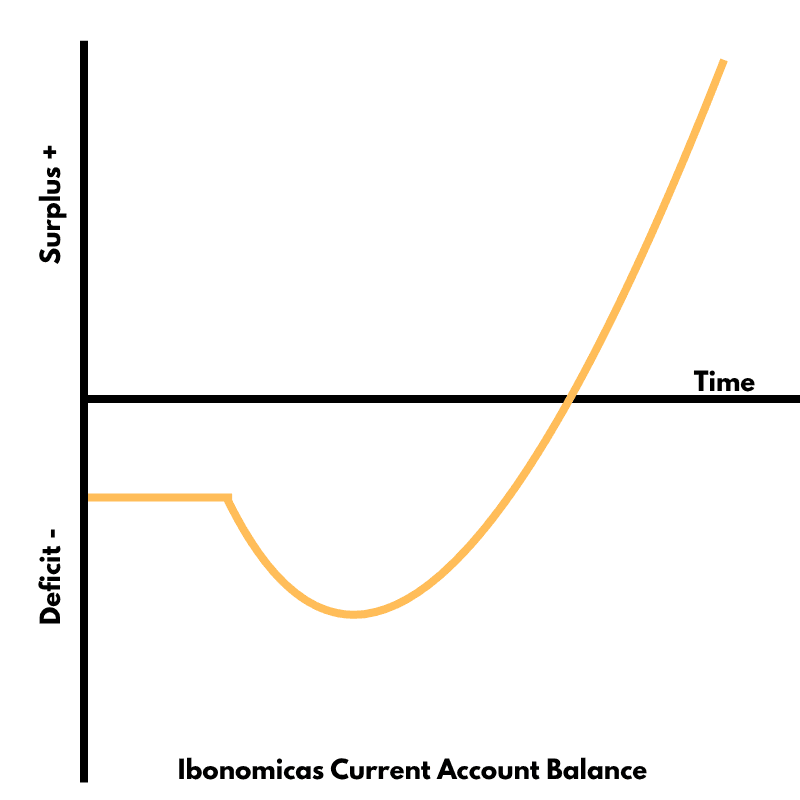
Global EconomicsThis diagram illustrates the J-curve effect that may follow a currency depreciation: a country’s current-account balance often worsens before it improves, in line with the Marshall–Lerner condition.
Curves and elements
- j curve
- Orange J-shaped line showing the current-account balance path after depreciation.
- x axis
- Time after depreciation.
- y axis
- Current-account balance: surplus above, deficit below the baseline.
- baseline
- Horizontal line representing a zero balance (neither surplus nor deficit).
Key explanations
- 1
The Marshall–Lerner condition states that a depreciation (or devaluation) will improve the current-account balance only if the sum of the absolute values of the price elasticities of demand for exports and imports is greater than one.
- 2
In the short run, demand elasticities are low: contracts are fixed and consumers take time to adjust, so the trade balance may initially deteriorate (movement downward on the J-curve).
- 3
As time passes, quantity adjustments dominate: exports become cheaper for foreigners and imports become dearer for residents; if the Marshall–Lerner condition is satisfied, the current-account balance eventually improves, giving the upward part of the J-curve.
- 4
Failure to satisfy the elasticity condition means the trade balance could remain in deficit even after depreciation, highlighting the importance of elastic demand for successful expenditure-switching policies.
- 5
The diagram tracks Ibonomica’s current-account balance over time after its currency depreciates, showing the initial worsening and later surplus once elasticities take effect.
Example exam question
Using the J-curve diagram, explain why a currency depreciation may initially worsen a country’s current-account balance before improving it.
Show example answer
Immediately after depreciation, prices change but quantities do not, so the value of imports (in domestic currency) rises and export revenue falls, worsening the deficit. Over time, higher price elasticities lead to larger export volumes and smaller import volumes. If |εx| + |εm| > 1 (Marshall–Lerner), the trade balance turns positive, forming the J-curve shape.