IBonomics
Should Data Be the Fifth Factor of Production? Rethinking Economics in the Age of AI
China recognises data as a production factor. Does AI mean the traditional four factors need updating? An accessible IB Economics discussion.
Should Data Be the Fifth Factor of Production? Rethinking Economics in the Age of AI
In 2020, China made an unusual move. Its government included data alongside more familiar resources in plans to develop the country's markets for factors of production. These are the resources businesses use to make goods and services.
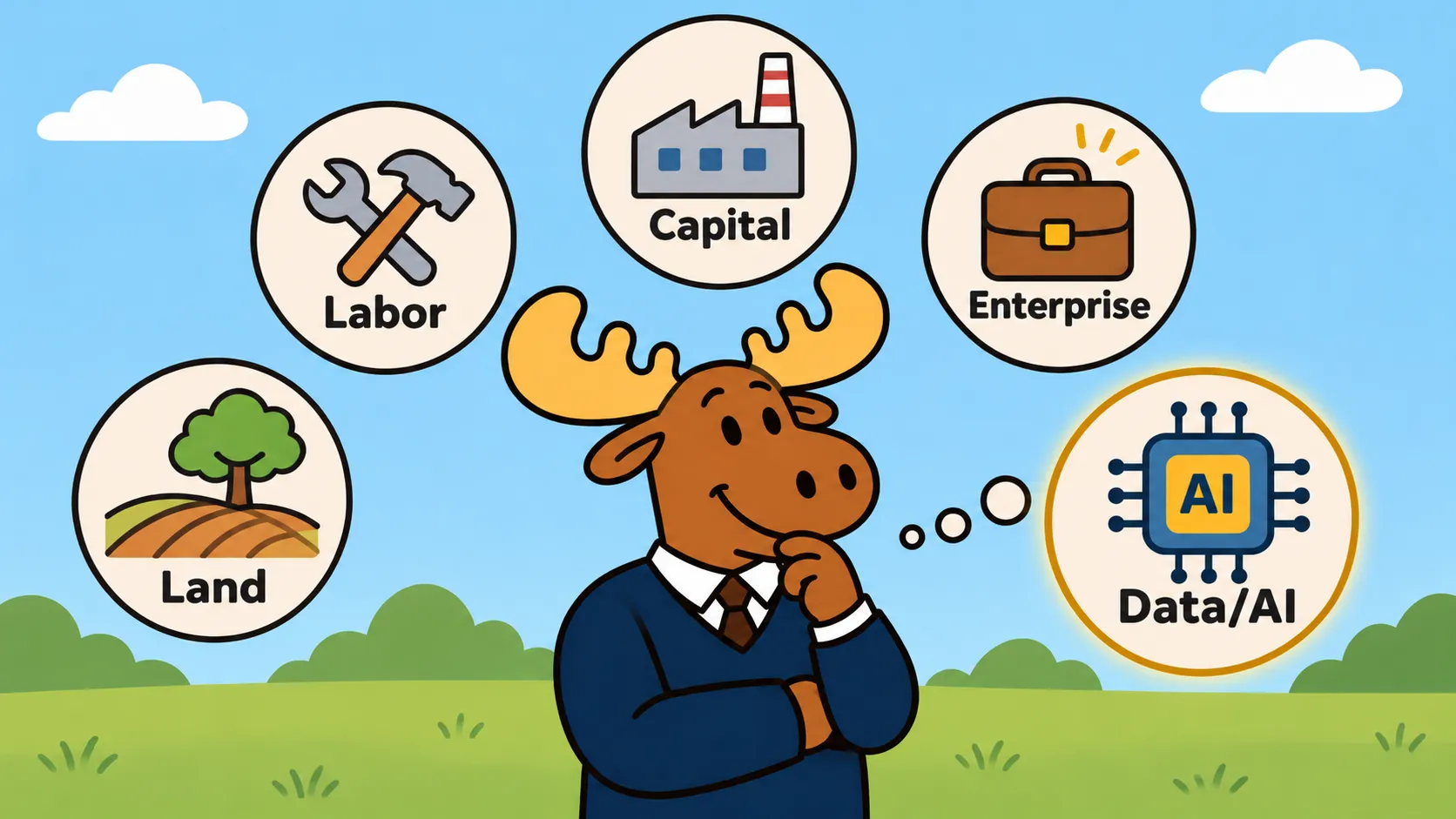
For an IB Economics student, that raises a question. We usually learn four factors of production: land, labour, capital and enterprise. If data has become important enough for a government to treat it as a productive resource in its own right, is the traditional model missing something?
The question is not just about artificial intelligence. It is about how economists decide which parts of a changing economy their models need to explain.
China is treating data as more than information
Chinese President Xi Jinping argued in 2017 that data should play a central role in the country's digital economy, according to China's official government reporting. In April 2020, the government went further, announcing reforms to develop markets for technology and data alongside land, labour and capital.
The 2020 policy was concerned with allocation, or how resources are made available for different uses. It proposed encouraging the use of data in industries including farming, transport and manufacturing.
Why would this matter? A business with useful information might plan production better than a rival, even if both employ similar workers and own similar equipment. Rules about who can collect, use or share that information can therefore affect which businesses are able to innovate.
China's approach does not mean the four factors taught in IB Economics have been replaced. It does, however, challenge us to look more closely at a resource that traditional diagrams rarely name.
How data changes what a firm can produce
Take a delivery company. Its drivers, vans and warehouses stay the same, but it begins using traffic information and past delivery records to plan routes. Drivers spend less time on the road and complete more deliveries each day.
The company has increased its productivity: it produces more output using the same quantity of inputs. The data has not replaced its workers or vehicles. It has helped the company use them better.
AI makes this more visible. An AI system might learn patterns from large amounts of information and then help a business forecast demand or respond to customer questions. Engineers contribute labour, computers and software provide capital, and data helps the system learn or make useful decisions. Poor-quality data, however, can produce poor results, so simply collecting more information is not enough.
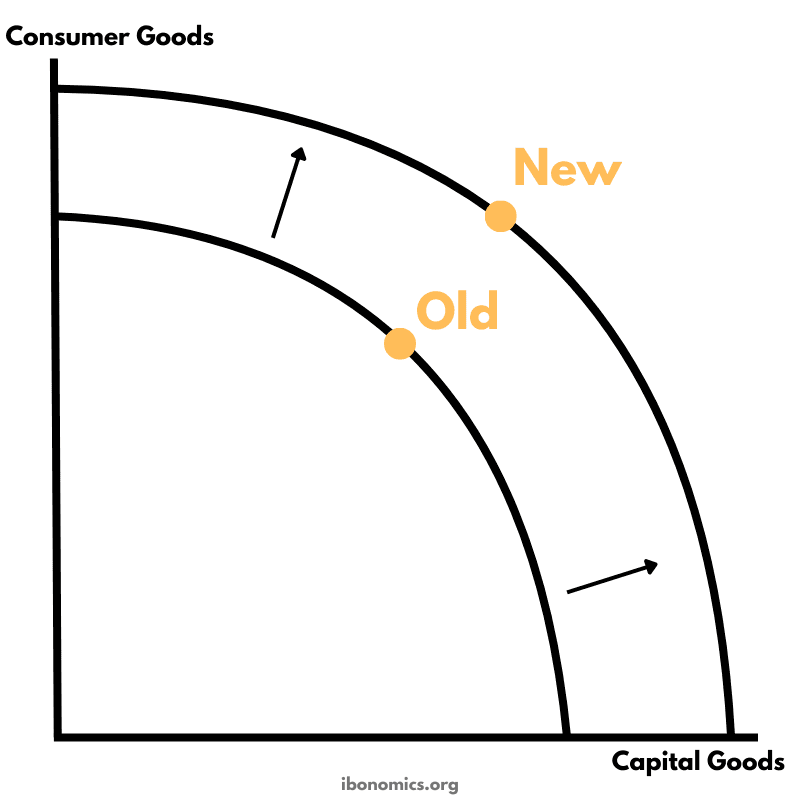
This links to a familiar IB Economics diagram. If improvements like these become widespread and raise what an economy can potentially produce, its production possibilities curve (PPC) can shift outwards. The PPC shows the maximum combinations of two goods an economy can produce with its available resources and technology.
Notice what the diagram already tells us: technology and information can increase productive capacity. We do not necessarily need a fifth factor to show their effect. But the diagram alone says little about which kinds of information make that improvement possible.
Is data really different from capital?
There is a reason economists are interested in treating data separately. A van can only be in so many places at once. A dataset can be copied and used by several businesses simultaneously without being used up.
Economists call this non-rivalry. The same weather information could help a farmer decide when to irrigate, an airline prepare routes and an electricity company predict demand. According to the OECD's research on the value of data, this ability to store and reuse data makes it an unusual productive asset.
That does not make valuable data freely available. A company can restrict access to its records, and personal information may be protected by privacy rules. Firms also need the skills and systems to turn information into something useful.
So why not add data as a fifth factor? One argument is that separating it would make its contribution easier to recognise and measure. Two firms may own similar computers but have very different collections of useful data. Treating both simply as 'capital' could hide part of that difference.
The counterargument is that the traditional category of capital is broader than machines and buildings. Economists can also describe software and developed databases as intangible capital, meaning productive assets that have value but no physical form. AI systems can similarly be understood as capital or technology used alongside labour. In that view, a new category may add complexity without explaining much more.
Economic statistics have already changed, although in a narrower way than a new fifth factor. The 2025 System of National Accounts, the international standard for measuring national economic activity, recognises qualifying electronic data used in production as a type of produced fixed asset. In simple terms, certain data created for repeated productive use can be counted as an investment asset rather than only an ongoing expense.
That is a change in how economic activity is measured, not a decision that every economics course should teach five factors of production.
What would a better economic model explain?
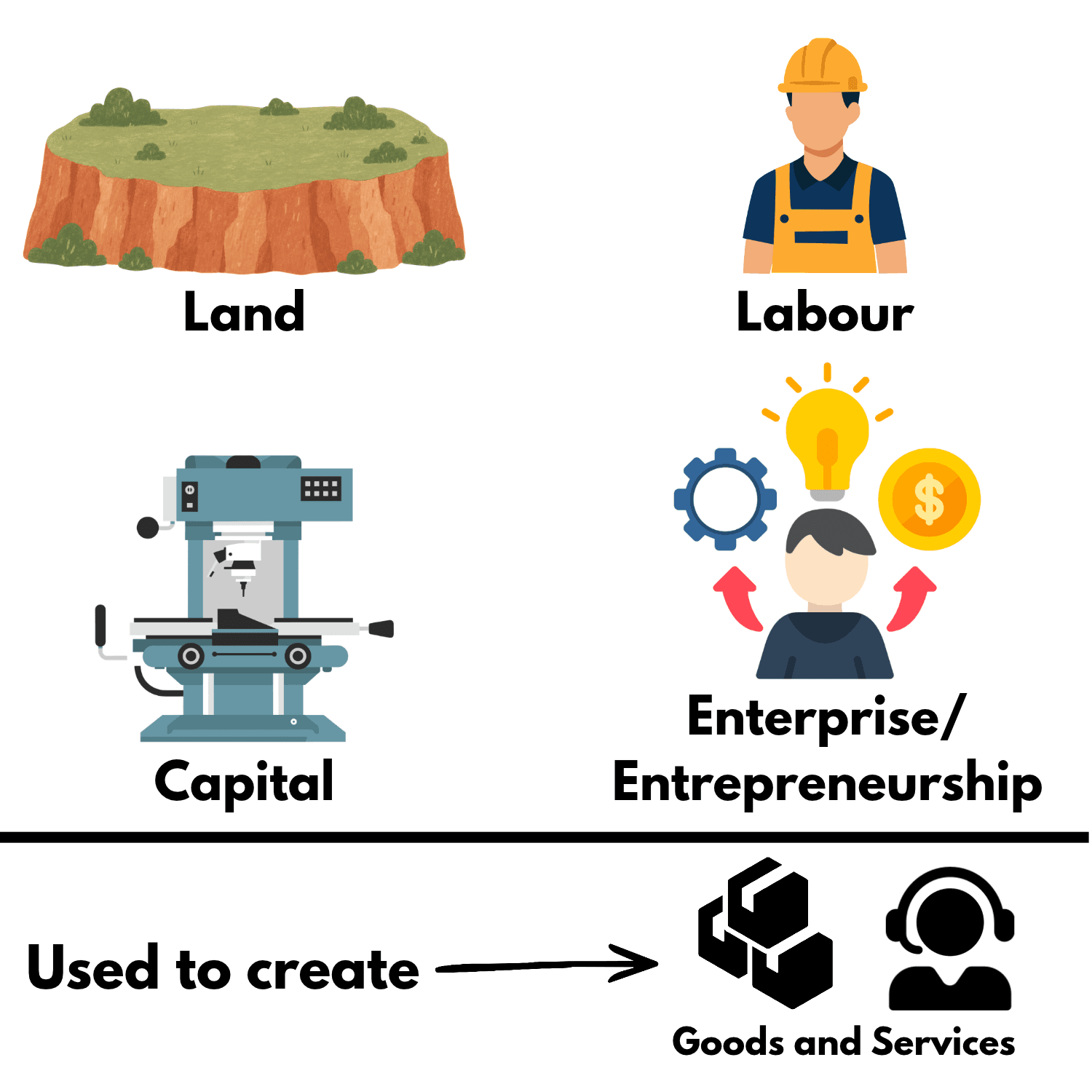
A model is a simplified representation of reality. Economists deliberately leave out details so they can focus on a relationship, such as how available resources limit production. Our Factors of Production diagram illustrates that familiar starting point: land, labour, capital and enterprise combine to produce goods and services.
The value of a more detailed model would be in answering questions that the simpler version leaves open. Why do two businesses with similar staff and equipment achieve different output? How much of an economy's growth comes from better information rather than more machines? And why might an established technology company have an advantage over a newcomer?
For the last question, access to valuable data may act as a barrier to entry, an obstacle that makes it harder for new firms to compete. This connects to market power in IB Economics Unit 2.11, although owning a large dataset does not automatically make a business a monopoly.
For growth, improvements in information and AI can increase potential output, linking to shifts in long-run aggregate supply. The existing model still works. What economists might refine is how they measure and explain the productive resources behind the shift.
When should economists update a model?
China's policy offers one answer: treat data separately when doing so helps explain how businesses gain access to a valuable resource. The revised international accounting standard offers another: measure investment in data more explicitly, while still treating it as an asset.
Neither approach requires abandoning land, labour, capital and enterprise. Those four categories remain a useful introduction to production, particularly for students learning economics for the first time.
But imagine comparing two AI companies using only their workers, offices and computers. You might overlook the years of collected and organised information that help explain why one produces a more useful service. Calling that information 'capital' is defensible. Measuring it separately might tell us more.
This is what IB Economics Unit 1.2, on economic methodology, is ultimately about: models are tools for understanding the world, and their usefulness depends on the questions we ask. As production changes, economists have to decide when an old category is sufficient and when a new distinction reveals something important.
Related syllabus topics
Factors of Production
Unit 1.1: What Is Economics? Scarcity, Choice, and Economic Models
Economic Methodology and the Evolution of Economic Thought
Unit 1.2: Economic Methodology and the Evolution of Economic Thought
Shifts of the LRAS or Keynesian AS Curve
Unit 3.2: Variations in Economic Activity: Aggregate Demand and Aggregate Supply
Market Failure: Market Power
Unit 2.11: Market Failure: Market Power