IBonomics
Balance of Payments – The Current, Capital and Financial Accounts
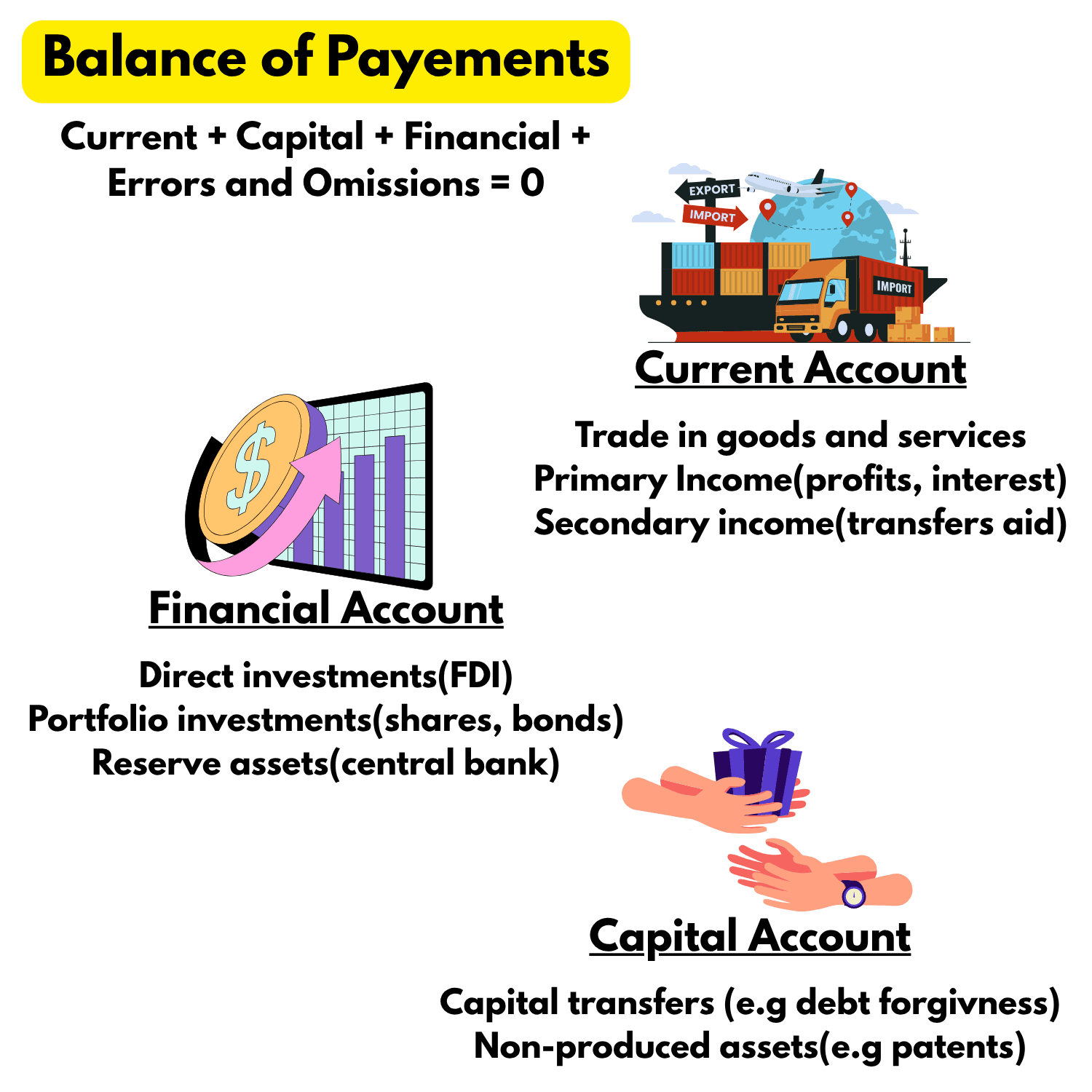
This diagram shows the structure of the balance of payments, the record of all transactions between a country's residents and the rest of the world over a period, usually a year. It has three accounts, the current account, the capital account and the financial account, which together with errors and omissions always add up to zero.
Curves and elements
- Current + Capital + Financial + Errors and Omissions = 0
- The balance of payments always balances. Every transaction is recorded once as a credit and once as a debit, so the three accounts add up to zero, and errors and omissions cover transactions that were missed or measured wrongly.
- Current Account
- The record of trade in goods and services, of primary income, such as profits and interest earned abroad, and of secondary income, which is transfers such as foreign aid and money sent home by workers abroad.
- Financial Account
- The record of investment flows. It covers direct investment (FDI), such as building a factory or buying a firm abroad, portfolio investment in foreign shares and bonds, and changes in the reserve assets held by the central bank.
- Capital Account
- Usually the smallest account. It records capital transfers, such as debt forgiveness, and the purchase or sale of non-produced assets, such as patents.
Key explanations
- 1
The balance of payments records every transaction between a country and the rest of the world. Money flowing into the country, such as payment for exports, is a credit, and money flowing out, such as payment for imports, is a debit.
- 2
The current account records trade in goods and services, primary income and secondary income. Primary income is earned from work and investments abroad, such as wages, profits and interest. Secondary income is transfers, such as foreign aid and money sent home by workers abroad, for which nothing is given in return.
- 3
The capital account is usually small. It records capital transfers, such as the forgiveness of a country's debt, and the purchase or sale of non-produced assets, such as patents.
- 4
The financial account records flows of investment. It covers direct investment, such as a firm building a factory abroad, portfolio investment in foreign shares and bonds, and changes in the reserve assets held by the central bank.
- 5
Every transaction is recorded twice, once as a credit and once as a debit, so the accounts always add up to zero. Errors and omissions correct for transactions that were missed or measured wrongly.
- 6
A current account deficit is therefore matched by a surplus on the capital and financial accounts. A country that spends more abroad than it earns pays for the difference by selling assets to foreigners or borrowing from them, which shows up as inflows on the financial account.
Example exam question
Outline the three accounts of the balance of payments, and explain why they always add up to zero.
Show example answer
The balance of payments records all transactions between a country and the rest of the world. The current account records trade in goods and services, primary income, such as profits and interest earned abroad, and secondary income, such as foreign aid and money sent home by workers abroad. The capital account records capital transfers, such as debt forgiveness, and the purchase or sale of non-produced assets, such as patents. The financial account records direct investment, portfolio investment in shares and bonds, and changes in the central bank's reserve assets. Every transaction is recorded as both a credit and a debit, so the current, capital and financial accounts, together with errors and omissions, add up to zero. A current account deficit must therefore be matched by a surplus on the capital and financial accounts, as the country sells assets or borrows from abroad to pay for it.