IBonomics
Devaluation – Lowering an Overvalued Exchange Rate Peg
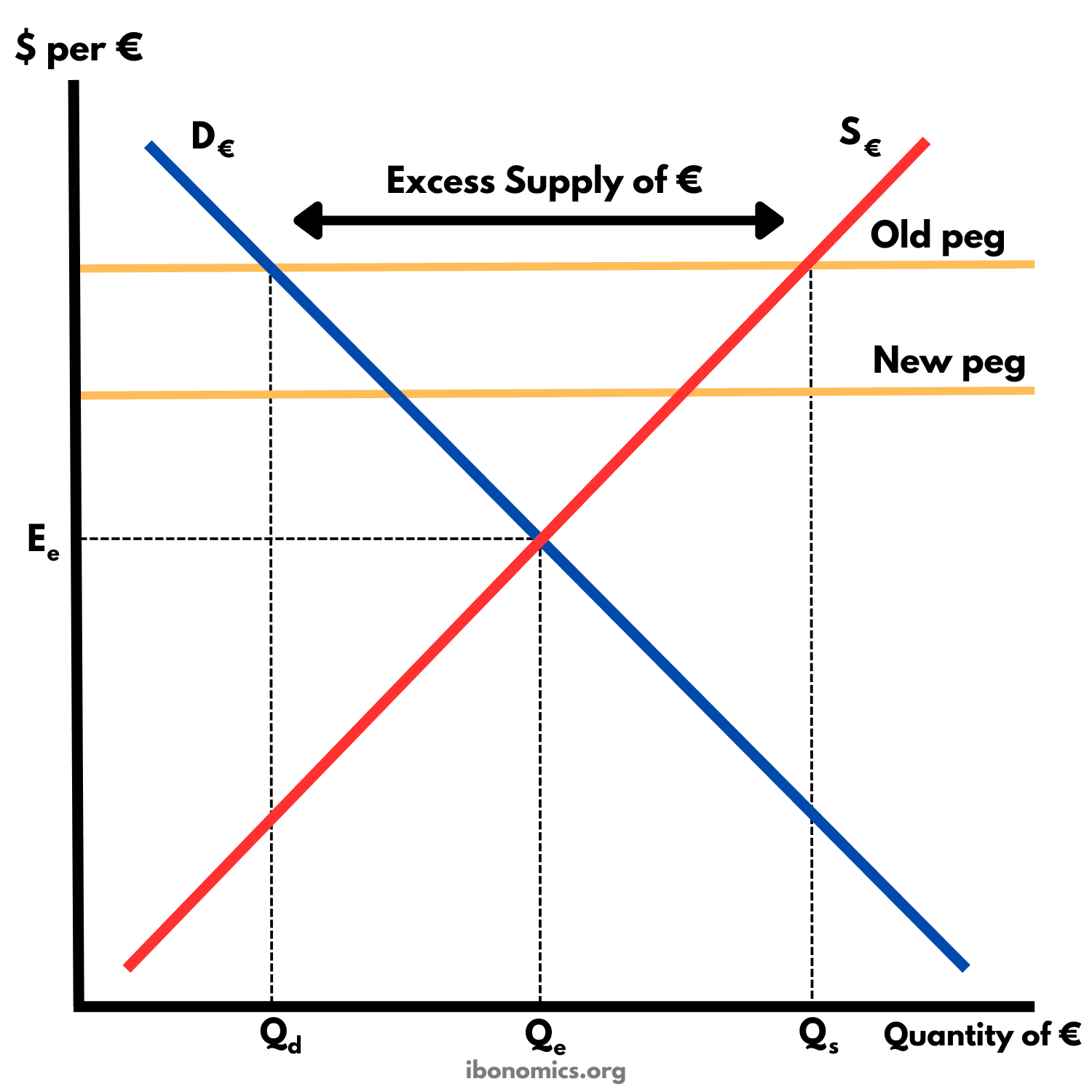
This diagram shows a devaluation, when a government lowers the value at which it fixes its currency. The euro is pegged above Ee, the rate the market would set, which leaves an excess supply of euros. Lowering the peg from the old level to the new one makes the excess supply smaller, so less intervention is needed to hold it.
Curves and elements
- D€
- The demand for euros. At a lower exchange rate, European goods are cheaper for Americans, so the quantity of euros demanded is higher.
- S€
- The supply of euros. At a higher exchange rate, American goods are cheaper for Europeans, so they sell more euros to buy dollars.
- Excess Supply of €
- The gap between Qd and Qs at the old peg. These are euros that people want to sell at the pegged rate but that nobody in the market wants to buy, so the central bank has to buy them to hold the peg.
- Old peg
- The exchange rate the government first fixed, above Ee, so the euro is overvalued.
- New peg
- The lower fixed rate after the devaluation. The excess supply is smaller here, but because the new peg is still above Ee, some remains.
- Ee
- The exchange rate the market would set without a peg, where D€ meets S€.
- Qd
- The quantity of euros demanded at the old peg.
- Qe
- The quantity of euros that would be traded at Ee.
- Qs
- The quantity of euros supplied at the old peg.
Key explanations
- 1
This is the market for euros, with the exchange rate in dollars per euro. Without intervention, the exchange rate would settle at Ee, where D€ meets S€.
- 2
The government has fixed the euro at the old peg, above Ee, so the euro is overvalued. At this rate the quantity of euros supplied, Qs, is greater than the quantity demanded, Qd, which leaves an excess supply of euros.
- 3
To hold the peg, the central bank must buy up the excess euros, paying with its reserves of foreign currency. It can also raise interest rates to attract financial inflows, which raises the demand for euros. Neither can go on for ever, because reserves run out and high interest rates slow the economy.
- 4
A devaluation lowers the peg from the old level to the new one. At the new peg, the gap between the quantity supplied and the quantity demanded is smaller, so the central bank needs to buy fewer euros to hold it. The new peg is still above Ee, so some excess supply remains.
- 5
The lower value of the euro makes the country's exports cheaper for foreigners and its imports more expensive, which can improve the current account. It can also raise inflation, because imported goods and raw materials cost more.
- 6
A devaluation is a deliberate decision to lower a fixed exchange rate. A depreciation is a fall in a floating exchange rate caused by market forces.
Example exam question
Using a diagram, explain why a government might devalue its currency under a fixed exchange rate system.
Show example answer
Under a fixed exchange rate, the government sets the value of its currency. In the market for euros, the free-market rate would be Ee, where D€ meets S€. If the euro is pegged above Ee, at the old peg, the quantity of euros supplied, Qs, is greater than the quantity demanded, Qd, so there is an excess supply of euros. To hold the peg, the central bank must buy the excess euros with its foreign currency reserves, or raise interest rates to increase the demand for euros. If reserves are running low, or high interest rates are hurting the economy, the government may devalue, lowering the peg to the new level. The excess supply becomes smaller, so less intervention is needed. The lower value of the euro also makes exports cheaper and imports more expensive, which can improve the current account, although it may raise inflation.