IBonomics
Fixed Exchange Rate – Central Bank InterventionSL
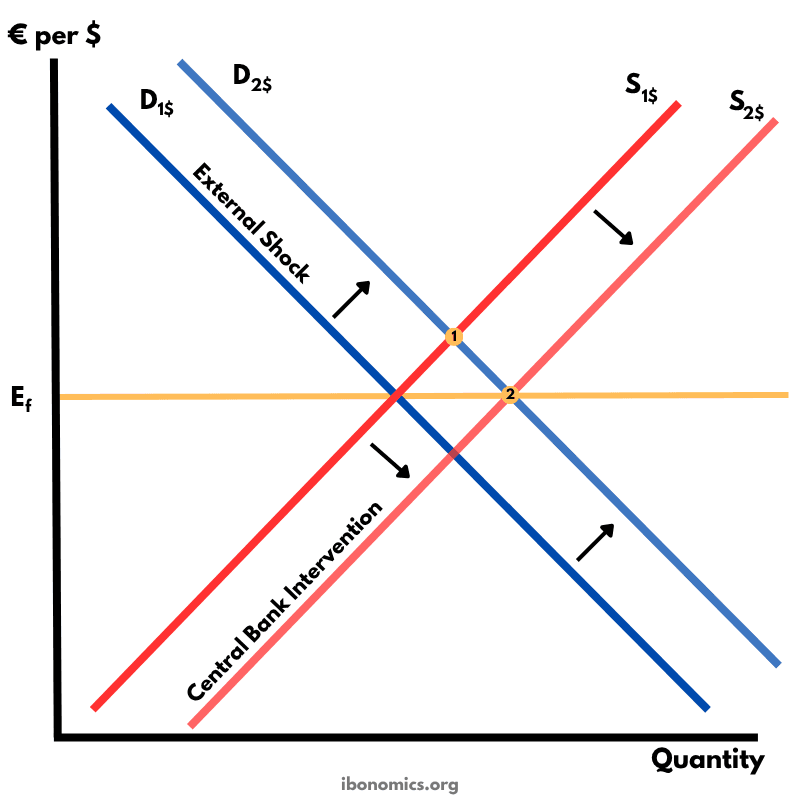
Global EconomicsThis diagram shows how a central bank intervenes in the foreign-exchange market to maintain a fixed (pegged) exchange rate after an external shock shifts demand.
Curves and elements
- d1
- D1$: Original demand for dollars.
- d2
- D2$: Higher demand after an external shock.
- s1
- S1$: Initial supply of dollars in the forex market.
- s2
- S2$: Supply of dollars after central-bank intervention.
- ef
- Ef: Fixed (pegged) exchange-rate level.
- point1
- Point 1: Pre-shock equilibrium on the peg.
- point2
- Point 2: Post-intervention equilibrium back on the peg.
Key explanations
- 1
The currency is initially pegged at the fixed rate Ef, where demand for the dollar (D1$) intersects supply of the dollar (S1$).
- 2
An external shock (e.g., higher foreign demand for exports or higher domestic interest rates) shifts the demand curve rightward from D1$ to D2$, creating upward pressure on the exchange rate.
- 3
To prevent the domestic currency (euro) from depreciating against the dollar (i.e., the dollar appreciating), the central bank sells dollars (increasing the supply of dollars) or buys euros, shifting the supply curve rightward from S1$ to S2$.
- 4
The new intersection (point 2) restores the exchange rate at Ef but increases the quantity of dollars traded in the market.
- 5
Maintaining a fixed rate requires adequate foreign-exchange reserves; prolonged intervention can be costly and may conflict with domestic monetary policy goals.
Example exam question
Using a fixed exchange-rate diagram, explain how a central bank can maintain a currency peg when faced with upward pressure on the exchange rate.
Show example answer
When demand for dollars rises (D1$→D2$), the dollar would appreciate above the peg Ef. The central bank intervenes by selling dollars (or buying domestic currency), shifting supply from S1$ to S2$. The exchange rate stays at Ef, but foreign-exchange reserves fall. Sustained interventions can deplete reserves or require higher interest rates to attract capital inflows.