IBonomics
Impossible Trinity – Why a Country Can Only Have Two of Three Policy Goals
This diagram shows the impossible trinity, also called the trilemma. A country can't have a fixed exchange rate, free movement of capital and an independent monetary policy all at once. It can choose any two, and each side of the triangle is one such choice, with the goal it gives up at the corner opposite.
This diagram goes beyond the IB Economics syllabus, so you don't need to learn it for your exams. It is here to deepen your understanding of the topic.
The idea comes from the Mundell–Fleming model, built in the early 1960s by Robert Mundell, who won the Nobel Prize in Economics in 1999, and Marcus Fleming of the International Monetary Fund.
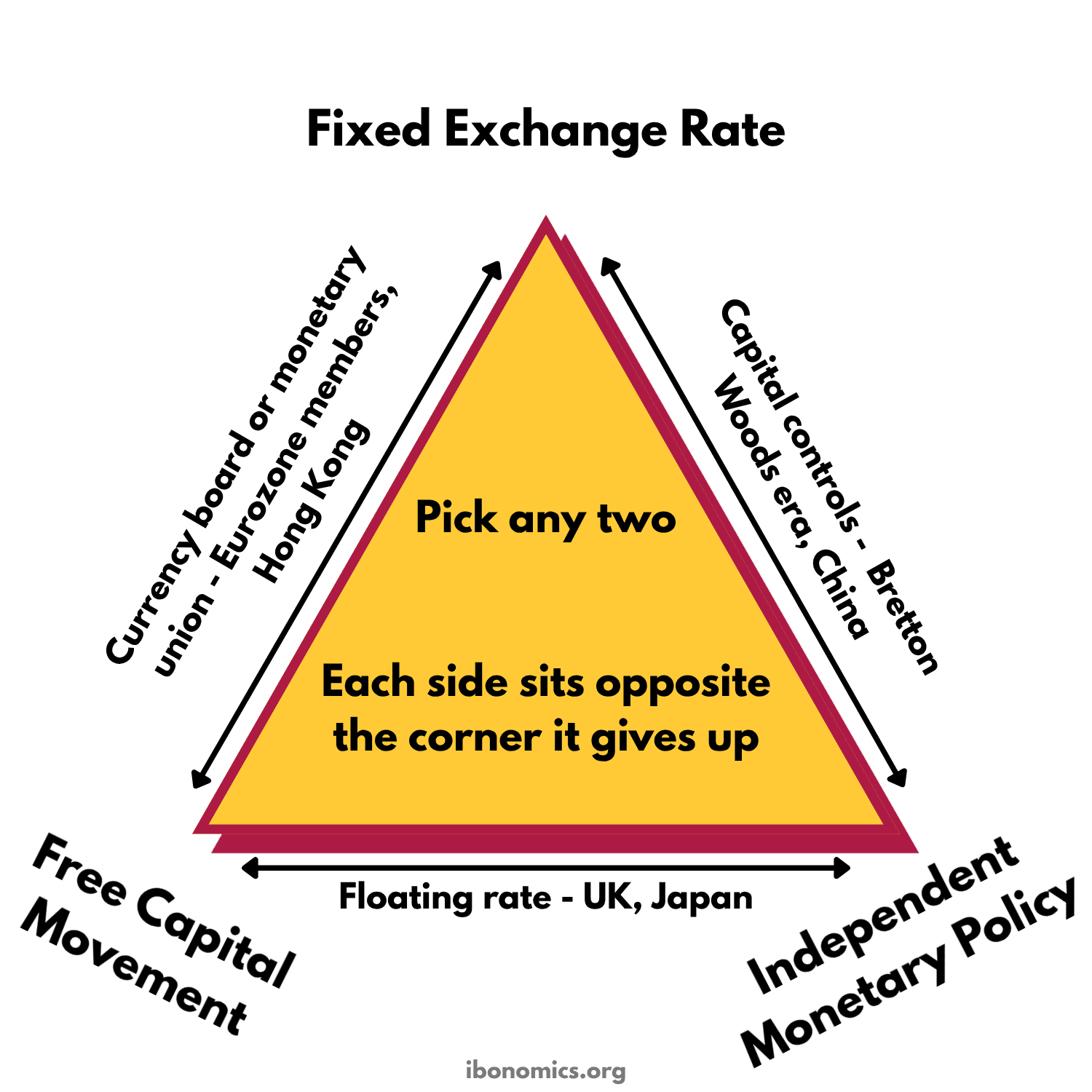
Curves and elements
- Fixed Exchange Rate
- The top corner. The central bank holds its currency at a set value against another currency.
- Free Capital Movement
- The bottom left corner. Money can move freely into and out of the country to buy foreign assets.
- Independent Monetary Policy
- The bottom right corner. The central bank sets interest rates to suit its own economy.
- Currency board or monetary union
- The left side, joining a fixed exchange rate and free capital movement. It gives up an independent monetary policy, as in Hong Kong and the eurozone.
- Capital controls
- The right side, joining a fixed exchange rate and an independent monetary policy. It gives up free capital movement, as in the Bretton Woods era and in China.
- Floating rate
- The bottom side, joining free capital movement and an independent monetary policy. It gives up a fixed exchange rate, as in the UK and Japan.
- Pick any two
- A country can have any two of the three goals, but never all three at once.
- Each side sits opposite the corner it gives up
- Each side of the triangle is one policy choice, and the goal it can't have is the corner facing it.
Key explanations
- 1
A fixed exchange rate means the central bank holds its currency at a set value against another currency, such as the US dollar. Free capital movement means people and firms can move money into and out of the country to buy foreign assets. An independent monetary policy means the central bank sets interest rates to suit its own economy, for example cutting them in a recession.
- 2
Suppose a country tries to have all three. If its central bank cuts interest rates below those abroad, savers and investors move their money abroad for a better return. They sell the domestic currency to do so, which pushes its value down. To hold the fixed rate, the central bank has to buy its own currency with its foreign currency reserves, and once those run low it must raise interest rates again or let the currency fall. One of the three goals has to go.
- 3
Currency board or monetary union. A country that fixes its exchange rate and lets capital move freely gives up its own monetary policy. Hong Kong's currency board ties the Hong Kong dollar to the US dollar, so its interest rates follow those in the United States, and eurozone members share one interest rate set by the European Central Bank.
- 4
Capital controls. A country can keep a fixed exchange rate and set its own interest rates if it limits how much money flows in and out. Most countries did this under the Bretton Woods system of fixed exchange rates, from the end of the Second World War to the early 1970s, and China has used capital controls alongside a managed exchange rate.
- 5
Floating rate. A country that lets capital move freely and sets its own interest rates has to let its exchange rate float. The UK and Japan do this, so their central banks can respond to their own economies, but their currencies can rise and fall sharply.
- 6
In an IB answer, the trinity can support an evaluation of fixed and floating exchange rates, or of joining a monetary union, by showing what each choice costs.
Example exam question
Explain why a country that fixes its exchange rate and allows capital to move freely cannot run an independent monetary policy.
Show example answer
With a fixed exchange rate, the central bank must keep its currency at a set value against another currency. With free capital movement, savers and investors can move money into or out of the country in search of the best return. If the central bank cut its interest rate below the rate abroad, money would flow out, and selling the domestic currency to move it would push its value below the fixed rate. To defend the rate, the central bank would have to buy its own currency with foreign currency reserves, and once these ran low it would have to raise its interest rate back to the foreign level. Raising its interest rate above the foreign rate would fail in the same way, as money flowed in and pushed the currency up. So the country's interest rate is tied to that of the country it fixes against, and it cannot be set to suit the domestic economy. This is the impossible trinity. Hong Kong, whose currency board ties its dollar to the US dollar, has interest rates that follow those in the United States.