IBonomics
Levels of Economic Integration – From Preferential Trade Agreements to Monetary Union
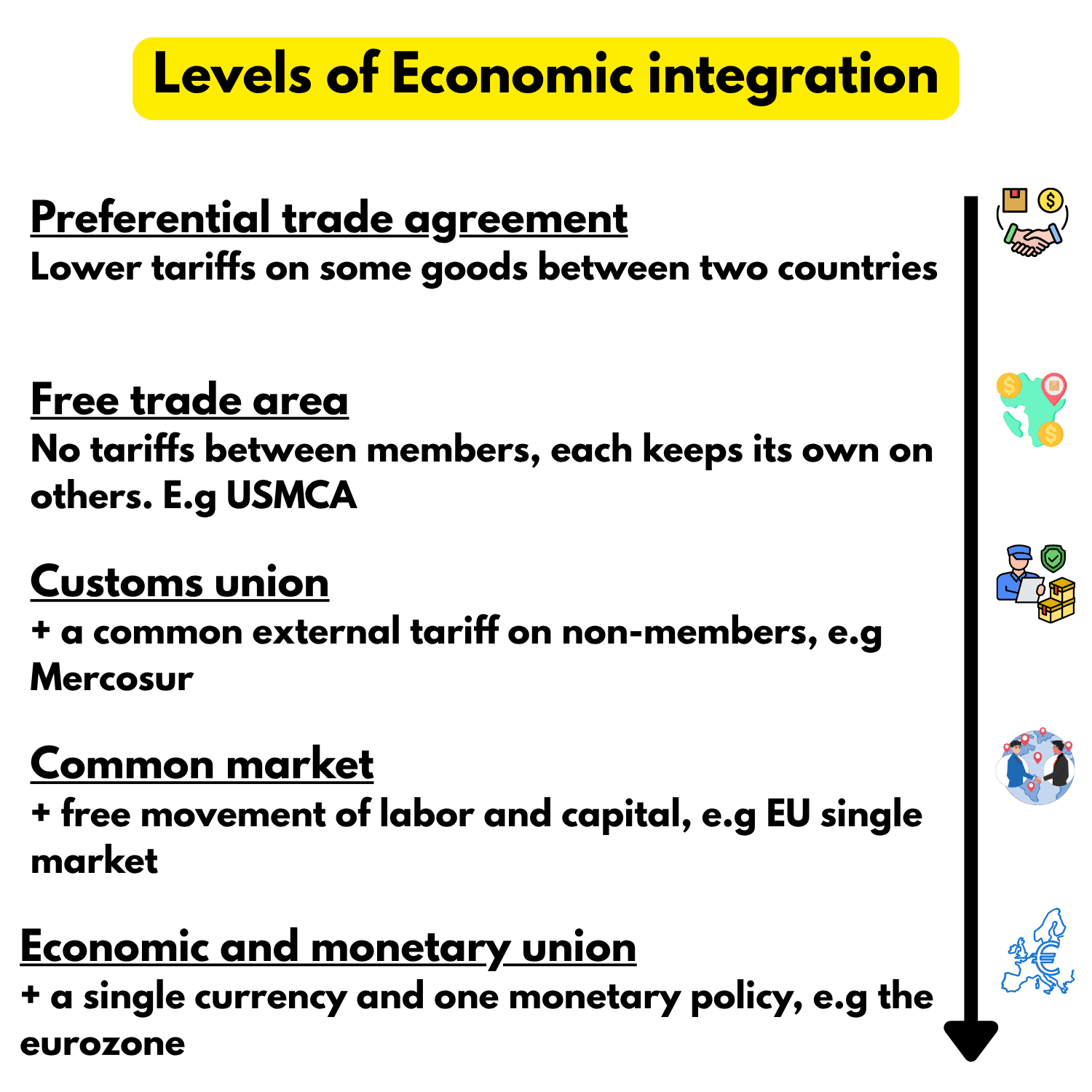
This diagram shows the levels of economic integration, from the shallowest, a preferential trade agreement, to the deepest, an economic and monetary union. Each level keeps the features of the one before and adds more, so members trade more freely with each other but share more of their economic policy.
Curves and elements
- Preferential trade agreement
- Members cut tariffs on some of each other's goods, giving them easier access than goods from other countries. It is the shallowest level, and can be between two or more countries.
- Free trade area
- Members remove tariffs on trade with each other, but each sets its own tariffs on goods from non-members. The USMCA, between the United States, Mexico and Canada, is an example.
- Customs union
- A free trade area with a common external tariff, so every member charges goods from non-members the same tariff. Mercosur, in South America, is an example.
- Common market
- A customs union that also lets labour and capital move freely between members, so people can work, and firms can invest, anywhere in the bloc. The EU single market is an example.
- Economic and monetary union
- A common market with a single currency and one central bank setting monetary policy for every member, as in the eurozone. Members give up their own currency, exchange rate and interest rate decisions.
- Downward arrow
- Integration deepens down the list. Each level keeps what the level above has and adds more, so members trade more freely with each other but give up more control over their own policies.
Key explanations
- 1
Economic integration is the process of countries reducing barriers to trade with each other and coordinating their economic policies. The diagram lists its levels from the shallowest to the deepest.
- 2
A preferential trade agreement cuts tariffs on some goods traded between members. A free trade area goes further and removes tariffs on trade between members, but each member still sets its own tariffs on goods from outside.
- 3
A customs union adds a common external tariff, so all members charge non-members the same rate and negotiate trade deals as a group. A common market adds the free movement of labour and capital, so workers and investment can move between members as freely as goods and services.
- 4
An economic and monetary union adds a single currency, with one central bank setting monetary policy for all members, as in the eurozone. Members no longer have their own exchange rate or interest rate to use as policy tools.
- 5
Free trade areas, customs unions and common markets are all trading blocs. The deeper the integration, the more freely goods, services and factors of production move within the bloc, but the less control each country keeps over its own trade and economic policy.
Example exam question
Distinguish between a free trade area, a customs union and a common market.
Show example answer
All three are trading blocs, in which member countries remove tariffs and other barriers to trade with each other. In a free trade area, such as the USMCA, members trade freely with each other but each keeps its own tariffs on goods from non-members. A customs union, such as Mercosur, adds a common external tariff, so every member charges non-members the same tariff and the bloc negotiates trade deals together. A common market, such as the EU single market, is a customs union that also allows the free movement of labour and capital between members. Each is a deeper form of integration than the one before.